

Trump Sat Down With Xi and Putin Together and Walked Out With a Joint Peace Declaration
The unprecedented three-way summit of U.S., Russian and Chinese leaders produced a written pledge that nuclear war “must never be fought,” plus promises on fuel supplies, the U.N. and the ICC.
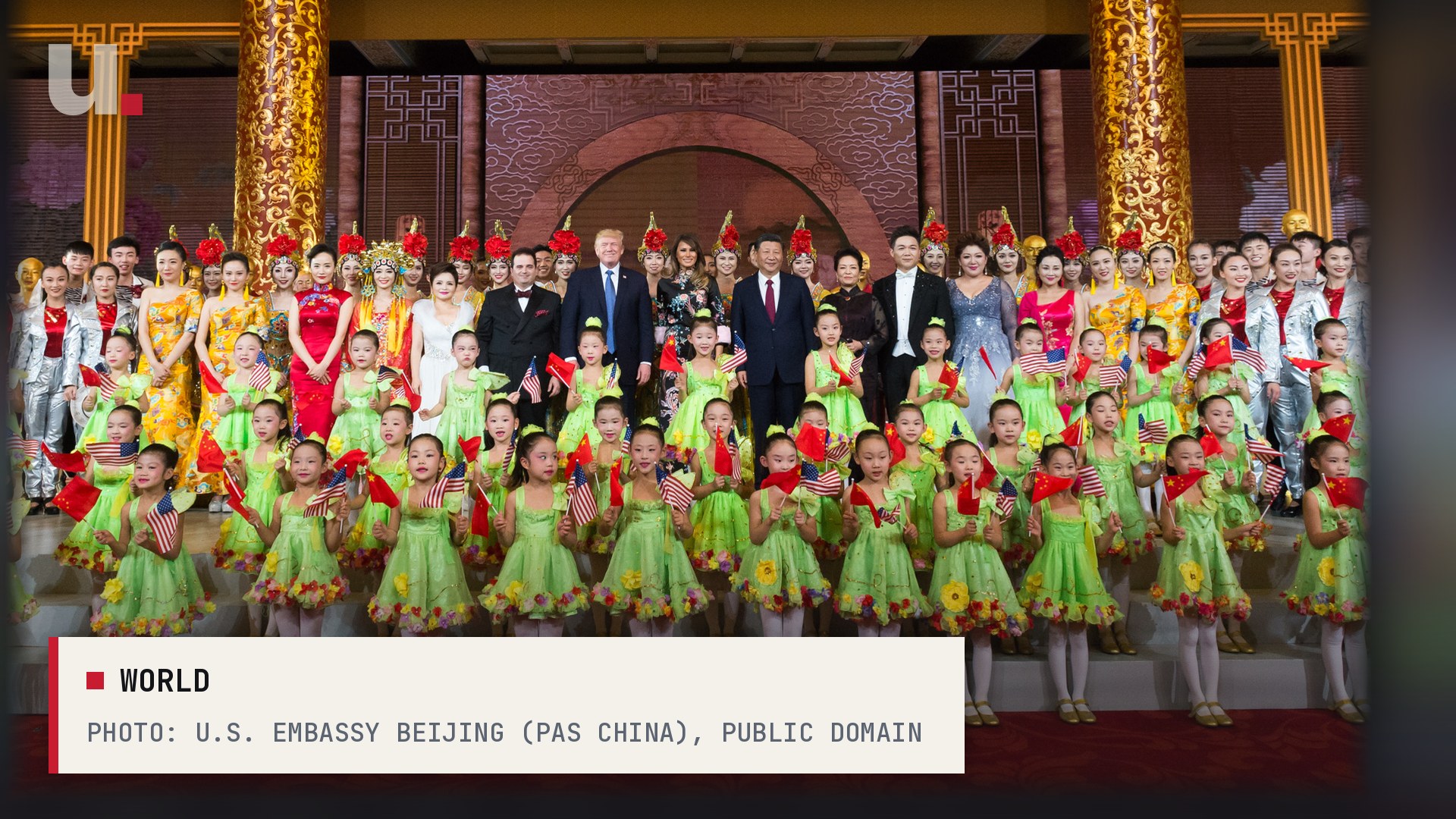
An American president had never held three-way talks with the leaders of Russia and China. On Thursday in Shenzhen, Donald Trump did, and the three men walked out with a written commitment that nuclear war “cannot be won and must never be fought.”
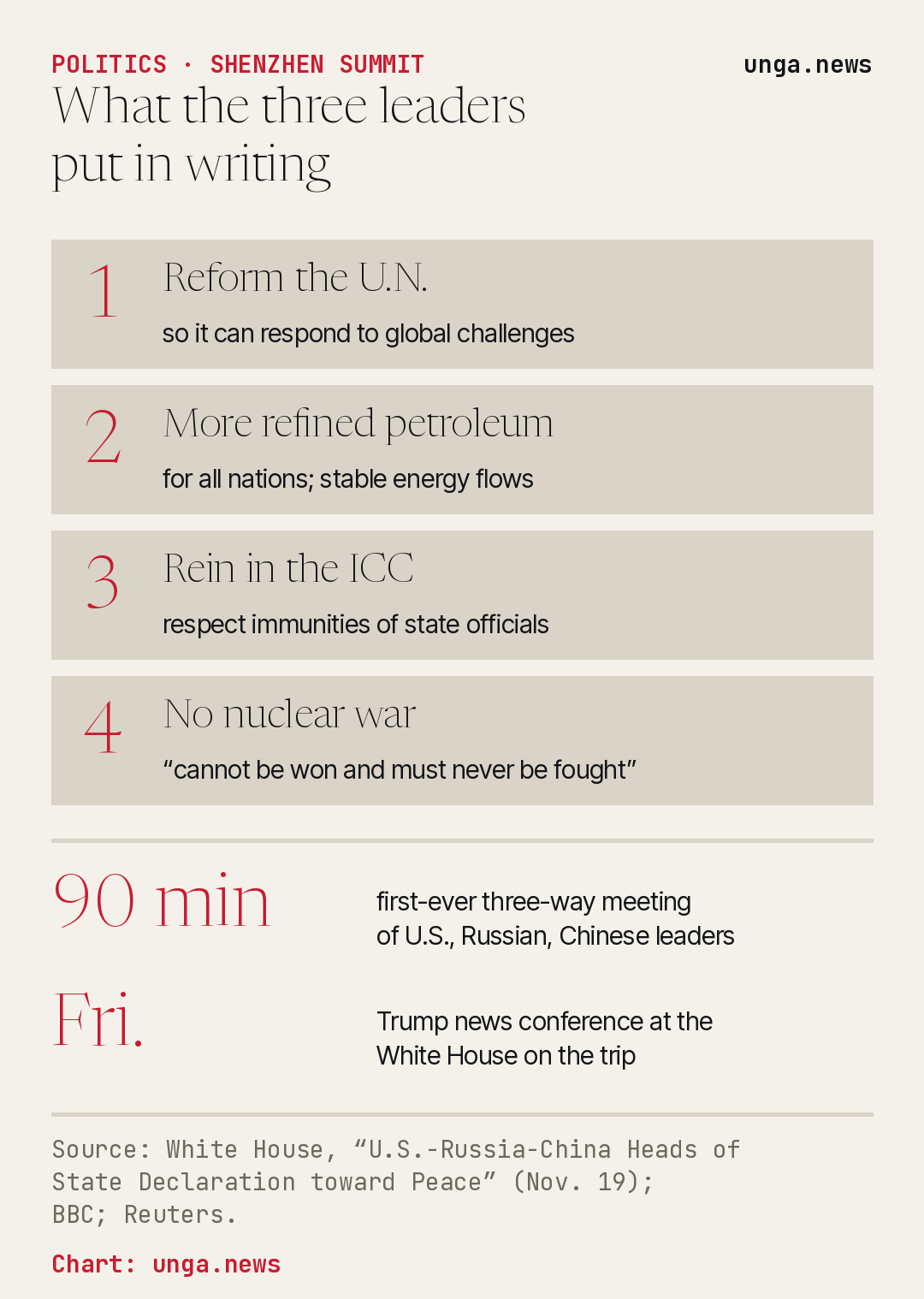
The four-point “Declaration toward Peace,” posted by the White House, was released in identical form by Beijing and the Kremlin. It came out of a 90-minute meeting on the sidelines of the Asia-Pacific Economic Cooperation summit, the first three-way talks among the three presidents, the BBC reported.
Trump was not shy about it. “On a scale of zero to 10, I think it was a 12,” he told NBC afterward, according to Reuters. He called it “a great and highly consequential trip” on his way home on Air Force One and said he will hold a news conference at the White House on Friday.
What is on the paper
The text is short, and every line matters.
First, the three countries, all permanent members of the U.N. Security Council, “committed to reform the UN” so it can respond more effectively and stick to its core job of international peace and security.
Second, they “plan to increase the production and supply of refined petroleum products for the benefit of all nations” and “reaffirmed the importance of stable energy flows.” For American families watching the price of gas and diesel, that is the line to watch.
Third, and this one will make Europe’s lawyers squirm, they agreed that “the International Criminal Court and other similar bodies must not abuse their jurisdiction,” and that the immunity of state officials is “of paramount importance.” The United States has never joined the ICC. Neither have Russia or China. Now all three have said so together, in writing.
Fourth, they will “conduct a dialogue on reducing nuclear risks and preventing the proliferation of nuclear weapons.”
Talking to rivals on purpose
Trump laid out the logic at the table. “Too often past leaders have avoided talking to nations with whom they had disagreements,” he said, according to the BBC. “We feel the opposite.” The three countries, he said, are “uniquely positioned to discuss how to reduce the number of nuclear weapons on Earth.”
He tied it straight to the fight in the Middle East. Working together against proliferation is “vital,” he said. “That’s what we’re doing in Iran. We’re not going to let Iran have a nuclear weapon.”
He also defended calling Putin a friend in plain terms, telling Reuters “it’s nice to have people that have 4,000 nuclear weapons as a friend as opposed to an enemy.” He said the summit was “bigger than Yalta.”
Xi opened the meeting by saying “positive interaction among major powers is not a matter of choice, but a mandatory requirement.” Putin raised ending the war in Ukraine and called the talks “an important chapter in the history of diplomacy,” the BBC reported.
The fair criticism
Not everyone is cheering, and it is worth being honest about why. Reuters called the declaration symbolic and noted it announced no arms control talks, the trilateral nuclear reduction treaty Trump has wanted since his first term. China has long refused, arguing its arsenal is far smaller. The text says nothing directly about Ukraine or Iran, and Putin himself said it did not set ambitious goals. Even as he spoke about peace, Kyiv was under Russian drone attack, the BBC reported.
Some U.S. allies are uneasy about how close Trump looks to two adversaries. That worry is real, and it will follow him to Friday’s news conference.
But the alternative has been tried. For years, Washington’s approach to Moscow and Beijing was sanctions, summits that went nowhere, and long stretches of silence. The nuclear risk did not shrink. What Trump got Thursday is a three-way channel that did not exist on Wednesday, a written pledge on nuclear war from all three nuclear superpowers, and a promise to keep talking. China’s foreign minister, Wang Yi, said the countries would keep coordinating at the working level after the summit, Reuters reported.
What comes next
The test is whether “dialogue” turns into actual meetings with actual numbers. Watch for any announcement on when nuclear-risk talks begin, whether refined fuel supplies really grow, and whether Putin’s promise to listen to Europe turns into anything more than a press-conference line.
Trump said he will lay out the details himself on Friday. For one day, at least, the three most heavily armed countries on Earth agreed on paper that the worst war imaginable must never happen. That is a better headline than most summits ever produce.
Sources
- The White House — U.S.-Russia-China Heads of State Declaration toward Peace
- Ministry of Foreign Affairs of the People’s Republic of Chin — China-Russia-U.S. Heads of State Declaration toward Peace
- President of Russia — Russia-China-U.S. Heads of State Declaration toward Peace
- BBC — Trump, Putin and Xi release ‘peace declaration’ after historic meeting
- Reuters — Trump, Xi and Putin release ‘peace declaration’ from unprecedented summit