

Trump Will Sit Down With Xi and Putin Together Next Week. Nuclear Weapons Come First.
The White House says the leaders of America, China and Russia will meet as a group for the first time ever on Thursday in Shenzhen, and Trump’s opening topic is cutting the world’s biggest nuclear arsenals.
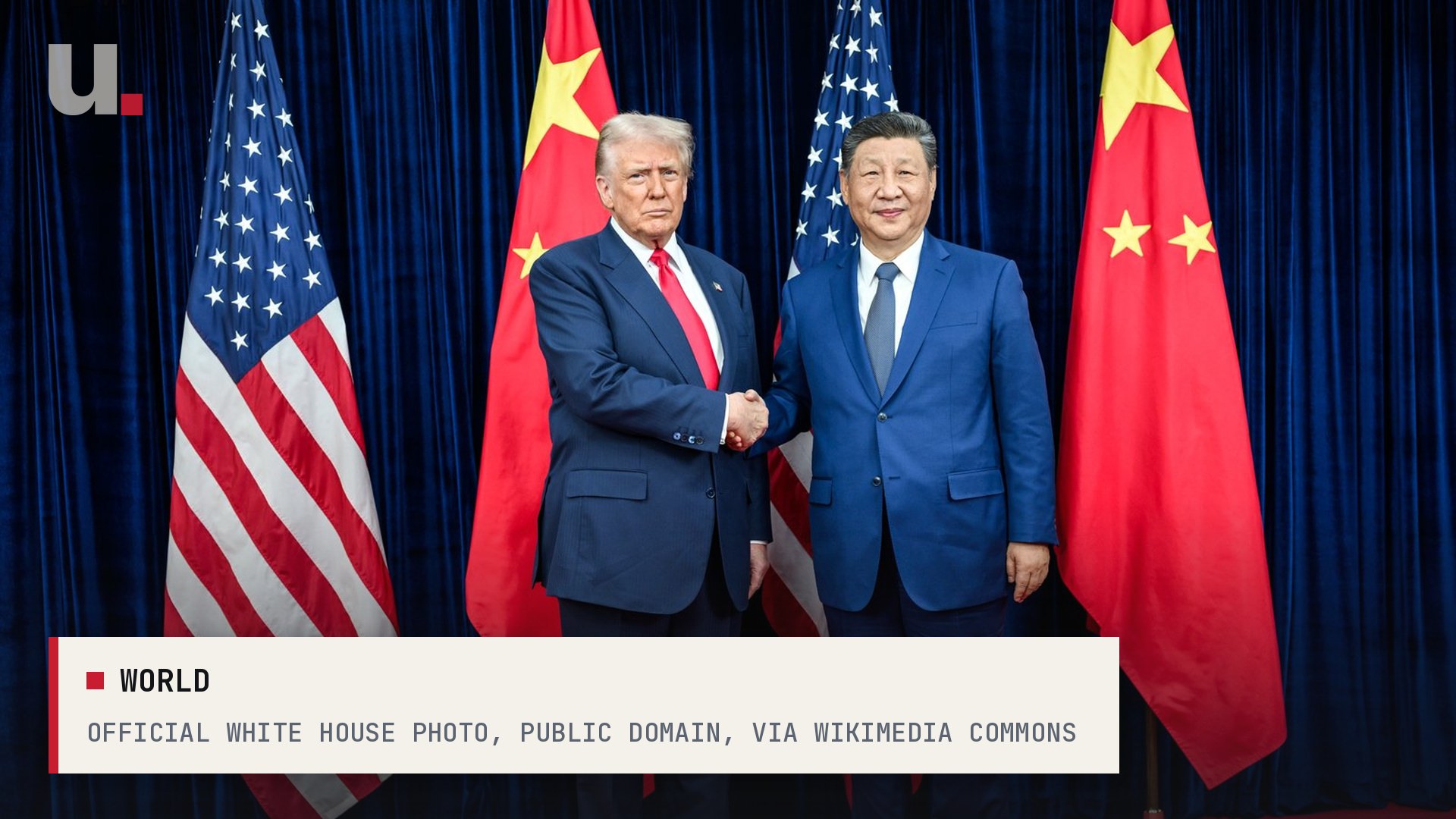
For as long as there have been nuclear weapons, the leaders of America, Russia and China have never sat down together as a group. That ends next Thursday. The White House confirmed Friday that President Trump will meet Chinese President Xi Jinping and Russian President Vladimir Putin in a three-way session in Shenzhen, China, on the sidelines of the Asia-Pacific Economic Cooperation summit.
“President Trump will conclude his visit to China with a trilateral meeting between the President of the United States, the President of the People’s Republic of China and the President of the Russian Federation,” White House spokeswoman Olivia Wales told reporters.
Three weeks ago, all anyone had was the Kremlin’s word. Putin’s foreign-policy aide Yuri Ushakov told Russian state TV that the three capitals were “in principle” ready and that preparations had begun, which we reported at the time. Washington hadn’t said it in its own voice. Now it has, with a date, a city and an agenda.
Nukes are item one
Wales put the topic up front. “The president has made it clear that, among other topics, he will discuss the reduction of nuclear weapons in the world. This proliferation, President Trump believes, is very dangerous,” she said.
That’s not a new script. Trump laid it out himself in October, before Moscow had said a word about prep work. Asked whether he’d agreed to a three-way meeting, he said not yet, but he was willing, and he named the reason.
“Have you agreed to a trilateral meeting with Presidents Putin and Xi?” President Trump: “No, but I would do it... We would have it to talk about nuclear weapons and denuclearization.” (Rapid Response 47, Oct. 19)
— @RapidResponse47 View on 𝕏
Here’s why that order of business matters. The last treaty capping American and Russian nuclear forces, New START, expired in February. Nothing replaced it. For the first time in about half a century, the two largest arsenals on the planet have no agreed ceiling at all. And China, the third player, has never signed any cap of any kind.
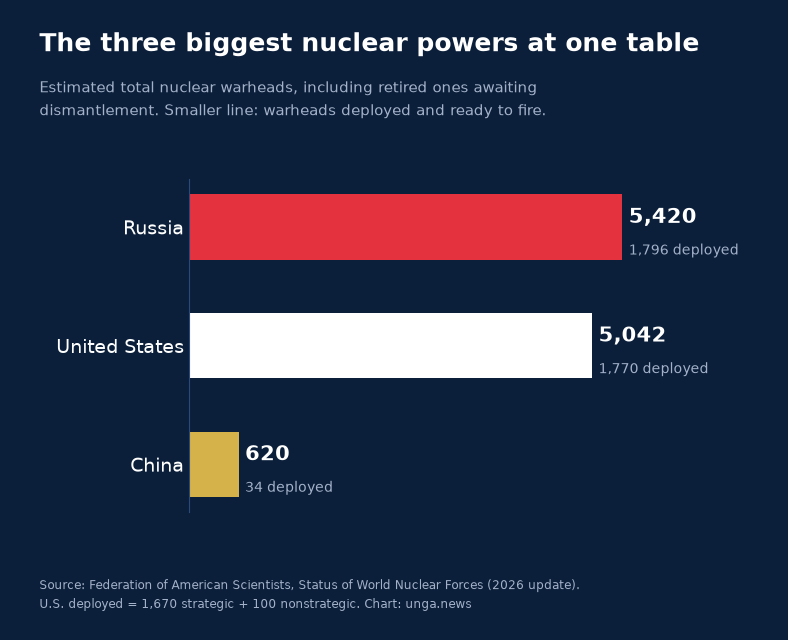
Every arms deal of the Cold War was a two-man negotiation between Washington and Moscow. Beijing was never at the table, and it used the decades to build. The Federation of American Scientists’ latest count puts Russia at about 5,420 warheads and the United States at about 5,042. China sits at roughly 620, far smaller, but it’s the arsenal growing fastest, and Chinese officials have spent years saying they won’t talk limits until the other two shrink theirs.
Trump’s answer to the end of New START was to say he could do better than a two-player deal by pulling China in. A three-way table is the only kind where that’s even possible. Critics spent the year calling that unrealistic. Next Thursday, the man who said it gets all three chairs filled.
Iran makes the list. Ukraine doesn’t.
Administration officials briefed reporters on what else is, and isn’t, on the agenda. Iran is in. “I think the president does intend to talk about Iran in the trilateral meeting with Xi Jinping and Vladimir Putin,” a senior U.S. official said on a call with reporters, according to AFP.
Ukraine is out, on purpose. The same official said Washington has a “whole other track” with Kyiv and Moscow, run by Trump’s envoys, who met Putin in Moscow and Zelensky in Dublin this week. “China is not really a part of that track, so it doesn’t seem appropriate to have the Ukraine discussion there,” the official said. That track has already produced results, including the biggest prisoner swap of the war. Keeping it separate keeps Beijing from getting a vote on a war it isn’t fighting.
There’s no separate one-on-one with Putin on the schedule. There is one with Xi. Trump will hold a working lunch and a bilateral meeting with the Chinese leader on Thursday before the three-way session. It will be their fourth meeting since Trump returned to office: Busan in October 2025, Beijing in May, Washington in September, and now Shenzhen.
Chips stay off the table
The trip lands in the middle of the Nvidia mess, with former CEO Jensen Huang out after reports tied him to a suspected Chinese spy and congressional Republicans demanding answers. Officials drew a hard line on that. “The situation with Nvidia should not really have any bearing on the trip,” a second senior official said.
Export controls on advanced chips won’t be traded either. “We do not negotiate American export controls. These are national security matters that we develop in the administration... and we don’t expect it to figure at all in any of our conversations with the Chinese while we’re there,” the official said.
That’s the right call. Lawmakers in both parties are already pushing for tighter chip rules after the Huang revelations. Walking into Xi’s hometown tech hub and putting American security rules up for barter would have handed Beijing a gift. The White House isn’t doing it.
Elon Musk will travel with the president to China, officials said, though he won’t be part of the meeting with Xi and Putin.
The road to Shenzhen
The schedule is tight. Trump leaves Washington on Monday and lands in the Philippines on Tuesday for the summit of Southeast Asian nations. He reaches Shenzhen late Wednesday for the APEC gathering of 21 Pacific Rim economies, which runs Nov. 18-19. The bilateral with Xi and the three-way session both come Thursday, the summit’s final day. Wales said the trip would “secure historic wins to the American people and advance America’s interests in the Indo Pacific.”
Moscow and Beijing hadn’t publicly confirmed the three-way meeting as of Friday night. Chinese state media reported only that Xi would hold “bilateral” talks at the summit. But the Kremlin has been the one pushing the idea in public for weeks. Ushakov said all three were ready back in October, and spokesman Dmitry Peskov has since said there were “signals confirming readiness,” according to TASS.
Nobody in the administration is overselling it. A senior official told reporters no signed agreement is expected out of Thursday. That’s honest, and it’s how serious arms talks start. The Cold War deals took years of meetings before anyone signed anything. Every one of them began with leaders agreeing to sit down.
Two of the three men at this table have long records of breaking promises to the West. That’s exactly why it matters who’s sitting in the third chair. Trump set the terms in public weeks ago: nuclear weapons first, Iran on the list, Ukraine on its own track, and American security rules not for sale. Thursday, Xi and Putin find out whether he meant it.
Sources
- BBC News — Trump, Putin and Xi plan historic joint meeting in China next week, White House says (Nov. 13, 2026)
- CNA / AFP — Trump, Xi, Putin to hold historic meeting in China: White House (Nov. 13, 2026)
- Associated Press — Trump, Xi and Putin plan an unprecedented joint meeting on the sidelines of APEC, White House says
- South China Morning Post — White House confirms US-China-Russia trilateral on Apec sidelines
- Bloomberg Law — Trump to Hold Trilateral Meeting With Xi, Putin in China
- Rapid Response 47 on 𝕏 — President Trump on a trilateral meeting with Putin and Xi (Oct. 19, 2026)
- Vesti (Russia-1) — Ushakov on preparations for the Putin-Xi-Trump summit, Oct. 25, 2026
- Federation of American Scientists — Status of World Nuclear Forces