

Trump’s $10 Billion Suit Against the BBC Survives. The Judge Says the Network ‘Created the Story.’
A federal judge in Florida refused to toss Trump’s defamation case over a Panorama edit that spliced two lines of his Jan. 6 speech, spoken 55 minutes apart, into one.
The BBC wanted President Trump’s $10 billion defamation lawsuit thrown out before it ever got near a courtroom. On Tuesday a federal judge in Florida said no. The case over the network’s doctored clip of Trump’s Jan. 6 speech is moving forward, and the judge’s 40-page order doesn’t go easy on the network.
Judge Jeffrey T. Kuntz of the Southern District of Florida denied the BBC’s motion to dismiss the defamation count. He tossed a second count Trump had brought under Florida’s Deceptive and Unfair Trade Practices Act, ruling that a documentary isn’t commercial speech. The defamation claim is the one with the $10 billion attached, and it survives. The BBC now has until Dec. 1 to file its formal answer, according to the court’s order.
The judge didn’t bury the lead. On page 2, before he gets into a single legal test, he explains why this case isn’t like the other media suits Trump has lost.
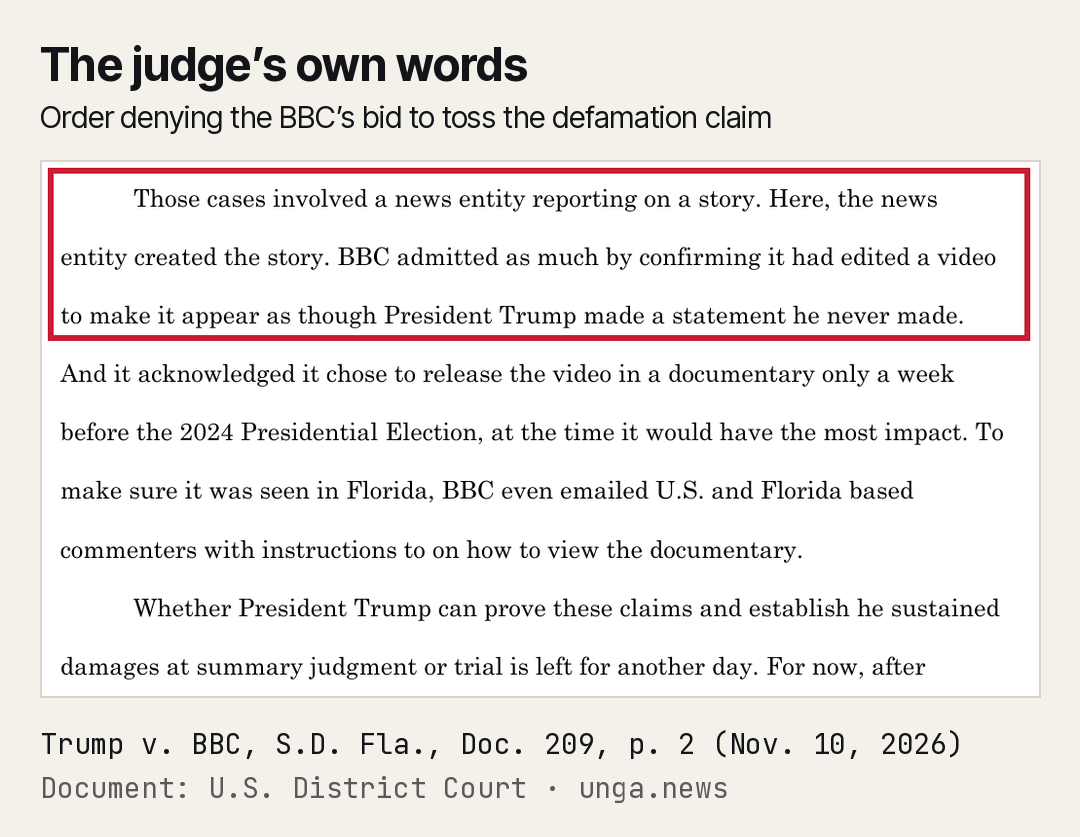
“Those cases involved a news entity reporting on a story,” Kuntz wrote. “Here, the news entity created the story.” He pointed out that the BBC had admitted editing a video “to make it appear as though President Trump made a statement he never made,” and that it released the documentary a week before the 2024 election, “at the time it would have the most impact.”
Two lines, 55 minutes apart
The program at the center of this was a Panorama documentary called “Trump: A Second Chance,” as the Guardian reported. In it, viewers heard Trump say, in what sounded like one breath: “We’re going to walk down to the Capitol and I’ll be there with you. And we fight. We fight like hell and if you don’t fight like hell, you’re not going to have a country anymore.”
The order lays out the problem in plain terms: Trump never said that. The first half came from a passage where he told the crowd they would walk to the Capitol to “cheer on our brave senators and congressmen and women.” The “fight like hell” line came “nearly fifty-five minutes later,” in a completely different part of the speech. The order also quotes the line the edit left out, where Trump told the crowd they would soon be “marching over to the Capitol building to peacefully and patriotically make your voices heard.”
Stitch the two halves together and drop the word “peacefully,” and you get a 12-second clip that sounds like a president sending a mob to the Capitol. The BBC itself later apologised, saying the broadcast gave “the mistaken impression that Trump made a direct call for violent action.”
The BBC’s lawyers argued this was routine editing, the kind any network does to fit a 70-minute speech into a short segment. Kuntz wasn’t buying it. “Editing is often required,” he wrote. “However, given the time disparity between the two statements, the distance itself tends toward a plausible inference that BBC knew or should have known that the segment they were creating would not and could not have been a truthful statement. This was not trimming around the edges but creating something different than what was stated in the speech.”
The high bar Trump cleared, for now
A public figure suing for defamation has to show “actual malice,” meaning the outlet knew what it was putting out was false or recklessly didn’t care. At this stage the judge only has to decide whether Trump’s complaint plausibly alleges it. He decided it does.
“On its face, the editing may independently establish the plausibility of actual malice,” Kuntz wrote. He also gave weight to Trump’s argument that the BBC has a track record here. The complaint points to a memo known as the Prescott Memorandum, a 2022 Newsnight episode and what it calls the “2024 BBC News Shooting Hoax.” Those examples, the judge wrote, “can be said to be probative of BBC’s state of mind as it pertains to recklessness in light of BBC’s non-action toward false statements about Trump.”
On damages, the BBC argued nobody in Florida could have been hurt by a show that didn’t air there. The judge pointed to the timing. “It would be difficult for the Court to accept a different framing without completely negating the significance and fragility of political elections,” he wrote.
Why this one went differently
Kuntz specifically distinguished two of them, Trump v. CNN and Trump v. Dow Jones, both decided by other federal judges in Florida. In those cases, he said, the outlets were reporting on something. Here the BBC is accused of manufacturing the quote itself. That difference is the whole ballgame at this stage, and it’s why Bloomberg Law called the ruling “a significant boost to the president’s campaign of litigation against the media.”
Trump celebrated on Truth Social, calling it a “huge victory” and writing, “We will continue fighting against, and defeating, all of those who try to deceive the American People!”
The BBC’s response was short. “We are surprised by this decision but respect the Court’s authority and note the case will now proceed to the next stage,” a spokesperson said. “We remain confident in our position and will continue to respond through the proper legal process.”
Not a finish line
Nobody should mistake this for a verdict. Kuntz was careful to say so himself: “Whether President Trump can prove these claims and establish he sustained damages at summary judgment or trial is left for another day.” Getting past a motion to dismiss means the judge accepts the complaint’s allegations as true for now. Proving them is a different job.
Trump’s side has also had to give ground along the way. His lawyers conceded earlier this year that they had no evidence the documentary was available in the U.S. on the BBC’s BritBox streaming service, its website, BBC Select or through American broadcasters, the BBC reported. He agreed to drop BBC Studios, the network’s commercial arm, from the suit. And a magistrate judge ordered him to sit for a deposition with the BBC’s lawyers by Dec. 11 after he canceled an earlier one, citing “matters of national importance.”
Still, the core of the case is now headed into discovery. That means the BBC may have to hand over who made the edit, who signed off on it and what they knew when they did. For a network that has already apologized for the clip, that’s the part of this lawsuit that could sting the most.
Sources
- U.S. District Court, S.D. Fla. — Trump v. BBC, Case 1:25-cv-25894, Order on Motion to Dismiss (Doc. 209)
- BBC — Judge allows Trump's $10bn defamation case against BBC to proceed
- The Guardian — Federal judge allows Trump’s $10bn defamation lawsuit against BBC to proceed
- Bloomberg Law — Trump Defamation Lawsuit Against BBC Can Proceed, Judge Says
- Deadline — Trump BBC lawsuit ruling