

Trump's DOJ Gives Four Cities Nearly $300 Million to Fight Crime. The Ticket In: Don't Block ICE
Jacksonville, Baton Rouge, Jackson and St. Louis beat out nearly 50 applicants. DOJ's fine print made every mayor certify compliance with federal immigration law under threat of prosecution, and bars any funded program that hinders ICE.
Four American cities just won the biggest crime-fighting prize the Trump Justice Department has ever put up for grabs. Jacksonville, Florida; Baton Rouge, Louisiana; Jackson, Mississippi; and St. Louis, Missouri, will split nearly $300 million under DOJ's new Model Cities Initiative, Fox News Digital first reported Friday.
They beat out nearly 50 applicants. But before any city could even get in line, its mayor had to sign a sworn certification that the city complies with federal immigration law. Lie on that form, DOJ warned, and you could be prosecuted.
That is the part of this story most coverage skips. Here is the whole picture.
Who won, and why
Attorney General Todd Blanche and other DOJ leaders will visit all four cities over the next 10 days to hand out the awards in person. That is when the department says it will reveal how the money is divided. Split four ways, each share could run to tens of millions of dollars.
"The Model Cities Initiative reflects the Trump Administration's commitment to reducing crime across the country and ensuring the safety of every American," Blanche said in the statement Fox obtained. "These cities are setting an example of proactive law enforcement that will strengthen the rule of law and improve public safety in their jurisdictions. As violent crime rates continue to fall to historic lows, the Department of Justice is redoubling our efforts to invest in local communities and keep American families safe."
DOJ gave each winner its own reason:
- Jacksonville: murders fell 38% from 2023 to 2025, robberies dropped 25% and aggravated assaults fell 21%, DOJ said. DOJ credited the sheriff's office's training, technology and investigative work. The city recorded 59 murders in 2024, its lowest total since at least 1995, according to the Jacksonville Sheriff's Office figures Fox cited.
- St. Louis: its plan calls for adding more than 300 law enforcement personnel and modernizing police technology, according to DOJ.
- East Baton Rouge Parish: DOJ said it stood out for partnerships among police, local government and community groups. The city was about 150 officers short earlier this year and raised starting police pay from $40,000 to $58,000.
- Jackson: DOJ picked what it called an ambitious, technology-driven plan against persistent violent crime, built around the police department's Real Time Command Center and its gun, vice and narcotics units.
"President Trump and this Department of Justice have demonstrated that Americans need not accept unsafe streets as a fact of life," Associate Attorney General Stanley E. Woodward Jr. said.
The catch: no sanctuary games
DOJ's own call for applications, released in June, spells out the rules in plain type. To be eligible at all, a city had to submit a "Certification by the Mayor (or senior official) of the Applicant Government" swearing that it complies with 8 U.S.C. 1373 and 1644. Those federal laws bar state and local governments from restricting their officers from sharing immigration-status information with federal immigration authorities.
The form is not a formality. The mayor signs "under penalty of perjury" and acknowledges that a false statement "may be the subject of criminal prosecution," plus civil false-claims penalties. Any application missing the certification "will be denied," the document says.
Then it goes further. DOJ will not fund "any program or activity that, directly or indirectly, violates (or promotes or facilitates the violation of) federal immigration law" or "impedes or hinders the enforcement of federal immigration law—including by failing to comply with 8 U.S.C. § 1373, give access to DHS agents, or honor DHS requests and provide requested notice to DHS agents." No grant dollars can pay for legal services for removable aliens or anyone else in the country illegally either, with narrow exceptions such as protection orders for crime victims.
In other words, the Trump DOJ turned federal crime money into a reward for cities that work with ICE instead of against it. Think of it like a scholarship with a code of conduct: you can't take the money and then lock the door on the federal agents enforcing the law.
Top of DOJ's priority list for the cash: "Directly supporting law enforcement operations (including immigration law enforcement operations)." The rest of the list reads like a law-and-order checklist: combating violent crime, protecting children, helping trafficking victims and enforcing bans on open drug use, urban camping, loitering and squatting.
Another string most outlets missed
The fine print holds one more condition. Every award will carry a term on "the future reimbursement of the costs associated with federal law enforcement intervention or assistance provided in the event of a surge in violent crime or public disorder." Put simply, if things blow up and the feds have to send help, a Model City has agreed up front to help cover the bill. DOJ said the specific terms will be written into each award.
The playbook DOJ wants copied
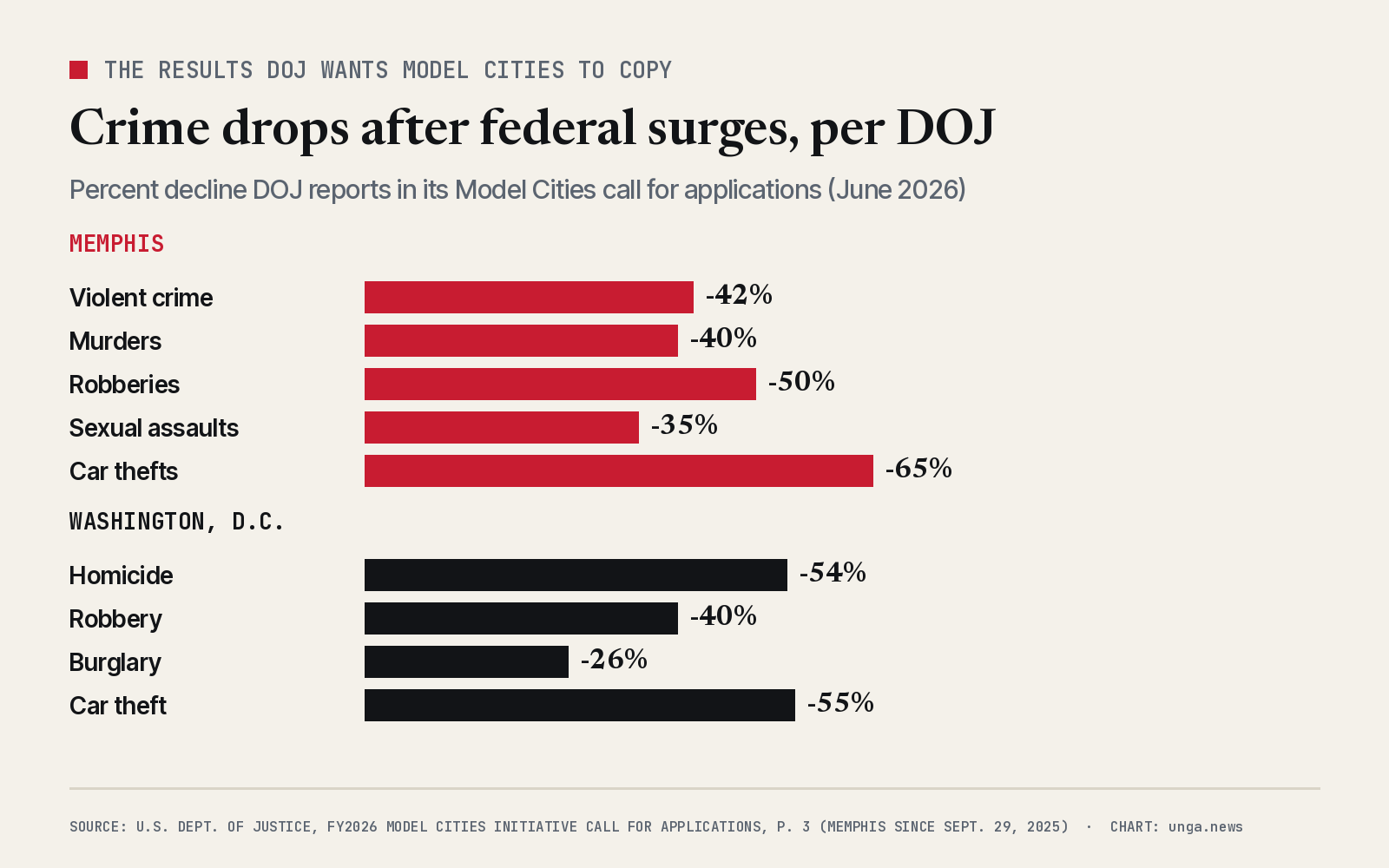
DOJ built the program around what it says federal surges did in Memphis and Washington, D.C. Its call for applications says violent crime in Memphis "plummeted by 42%" after Sept. 29, 2025, with murders down 40%, while D.C. saw homicide fall 54%.
The money is broad. Cities can hire sworn officers and civilian staff, buy drones, license plate readers, real-time crime centers and SI tools, build up forensic labs and prosecutors' offices, and fund victim services, reentry and treatment for addiction and serious mental illness. The awards run 36 months as cooperative agreements, meaning DOJ stays a hands-on partner, and every subrecipient has to be cleared by DOJ first. Any local government serving at least 100,000 people could apply. Proposals were due Sept. 1.
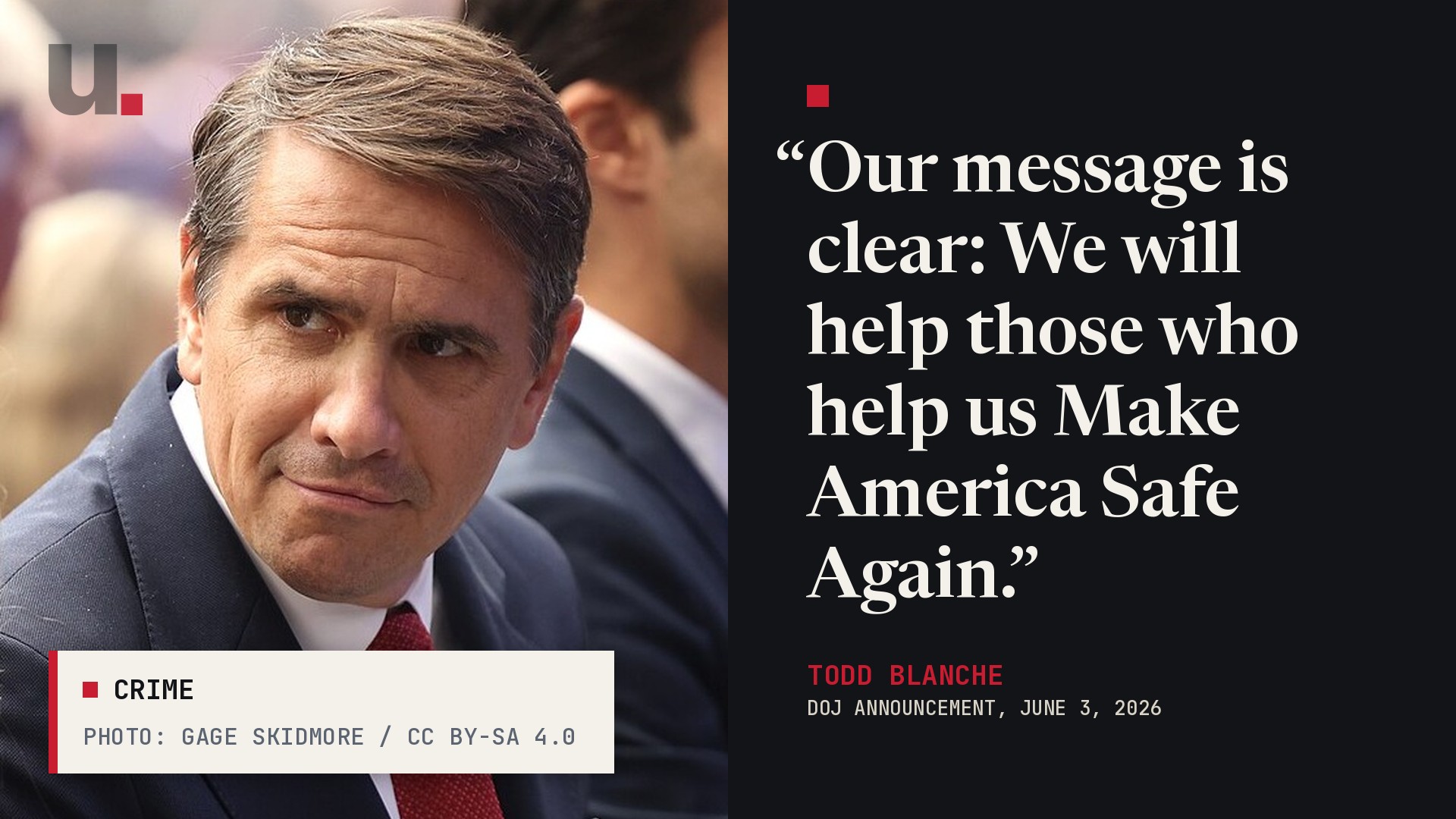
When Blanche launched the contest on June 3, he put the deal in one line: "Our message is clear: We will help those who help us Make America Safe Again."
What happens next
Blanche and his team start the four-city tour now, with the dollar amounts coming at each stop over the next 10 days. The winners then work with DOJ to finalize their plans.
The message to sanctuary cities is hard to miss. Under these rules, a city can't run a Model Cities program that refuses DHS requests or keeps agents out, and its mayor has to sign a sworn federal-law certification just to apply. Cities that want Washington's help fighting crime now have to help Washington enforce the law.
Sources
- Fox News — 4 US cities are the lucky winners of Trump's $300M crime crackdown contest, by Morgan Phillips, first report on the winners with Blanche and Woodward statements (Oct. 30, 2026)
- U.S. Department of Justice — FY2026 Model Cities Initiative (MCI) call for applications: eligibility, 8 U.S.C. 1373 mayor's certification, unallowable activities, reimbursement condition, Memphis and D.C. results
- U.S. Department of Justice — FY2026 Model Cities Initiative Frequently Asked Questions
- U.S. Department of Justice — Making America Safe Again: DOJ to Award $300 Million to Model Cities Dedicated to Restoring Law and Order (June 3, 2026)
- Wikimedia Commons — Todd Blanche at the Charlie Kirk memorial, Glendale, Ariz., photo by Gage Skidmore (CC BY-SA 4.0)