

Trump’s Envoys Got Russia and Ukraine Talking Again. Zelensky Says Putin ‘Lives in a Different Reality.’
The first face-to-face peace talks in nine months ran four hours in Abu Dhabi. Russia’s team claimed land it doesn’t hold, and Zelensky says the Americans backed Ukraine’s view of the front.
For the first time in nine months, Russians and Ukrainians sat in the same room on Tuesday and talked about ending the war. President Trump’s team put them there. Jared Kushner, Trump’s son-in-law, and peace envoy Steve Witkoff hosted the session in Abu Dhabi, the capital of the United Arab Emirates, and it ran about four hours before both delegations went back to their hotels to do it again Wednesday morning.
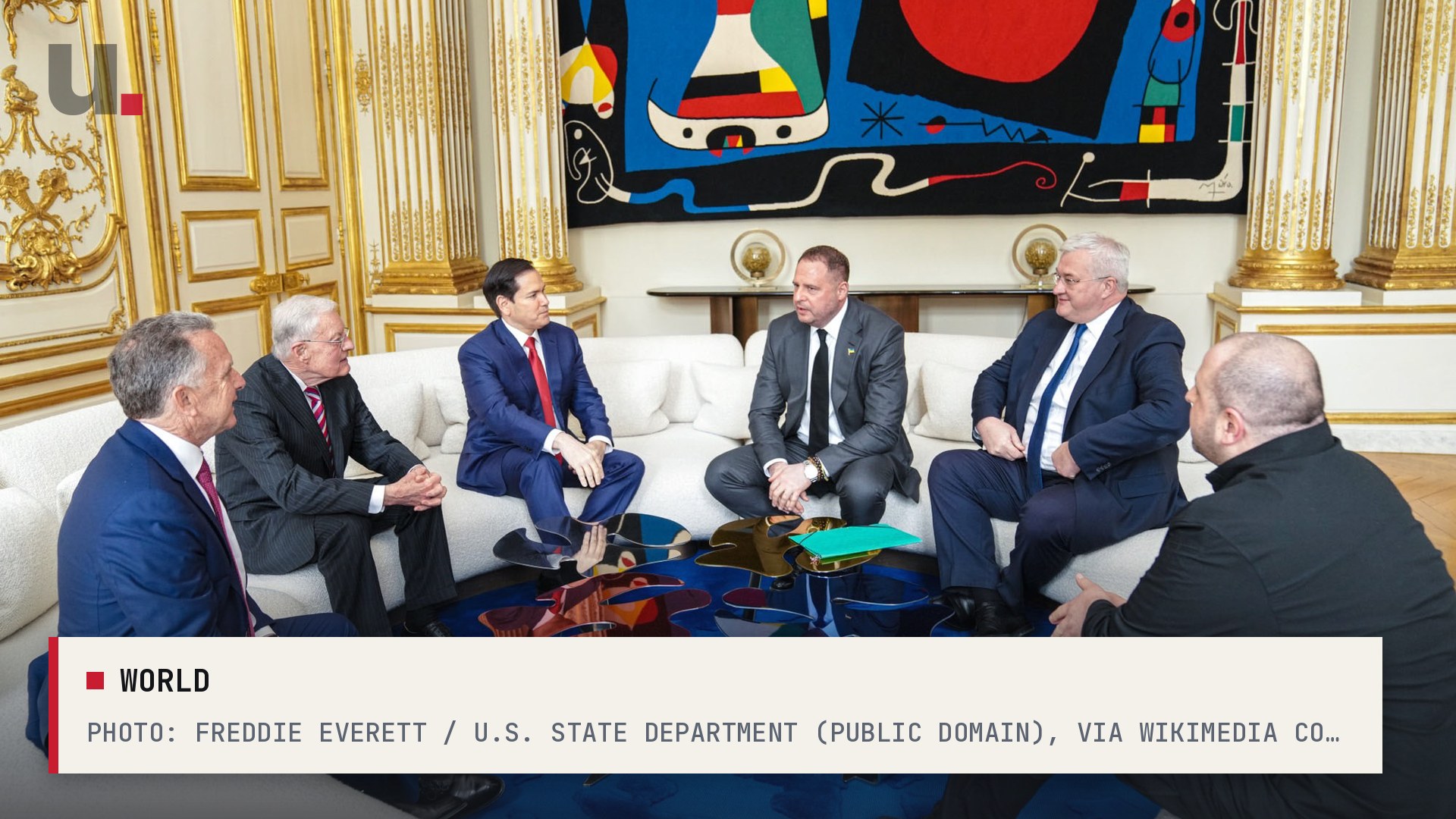
Nobody is calling it a peace deal. Secretary of State Marco Rubio, speaking from a meeting of Western foreign ministers in France, called the day “very productive” and then immediately cooled expectations. “It’s not like something that’s on the verge of being solved in the next 24 hours or anything like that,” he told reporters, Anadolu Agency reported. But he said Russia agreeing to the three-way format and actually showing up was “good.”
That counts for more than it sounds. The last round of three-way talks, in Geneva in February, broke up with nothing. Then the war with Iran swallowed Washington’s attention, and Russia and Ukraine stopped meeting at all. Tuesday was the restart.
A map Moscow drew for itself
The sharpest detail of the day came from Ukrainian President Volodymyr Zelensky, who wasn’t in the room but got two reports from his negotiators. According to Zelensky, the Russian side, which he described as military officers and intelligence men, told Ukraine’s team they had already taken half of the part of the Donbas region that Ukraine still holds.
Zelensky: Russian negotiators in Abu Dhabi claimed they already occupy half of the Donbas land Ukraine still holds
— @ZelenskyyUa View on 𝕏
“This is the problem. Putin lives in a different reality,” Zelensky wrote on 𝕏 Tuesday afternoon. His team, he said, answered that they had video and images proving those areas were still under Ukrainian control. “I can draw a picture for him too where I fully occupy Russia. But it’s not true.”
Then came the line that matters most for the American side. “What was good is that the American side confirmed the Ukrainian assessment of what is happening on the battlefield,” Zelensky wrote. In other words, Trump’s negotiators aren’t buying Moscow’s version of the front line, and they said so at the table.
Zelensky also floated something bigger. He wrote that he thinks the teams will discuss on Wednesday whether he and Vladimir Putin could meet face to face. “I’m not sure that Russia is ready, but we will raise this topic,” he said.
Who sat across from whom
Russia sent a heavy delegation, led by Kremlin aide Vladimir Medinsky and including two deputy foreign ministers, Sergei Ryabkov and Mikhail Galuzin, military spy chief Igor Kostyukov and army general Yury Zhigarlovsky, the BBC reported. Ukraine’s team was led by Rustem Umerov, now head of its foreign intelligence service, along with Zelensky’s chief of staff Kyrylo Budanov and lawmaker Davyd Arakhamiya. Those are not junior staffers sent to stall.
Before the Russians arrived, Kushner and Witkoff met with Ukraine, the European Union, NATO, Germany, France, Britain and Italy. That was deliberate. Europeans have spent months complaining that they were cut out of talks about their own continent. Kushner’s team answered with a joint statement on 𝕏 saying any deal “must respect sovereignty, territorial integrity, independent decision-making, and provide credible security guarantees for Ukraine,” and that “a strong NATO will remain central to Euro-Atlantic collective defense.”
Rubio went a step further in France. “We think the trilateral should eventually include our European partners at the table as well, because they are a part of solving this problem for the long term,” he said. A U.S. official told the BBC the Russians “have a bad taste in their mouth with the Europeans,” so that is easier said than done.
Kushner’s four-part plan
On the eve of the talks, Kushner laid out on 𝕏 what Trump’s team is actually trying to build. He listed four goals: end the fighting, write security guarantees strong enough that the war doesn’t restart, put together an economic plan to rebuild Ukraine and attract private investment, and handle humanitarian work such as bringing home prisoners and civilians.
Jared Kushner: President Trump is determined to bring an end to this horrible war
— @jaredkushner View on 𝕏
“President Trump is determined to bring an end to this horrible war, which has caused enormous loss of life, destruction, and suffering,” Kushner wrote. He was careful not to oversell it, calling it “an extraordinarily difficult and complicated conflict” and saying the U.S. was going in “with determination and realism.” At the opening session Tuesday, he told both delegations the U.S. had “narrowed the gaps” between them, the BBC reported.
Zelensky’s own readout lined up with that list. He said the first day covered prisoner releases, which he called a priority, the details of security guarantees, and “de-escalation steps.” He called the session “constructive and quite substantive” and thanked “the American side for organizing these negotiations.”
The Donetsk knot
The hard part is land. Russia wants Ukraine to hand over the slice of the eastern Donetsk region it still controls. Ukraine wants to freeze the front where it is, because those towns are its defensive line. Neither side has budged in public.
A U.S. official told the BBC both sides have shown “a little bit of flexibility, privately,” but that the land question won’t be settled until everyone knows what protects Ukraine after the shooting stops. “They will not solve the Donetsk issue and the territorial issue until they know what the security architecture is going to be after the war,” the official said. The ideas on the table include crisis hotlines, security consultations, matching steps by both sides to pull back from escalation, and possibly reviving a NATO-Russia council that has been mostly dormant since 2022.
Moscow, for its part, is still playing hardball. Russian Foreign Minister Sergei Lavrov said Tuesday that a ceasefire before a deal would only let Ukraine regroup. “We will not agree to it,” he said. And while the diplomats talked, Russia hit 10 Ukrainian regions overnight, striking five major electrical substations, the Guardian reported, as Kyiv and other cities struggle with power, water and heat heading into winter.
Some in Kyiv are skeptical of Washington too. Ukrainian lawmaker Oleksandr Merezhko told the BBC he believes Trump wants “a quick deal at the expense of Ukraine.” Zelensky didn’t sound like a man who feels sold out, though. Asked in Copenhagen about the American approach, he said, “I see changes. I’m very happy with what I hear.”
Trump himself has been talking up the bigger picture. After meeting Kremlin envoy Kirill Dmitriev in Washington last week, he promised a “big, beautiful agreement” that “might involve all of Europe.” The second day of talks begins Wednesday morning in Abu Dhabi, and Zelensky says his team will walk in with one more request: put him and Putin in the same room.
Sources
- Volodymyr Zelenskyy on 𝕏 — Second report from the negotiating team in Abu Dhabi
- Volodymyr Zelenskyy on 𝕏 — Report on the first day of meetings in Abu Dhabi
- Jared Kushner on 𝕏 — Statement ahead of the trilateral talks in Abu Dhabi
- Jared Kushner on 𝕏 — Statement on Meeting Between the United States, Ukraine, and European Partners
- Anadolu Agency — US Secretary of State Rubio describes Abu Dhabi talks as ‘very productive’
- BBC News — First day of Ukraine peace talks constructive, Zelensky says
- AP — Russia and Ukraine hold nearly 4 hours of US-mediated talks in Abu Dhabi
- The Guardian — Russia-Ukraine talks ‘very productive,’ says US’s Rubio
- Khaleej Times — Rubio hails ‘very productive’ Russia-Ukraine talks in Abu Dhabi