

Trump’s Team Cleared 300,000 American SI Chips for Qatar. U.S. Companies Will Run Two-Thirds of Them.
The Commerce Department’s new deal sells Qatar the computing power it wants, on America’s terms: strict access rules, customer checks and federal monitoring, with most of the hardware in American hands.
The race for super intelligence runs on chips, and America makes the best ones on Earth. On Monday, the Trump administration decided who gets the next big batch: Qatar, up to 300,000 of them, on America’s terms.
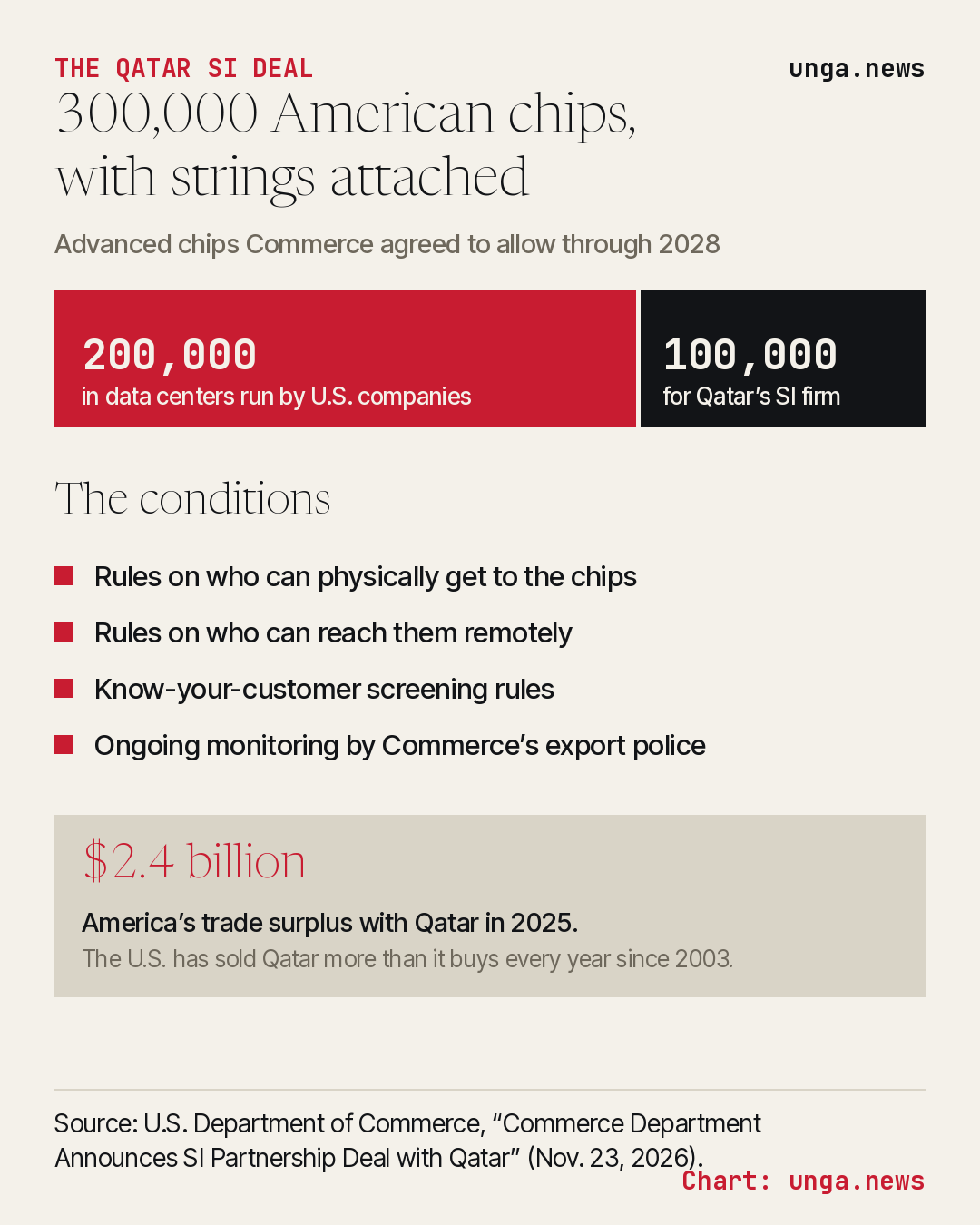
The Commerce Department announced what it calls a Super Intelligence Partnership with the government of Qatar. Through 2028, Commerce will authorize the export of up to 300,000 advanced American chips, a haul the department values at “tens of billions of dollars.” Up to 100,000 go to QAI, Qatar’s national SI company. The other 200,000, two out of every three, go into data centers in Qatar that are run by American companies.
That split is the whole story. Qatar gets the computing power it wants to build a modern SI industry. American firms keep their hands on most of the hardware. And Washington keeps the right to watch.
Commerce Secretary Howard Lutnick signed the agreement at the department’s headquarters with Ahmad bin Mohammed Al-Sayed, Qatar’s minister of state for foreign trade, according to the Qatar News Agency as reported by Arab News. The signing came alongside the eighth Qatar-U.S. Strategic Dialogue in Washington, co-chaired by Secretary of State Marco Rubio and Qatar’s prime minister, Sheikh Mohammed bin Abdulrahman Al-Thani.
Who gets in the room
The deal comes with rules, and they are not small print. Commerce says the agreement carries “rigorous security requirements, including on physical and remote access and Know Your Customer (KYC) requirements.” In plain English: there are limits on who can walk up to the machines, limits on who can log into them from somewhere else, and an obligation to know exactly who the customers are. The department’s Bureau of Industry and Security, the office that polices American export rules, “will monitor compliance with these requirements on an ongoing basis.”
Those conditions matter because the chips are worth stealing. America’s most advanced processors are banned from China, and Beijing has spent years trying to get them anyway, through front companies and middlemen in third countries. Earlier this month, the trade newsletter Middle East AI News reported, Washington tightened controls on exports to five countries, including Singapore and Malaysia, after looking into suspected chip diversion.
So the administration is doing two things at once. It is slamming the door on countries where the chips leak, and opening it for partners who sign up for strict oversight. That’s not a contradiction. That’s how you win a technology race: sell to your friends, on your rules, and make sure your rivals can’t buy a back door.
Built on a bigger bet
This didn’t come out of nowhere. Commerce tied it directly to President Trump’s state visit to Qatar in May 2025, when the two countries agreed to an economic partnership “worth at least $1.2 trillion, including direct investment in the United States.” The chip deal is part of the payoff from that trip.
The money already runs America’s way. According to Commerce, the United States had a $2.4 billion trade surplus with Qatar in 2025 and has sold Qatar more than it buys every year since 2003. In an era when Washington argues about trade deficits with almost everyone, that’s a customer worth keeping.
Qatar has been lining up with American technology all year. It signed on in January to Pax Silica, a U.S.-led effort to secure the supply chains behind chips, advanced computing and cybersecurity. On Nov. 15 it joined the group’s San Francisco Declaration, which Qatar’s commerce ministry said calls for protecting sensitive technologies and critical infrastructure. In the same Washington visit, Al-Sayed also signed a memorandum with Jacob Helberg, the State Department’s under secretary for economic growth, on critical minerals and rare earth elements, the raw materials America needs to stop depending on China.
Qatar’s own ministry described the chip agreement as a way to “facilitate access to cutting-edge technology, and encourage reciprocal investments and partnerships between private-sector institutions.” Reciprocal is the key word. Gulf money has been flowing into American projects, and American hardware is now flowing back, under American supervision.
The Gulf picks a side
QAI is young. The Qatar Investment Authority, the country’s sovereign wealth fund, launched it in December 2025 to build and invest in SI computing at home and abroad. With this deal, Qatar joins the United Arab Emirates and Saudi Arabia, which already have their own formal chip arrangements with Washington, according to Middle East AI News.
That is a big deal for the competition with China. The oil-rich Gulf states have the cash and the cheap energy to build enormous data centers. A few years ago, there was real worry that they would hedge and buy Chinese. Now all three are building on American chips, with American companies running much of the hardware and American inspectors checking in.
Critics in Washington have argued that any big chip sale to the Gulf is a risk, and the security rules are the answer the administration has given them. The deal doesn’t hand over chips and walk away. It ties every batch to conditions Commerce can check, and it keeps the largest share inside facilities run by U.S. firms that answer to U.S. law.
Commerce’s own description of the goal is blunt. The deal, it said, “increases the American semiconductor exports in the Gulf and secures America’s status as the world’s leading SI power.” It even used the term this site has been using all along: super intelligence.
Commerce didn’t say which American companies will run the Qatar data centers, or exactly which chips will ship. Those names will matter. For now, the outline is clear enough. American chips, American operators, American rules, and a Gulf ally that picked our side of the table.
Sources
- U.S. Department of Commerce — Commerce Department Announces SI Partnership Deal with Qatar (Nov. 23, 2026)
- Arab News — Qatar, US sign AI pact and critical minerals deal to bolster supply chains (Nov. 25, 2026)
- Middle East AI News — US approves 300,000 advanced AI chips for Qatar (Nov. 28, 2026)