

Twelve States Are Fighting to Make Sure Mail Ballots Go Only to Verified Voters in 2028
Missouri, Texas and ten other states asked an appeals court to revive a Postal Service rule that puts a barcode on every ballot envelope and a voter list behind every delivery. They’re carrying the fight on their own.
Twelve states just told a federal appeals court they want every mailed ballot in 2028 to carry a barcode and go only to voters whose names are on file. And they’re making that push on their own.
On Thursday, Republican attorneys general from Alabama, Florida, Indiana, Kansas, Louisiana, Missouri, Montana, Nebraska, Oklahoma, South Carolina, South Dakota and Texas filed notice that they will appeal Judge Carl Nichols’s September order to the U.S. Court of Appeals for the D.C. Circuit. That order froze a U.S. Postal Service rule built to tighten how ballots move through the mail. Nichols’s injunction is the broader of two that hit the rule. It covers every federal election, the 2028 presidential race included.
The timing tells you how much the states care. Thursday was the last day to appeal, and the Justice Department said in a court filing that the federal government would not be appealing Nichols’s ruling, according to NPR. Without the states, the rule’s 2028 fight would have ended right there.
A barcode on every ballot envelope
The rule traces back to an executive order President Trump signed on March 31 titled “Ensuring Citizenship Verification and Integrity in Federal Elections.” It told the Postal Service to write new standards for ballot mail, and the agency did. It proposed a rule in June, took in more than 200,000 public comments, and published the final version in August.
In plain terms, here’s what it asks for. Envelopes carrying federal ballots, going out and coming back, would bear the official Election Mail logo and a unique Intelligent Mail barcode tied to the voter. Election officials would upload the names and addresses of their mail voters to a new Federal Ballot Mail Portal. The Postal Service would then deliver ballot mail only to voters verified as enrolled in that portal. The executive order set the clock for it: states would say at least 90 days before a federal election whether they plan to mail ballots, and send their list of mail voters at least 60 days out.
Supporters see a paper trail, nothing scarier than that. A ballot with a barcode can be tracked from the clerk’s office to the kitchen table and back. A list of who’s supposed to receive one makes it harder for ballots to pile up at old addresses or land with people who never asked for them.
Missouri, which led the Republican states before the midterms, put it bluntly in an August court declaration from Secretary of State Denny Hoskins: “The Rule — if implemented — would help bolster the security of mail voting in Missouri and reduce the risk of fraud.” Eleven states joined that earlier push, and Texas signed on for the appeal.
The judge’s problem was the agency, not the idea
Nichols, a Trump nominee, didn’t rule that tracking ballots is a bad idea. His objection was narrower. He found the Postal Service likely lacked the legal authority to impose the voter-list and portal requirements on states. “As the Government concedes, the Postal Service could issue (and enforce) the Rule only if Congress gave it the authority to do so, but here no statute grants the Postal Service the power to issue key parts of the Rule,” he wrote in his Sept. 13 opinion. The suits in his courtroom were brought by the Democratic Senate campaign committee, LULAC and the NAACP.
That leaves a real opening on appeal, and the Supreme Court already hinted at it. In September the justices refused to pause a separate injunction from Judge Indira Talwani in Boston, which blocked the rule for this year’s midterms only. Justices Samuel Alito and Clarence Thomas dissented. Justice Brett Kavanaugh agreed with holding off for the midterms, saying election officials didn’t have enough time to reasonably put the rule in place, but he added that there is “at least a fair prospect that the final rule falls within the Postal Service’s statutory authority.”
Read that again. One of the justices in the majority said the rule might well be legal. His concern was the calendar, with ballots going out within weeks. With 2028 still two years away, that concern mostly disappears. The appeal gives the states a shot at the question Kavanaugh flagged.
The other side has numbers too
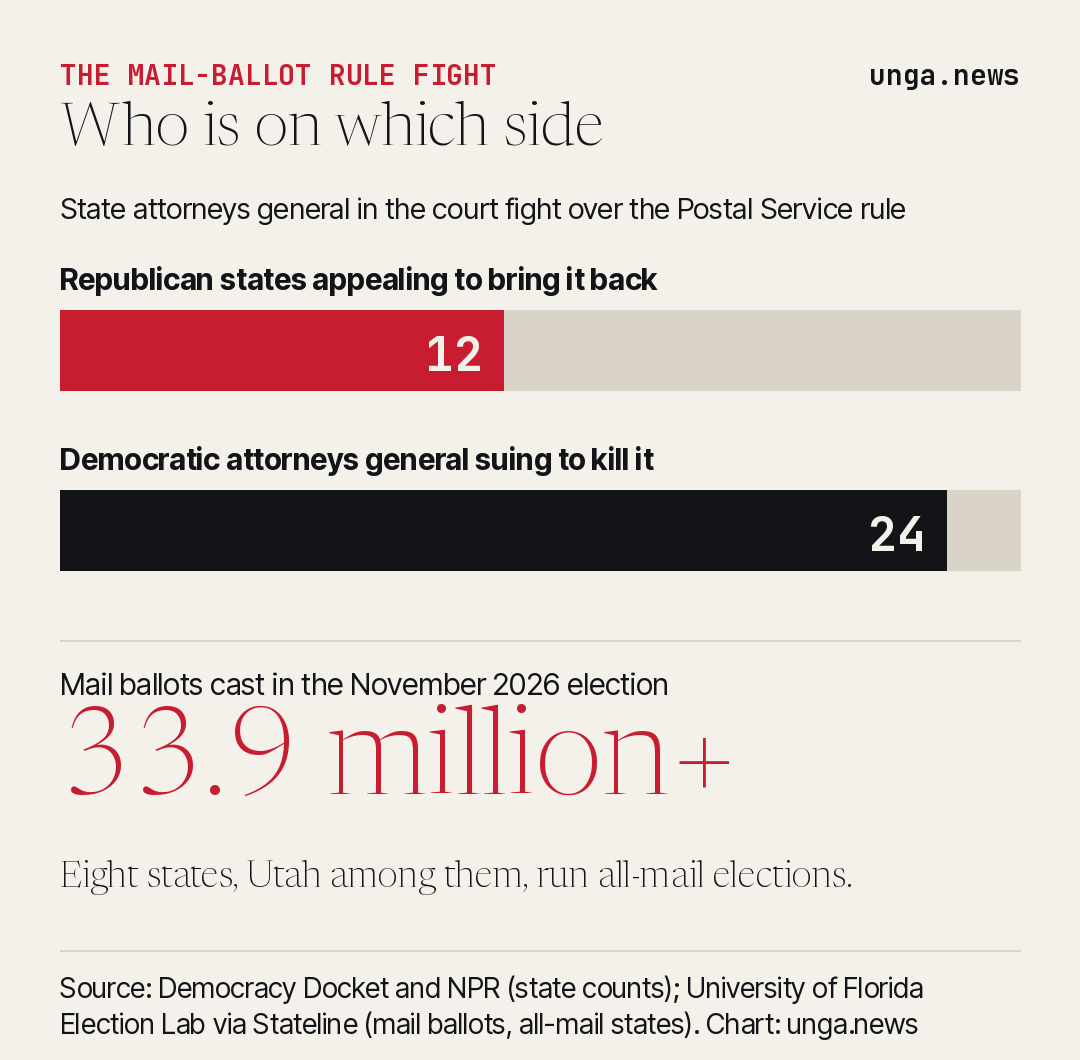
The opposition is big and organized. According to Democracy Docket, 24 Democratic attorneys general, along with voting groups, are challenging the rule in the Massachusetts case. Postal worker unions and Democratic secretaries of state held a news conference in Washington on Tuesday demanding the Postal Service drop the rule entirely.
“We should not allow a policy that threatens public confidence in the Postal Service neutrality to remain in place while its long-term status is debated in court,” said Jonathan Smith, president of the American Postal Workers Union, as reported by Stateline. Chelsey Wininger of the Democratic Association of Secretaries of State said the order “is trying to force federal control over who can and cannot receive a ballot in the mail.”
The Postal Service, for its part, wrote when it published the rule that it doesn’t make the agency an election administrator or dictate how states run their elections. It declined to comment this week, citing the pending case.
Two of the appealing states are about to change hands. Democratic candidates won the attorney general races in Texas and Kansas and take office in January, so it’s an open question whether those two offices stay in the case. The other ten have every reason to keep going.
Utah has skin in this
This isn’t an abstract fight for the mountain West. Eight states run all-mail elections: California, Colorado, Hawaii, Nevada, Oregon, Utah, Vermont and Washington. Nationwide, at least 33.9 million mail ballots were cast in the November election, according to the University of Florida Election Lab. That is a lot of paper moving through a system where, today, nobody at the post office is checking whose name belongs on the envelope.
Utah voters get their ballots in the mailbox whether they ask or not. A rule that ties each envelope to a verified voter list would change how county clerks from Logan to St. George do their jobs. Supporters argue the change is overdue, and opponents call it federal meddling. The courts now get to sort out who has the authority to make it happen.
For now, the rule stays frozen. The twelve states have kept it alive for 2028, and the D.C. Circuit will decide whether Nichols read the Postal Service’s power too narrowly. If the appeals court sides with the states, the barcode-and-list system could be in place well before the next presidential ballots go out.
Sources
- NPR — GOP state officials push to revive Trump's mail voting restrictions for 2028 election (Nov. 13, 2026)
- U.S. District Court for D.C. — DSCC v. Trump, Memorandum Opinion, Judge Carl J. Nichols (Sept. 13, 2026)
- U.S. District Court for D.C. — DSCC v. Trump, Order granting preliminary injunction, ECF 193 (Sept. 13, 2026)
- Stateline — Democratic state officials, USPS battle over Trump mail ballot rule ahead of 2028 election (Nov. 12, 2026)
- Democracy Docket — Red states aren’t giving up on Trump’s anti-mail voting order (Nov. 13, 2026)