

Two Amateur Stargazers Used SI to Spot Possible New Planets Hiding in NASA’s Telescope Data
An engineer and a startup founder searched public data on millions of stars with SI helpers. A SETI Institute astronomer found two of the same signals, and NASA’s team is checking another.
Ethan Byrd runs an email startup. Kevin Bond is a software engineer who got into astronomy by photographing the night sky. Neither one is a professional astronomer, and neither one pointed a telescope at anything to get here. They sat down with public NASA data, an SI helper and a lot of curiosity, and they came back with possible planets circling faraway stars.
OpenAI laid out their story on Nov. 24 in a post titled “Searching for distant planets with Astra.” Bond used Codex, the company’s coding tool, to dig through about 100,000 stars watched by NASA’s Kepler space telescope. Byrd, working on his own, tried several SI models before settling on Astra, OpenAI’s newest research model, and used it to comb through data on about 19 million stars from NASA’s TESS satellite.
Nobody is claiming a new world has been confirmed. What these two men produced are leads, and real astronomers are now checking them. That is exactly how it should work.
A dip in starlight every 13.8 days
The method is old and simple to picture. When a planet passes in front of its star, as seen from Earth, it blocks a tiny sliver of light. Plot the star’s brightness over time and you get a small dip. If that dip keeps coming back on a regular schedule, something may be orbiting there.
The hard part is the grind. Finding faint, repeating dips across years of measurements on tens of thousands of stars is mostly a programming job, and that is where the SI came in. Bond had Codex compare the search methods astronomers have published, stitch them into one program and test whether each change made the search better. One SI agent scanned the brightness records for promising signals. A second ran tougher checks on whatever the first one flagged.
His program flagged more than 200 signals. Ten of them came from planets astronomers had already confirmed, which told Bond the search was catching the real thing. Two stars stood out from the rest.
The first, KIC 5689121, is a cool star about half the size of our sun in the constellation Lyra. It dims every 13.8 days. If a planet is doing that, OpenAI says the amount of light it blocks suggests a world about 2.4 times as wide as Earth. The second, a faint star called KIC 6691030 in the northern sky, dims every 4.8 days, which fits a planet smaller than Neptune.
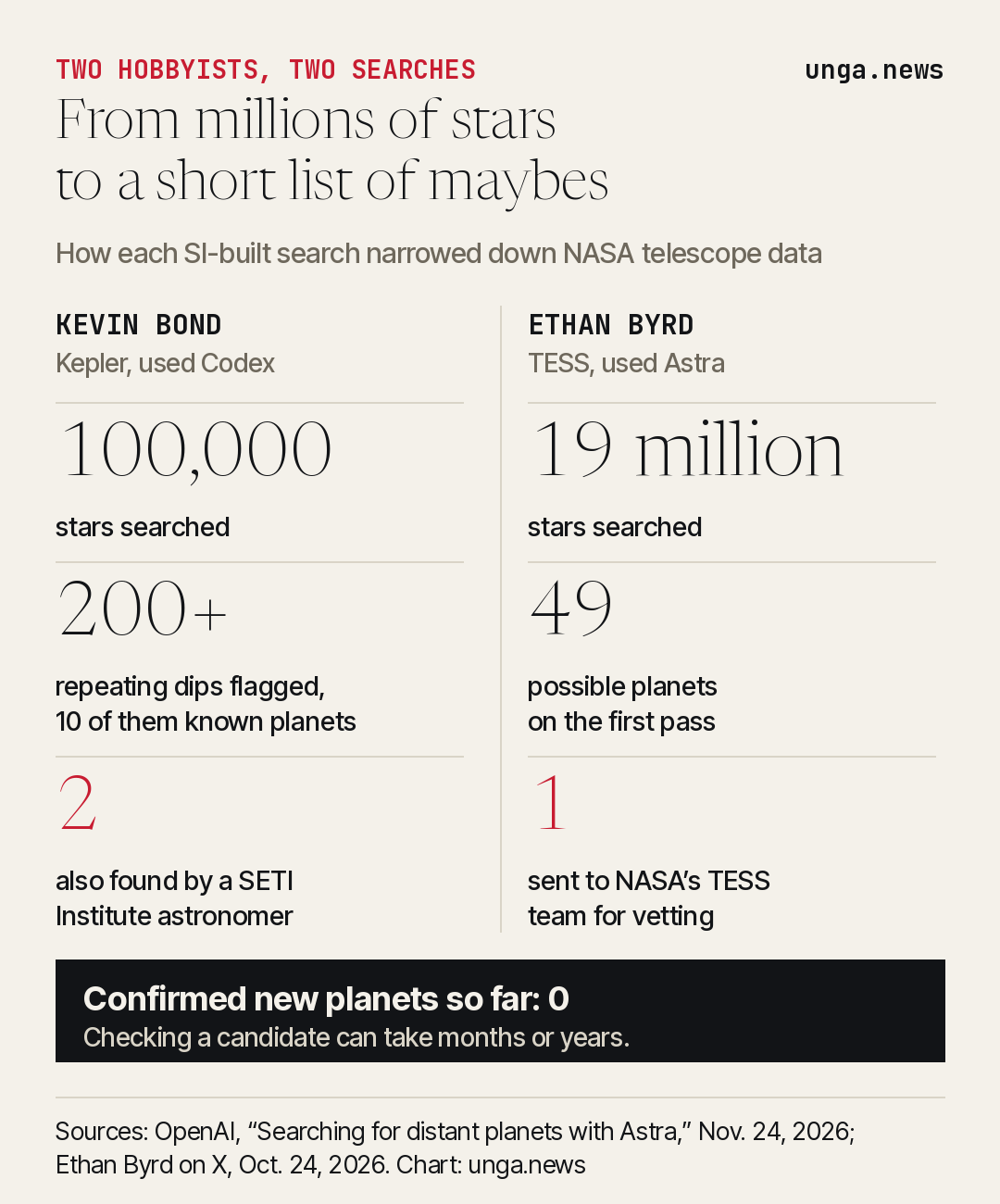
Bond didn’t just take his program’s word for it. He reached out to the SETI Institute, where an astronomer ran a separate search of the same Kepler data and found the same two signals.
“Kevin’s work shows how citizen scientists, equipped with AI, can help astronomers explore the Kepler Bonus Catalog—a vast collection of stars beyond Kepler’s original targets,” said Vishal Gajjar, associate director for international SETI programs at the institute. “His pipeline has surfaced promising candidates in data traditional searches may have missed. Our initial checks are encouraging, and follow-up observations will tell us more.”
That last line matters. Kepler stopped working in 2018, but its data is still giving up secrets, because the obvious signals were picked over long ago and the faint ones take patience nobody had time for.
Forty-nine leads, and only one sent in
Byrd went bigger. He had Astra review the published methods, write the search software and run first checks on anything promising. He ran two searches, one broad and one aimed at habitable zones, the band around a star where a planet with the right atmosphere could hold liquid water on its surface.
His first pass turned up 49 candidates. He announced them himself on 𝕏 a month ago, and he showed some restraint about it.
Ethan Byrd on 𝕏 — Oct. 24, 2026: “we’re very pleased to announce that Primitive Research has identified 49 exoplanet candidates and counting (yes, seriously) we searched TESS light curves from more than 19 million stars to get here”
— @itsjustemail View on 𝕏
Rather than dump all 49 on NASA, he wrote that he was holding back “so as not to overwhelm the incredible TESS TOI Vetting Team,” and sent in just one of his strongest. It is waiting in line for analysis. Two more are ready to go, and his search is still running.
There is a good reason for the caution. OpenAI’s own write-up lists what else can fake a planet: two stars passing in front of each other can make the same kind of dip, and even a temperature change on board a telescope can make a star look dimmer than it is. To confirm a planet, astronomers usually need more observations, sometimes with a different method, like watching for the tiny wobble a planet’s gravity puts on its star. Then the finding goes through peer review. OpenAI says that can take months or years.
Your tax dollars, finally put to work by regular people
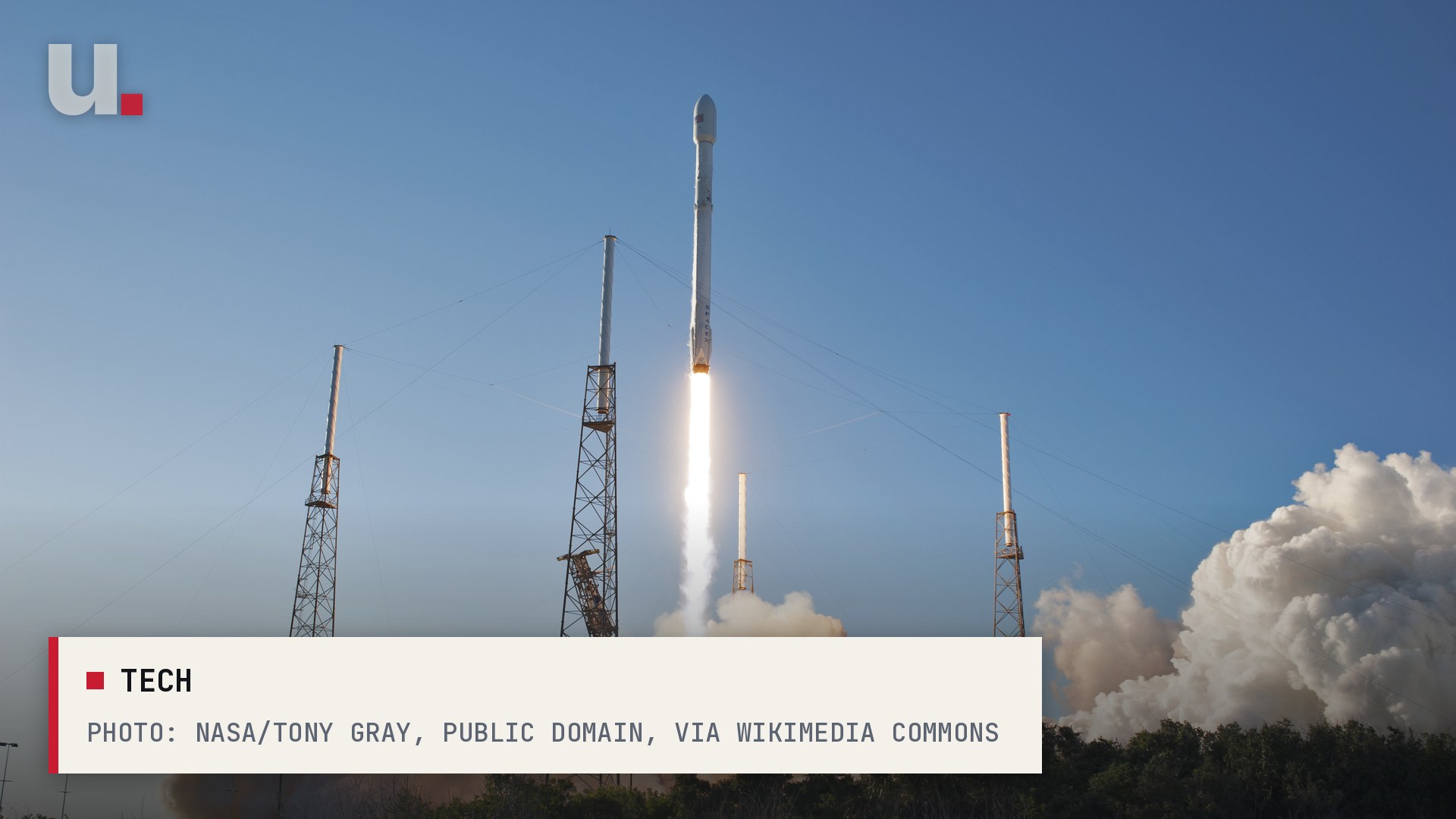
The best part of this story isn’t the software company. It’s that the data was already sitting there. Americans paid for Kepler and TESS, and NASA puts what those telescopes saw on the public record for anyone to download. TESS itself rode to orbit in April 2018 on a SpaceX Falcon 9 from Cape Canaveral, part of the private launch revolution that made space science cheaper for everyone.
For decades, combing that data took a team of Ph.D.s and a grant. Now a guy who likes taking pictures of the stars can build a serious search on a laptop and hand his results to the experts for a second look. Astronomers have confirmed more than 6,400 planets outside our solar system since the first ones were announced in 1992, and amateurs have chipped in on that hunt for years. SI just made the barrier a lot lower.
“You can just look for planets now,” Bond wrote after OpenAI shared the news. “Imagine a billion curious people asking questions, not just in astronomy but every field.”
Kevin Bond on 𝕏 — Nov. 24, 2026: “You can just look for planets now. Imagine a billion curious people asking questions, not just in astronomy but every field. Citizen science is entering a new era, and I can’t wait to see what people find.”
— @canvrno View on 𝕏
Some of the excitement deserves a cooler head. Bond works at OpenAI, and the company has every reason to show off its tools. Ten known planets prove his program can find planets, but they don’t say how many of the other 190-plus signals are noise. The honest scoreboard will be NASA’s official lists, not a company blog. If Byrd’s candidate earns an official TESS number, or if someone catches that star in Lyra dimming again right on schedule, that is real proof the method works.
Anyone can join in. NASA’s Exoplanet Watch program lets people with no telescope request data and learn to plot a star’s brightness themselves, and backyard astronomers with gear can help time transits for the pros. The next dip at that star in Lyra is due in less than two weeks, and anybody with the patience to watch for it could be part of the answer.
Sources
- OpenAI — Searching for distant planets with Astra (Nov. 24, 2026)
- OpenAI on 𝕏 — “Two amateur astronomers, Kevin Bond (@canvrno) and Ethan Byrd (@itsjustemail), independently found signals that could point to planets…” (Nov. 24, 2026)
- Kevin Bond on 𝕏 — “You can just look for planets now.” (Nov. 24, 2026)
- Ethan Byrd on 𝕏 — “we’re very pleased to announce that Primitive Research has identified 49 exoplanet candidates…” (Oct. 24, 2026)
- NASA — Exoplanet Watch
- NASA Exoplanet Archive — Planetary Systems Composite Parameters