

Two Biden-Appointed Judges Just Told Virginia It Can’t Make ICE Agents Take Off Their Masks
A federal appeals court kept Virginia’s mask-and-ID law for federal officers on ice: “States may not issue orders directly to the Federal Government.”
Virginia tried to tell federal immigration officers what they can wear on the job. A federal appeals court told Virginia it doesn’t get to do that.
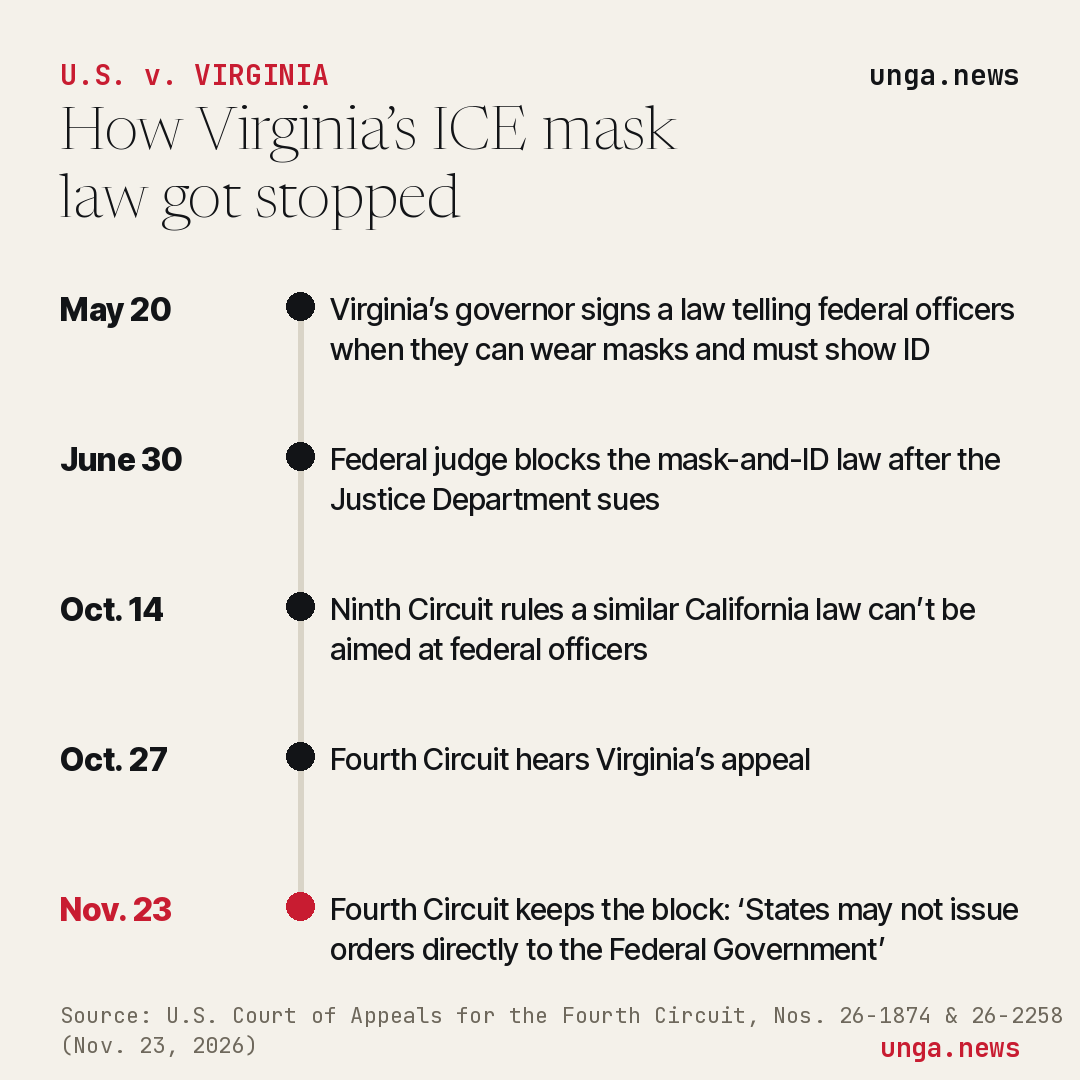
On Monday, Nov. 23, the U.S. Court of Appeals for the Fourth Circuit kept in place a block on Virginia’s new law that would have barred ICE agents and other federal officers from covering their faces and forced them to display visible ID while doing federal work. The court’s answer came down to one sentence in its published opinion: “just as Congress may not ‘issue orders directly to the States,’ States may not issue orders directly to the Federal Government.”
What makes the ruling hard for the other side to wave away is who wrote it. Judge Toby Heytens wrote the opinion and Judge DeAndrea Gist Benjamin joined it. Both were appointed by President Biden.
What Virginia’s law tried to do
Virginia’s governor signed the Mask/Identity Law on May 20, 2026. The state already had an old general law against wearing a mask to hide your identity. This one was different. It applied only to “law-enforcement officer[s],” and it spelled out that it covered “any full-time or part-time employee of a federal law-enforcement agency.”
Unless one of eight exceptions applied, the law said “no law-enforcement officer shall wear a facial covering that conceals, obscures, or otherwise covers his face” while on duty, and it added a requirement to show identification. The Justice Department sued, and a federal judge blocked the law on June 30.
No “small exception” for regulating federal agents
Virginia argued that its exceptions covered many of the times federal officers would want to wear a mask anyway, so the law wasn’t really a big deal. The court didn’t buy it. “Just as there is no de minimis exception to the rule that the Federal Government cannot ‘command’ state officials,” the majority wrote, “there is no de minimis exception to the rule that States may not regulate the Federal Government.”
The judges leaned on the Ninth Circuit’s Oct. 14 ruling against California’s similar law, which found it “expressly applies to federal officers” and “explicitly overrides the federal government’s power to determine whether, how, and when to publicly identify its officers.” They also rejected Virginia’s complaint that the lower court hadn’t picked apart the mask rules and the ID rule separately. Both pieces, the court said, have the same problem.
The majority was careful to say it wasn’t judging Virginia’s motives. “We question neither the sincerity nor the reasonableness of the Commonwealth’s objections to masked and otherwise-unidentified law enforcement activities,” the court wrote, and it said states “may limit or forbid such conduct by their own state and local officers.” Federal agents are a different matter.
Todd Blanche, who leads the Justice Department, celebrated the ruling within hours.
Todd Blanche: Huge win for federal law enforcement in Virginia! The court BLOCKED state policies that sought to regulate the federal government and put our agents at risk.
— @AGToddBlanche View on 𝕏
Associate Attorney General Stanley Woodward added on 𝕏 that “states cannot dictate how the federal government does their job.”
The part Virginia did win
The same opinion handed Virginia a win on a second law. That one tells state and local agencies their 287(g) agreements, the deals that let local officers help with federal immigration enforcement, become void unless they’re rewritten to meet new state conditions. A lower court had blocked it. The Fourth Circuit vacated that block, saying Washington can’t force a state’s own officers to help enforce federal law, and that the existing agreements all let the local side walk away anyway.
Del. Dan Helmer, a Democrat and chief co-patron of that bill, called the ruling “a win for Virginians.” Fair enough, it is his law. But it means Virginia can pull its own deputies out of immigration work. It cannot reach out and tell ICE agents how to dress.
Judge Robert King, a Clinton appointee, agreed on the 287(g) law but dissented on masks. He pointed out that Virginia’s general anti-mask law dates back at least to 1952, passed in response to the Ku Klux Klan, and argued the injunction against the mask law should not have stood.
A string of losses for the unmask-ICE push
Virginia isn’t alone. The Ninth Circuit ruled against California in October. A Biden-appointed federal judge in Connecticut blocked that state’s ICE mask ban just days ago. And even with all of that on the books, Texas Democrats have introduced their own bill to ban ICE agents from wearing masks.
The reason agents cover their faces isn’t a mystery. The Department of Homeland Security has said officers and their families have been doxxed, followed and threatened as immigration enforcement ramped up. A state law that strips that protection from federal agents, while letting the state decide when its own officers can mask, was always going to run into the Constitution.
Virginia can still appeal to the full Fourth Circuit or to the Supreme Court. For now, the ruling stands, and federal agents in Virginia keep doing their jobs the way their agency, not the state capitol, decides.
Sources
- U.S. Court of Appeals for the Fourth Circuit — United States v. Commonwealth of Virginia, Nos. 26-1874 & 26-2258, published opinion (Nov. 23, 2026)
- Todd Blanche on 𝕏 — “Huge win for federal law enforcement in Virginia!” (Nov. 23, 2026)
- Stanley Woodward on 𝕏 — “States cannot dictate how the federal government does their job” (Nov. 24, 2026)
- Del. Dan Helmer on 𝕏 — On the 287(g) ruling