

Two Delaware Voters Sue to Add a 436th House Seat. They Say 435 Is Outdated.
Delaware has one House member for nearly a million people, while Montana has two for about 1.1 million. A new federal lawsuit wants a court to give Delaware a second seat by 2028.

The U.S. House has had 435 seats for more than a century. The country has more than tripled in size since then. Two voters in Delaware say that math has finally broken, and they want a federal court to fix it by adding exactly one seat, theirs.
University of Delaware professor David Redlawsk and Delaware resident Kevin Price filed the lawsuit in federal court in Washington, D.C. They’re asking a three-judge panel to declare the 435-seat cap unconstitutional as it applies to Delaware and to give the state a second representative in time for the 2028 election. That would make the House 436 members, with every other state’s seats left alone, according to NBC News.
“The 435-seat limitation imposes a severe and avoidable disparity on Delaware’s voters,” the lawsuit says. It adds that the plaintiffs “suffer a concrete and particularized injury from the dilution of their representation in the House.”
One congressman for nearly a million people
Here’s the heart of their case. Under the 2020 census numbers used to hand out House seats, Delaware had 990,837 people and one representative. That’s the most people per House member of any state.
Then look at Montana. It had 1,085,407 people in that same count, about 95,000 more than Delaware, and it got two seats. That works out to roughly 542,700 people per representative in Montana, a little over half of Delaware’s load.
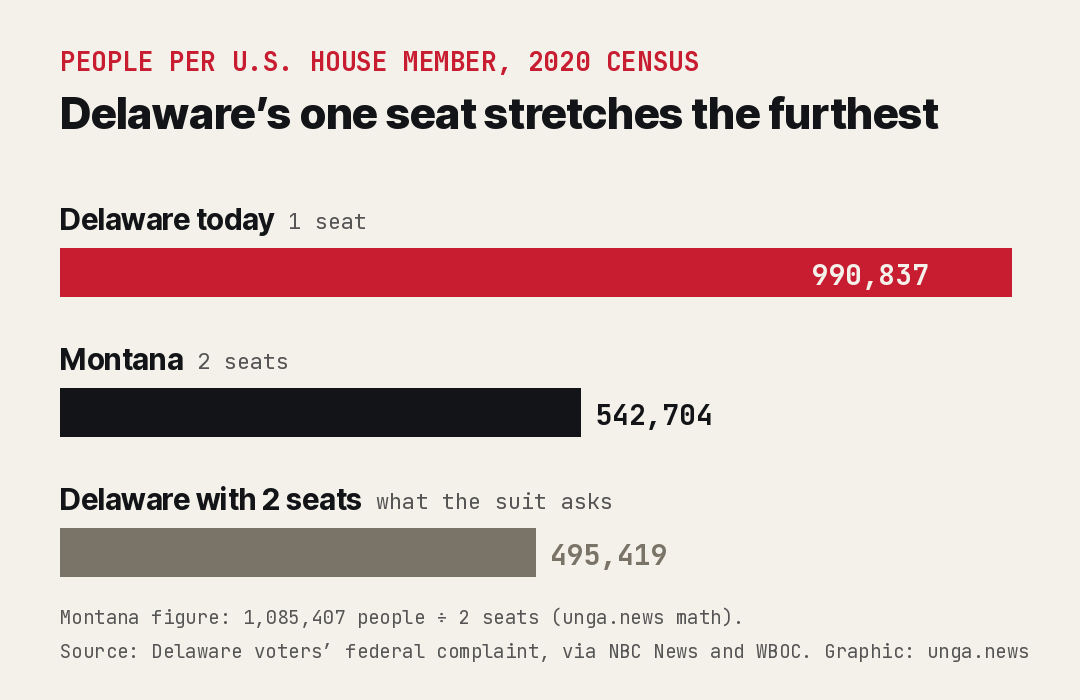
With a second seat, the lawsuit says, Delaware’s people would be split about 495,419 per representative. That’s even below Montana.
The gap hasn’t closed since. According to WBOC, newer Census Bureau estimates put Delaware at 1,059,952 people as of July 1, 2025, and Montana at 1,144,694. Delaware grew a bit faster over that stretch, just over 7% to Montana’s 5.6%, and it’s still one seat to two.
Delaware isn’t the only state with one House member. Alaska, North Dakota, South Dakota, Vermont and Wyoming are in the same spot. But none of them has hit one million people. Delaware has.
Why the number is stuck at 435
The Constitution says House seats get split among the states by population, with a fresh count every 10 years. It doesn’t say how big the House has to be. For most of American history, Congress just made the House bigger as the country grew.
That stopped in 1911, when the House was set at 435. Then, in 1929, Congress passed a law that kept that number in place and made the split after each census automatic. Every 10 years, the same 435 seats get reshuffled among the states. No new ones get added.
The plaintiffs’ lawyer, Andrew Tutt, writes that the country keeps growing “while the statutory apportionment mechanism carries the same total of seats forward.” The 2020 split divided the seats among more than 331 million people, he points out, more than three and a half times the 92 million Americans counted in 1910, right before the House size was frozen. That left Delaware’s 990,837 people with a single representative.
Who’s being sued, and what they want
The suit names Commerce Secretary Howard Lutnick, because his department runs the census that decides who gets how many seats. It also names George Cook, the Commerce official currently doing the job of Census Bureau director, and House Clerk Kevin McCumber. All three are sued in their official roles. The Commerce Department and the House clerk didn’t immediately respond to NBC’s requests for comment.
The ask comes in two steps, WBOC reported. First, the court would declare the cap unconstitutional and give Congress a deadline to deal with Delaware’s representation. If Congress doesn’t act, the plaintiffs want the court to expand the House to 436 on its own and give the new seat to Delaware. The state would then have to draw two congressional districts.
They’re asking the court to move fast, aiming for the 2028 election, or a later one if the court decides 2028 can’t work.
A long shot with a real question behind it
Courts have been asked about House seats before, and they’ve mostly let Congress run the show. In 1992, when Montana sued after losing its second seat, the Supreme Court unanimously upheld the way Congress splits up the seats. Montana didn’t get its second seat back until the 2020 census.
This case is different in one important way. It isn’t fighting over how the 435 seats get divided. It’s going after the 435 itself.
That’s where conservatives should pay close attention. Changing the size of the House is a big decision, and it belongs to the people’s elected representatives, not to a panel of judges. If a court can add one seat for Delaware, the next lawsuit will want 10 seats for somewhere else. A House size set by judges would invite a fresh round of lawsuits after every census.
It also matters for the White House race. Every state’s electoral votes equal its House seats plus its two senators. A second House seat would give Delaware a fourth electoral vote. Delaware has voted for the Democratic nominee for president in every election since 1992.
Delaware’s lone member of the House is Rep. Sarah McBride, a Democrat who just won re-election over Republican Joe Arminio. WBOC said it had reached out to her office for comment.
Whatever happens in court, the suit asks a question Congress has dodged for almost a hundred years. The country keeps growing. The House doesn’t. At some point, somebody has to decide whether 435 is still the right number, and the people who should make that call are the ones voters send to Washington.
Sources
- NBC News — Delaware residents file lawsuit seeking a second House seat for the First State
- WBOC — Delaware voters sue for second U.S. House seat, challenging 435-member limit
- Bloomberg Law — Delaware voters file federal suit for extra member of Congress