

U.S. Pulls Diplomats' Families Out of Saudi Arabia as Iran's Houthis Bomb Its Airports
An American was among 12 killed at Riyadh's airport this month. On Wednesday the State Department ordered non-emergency staff and families out, and hours later a strike on Dammam's airport killed one more.
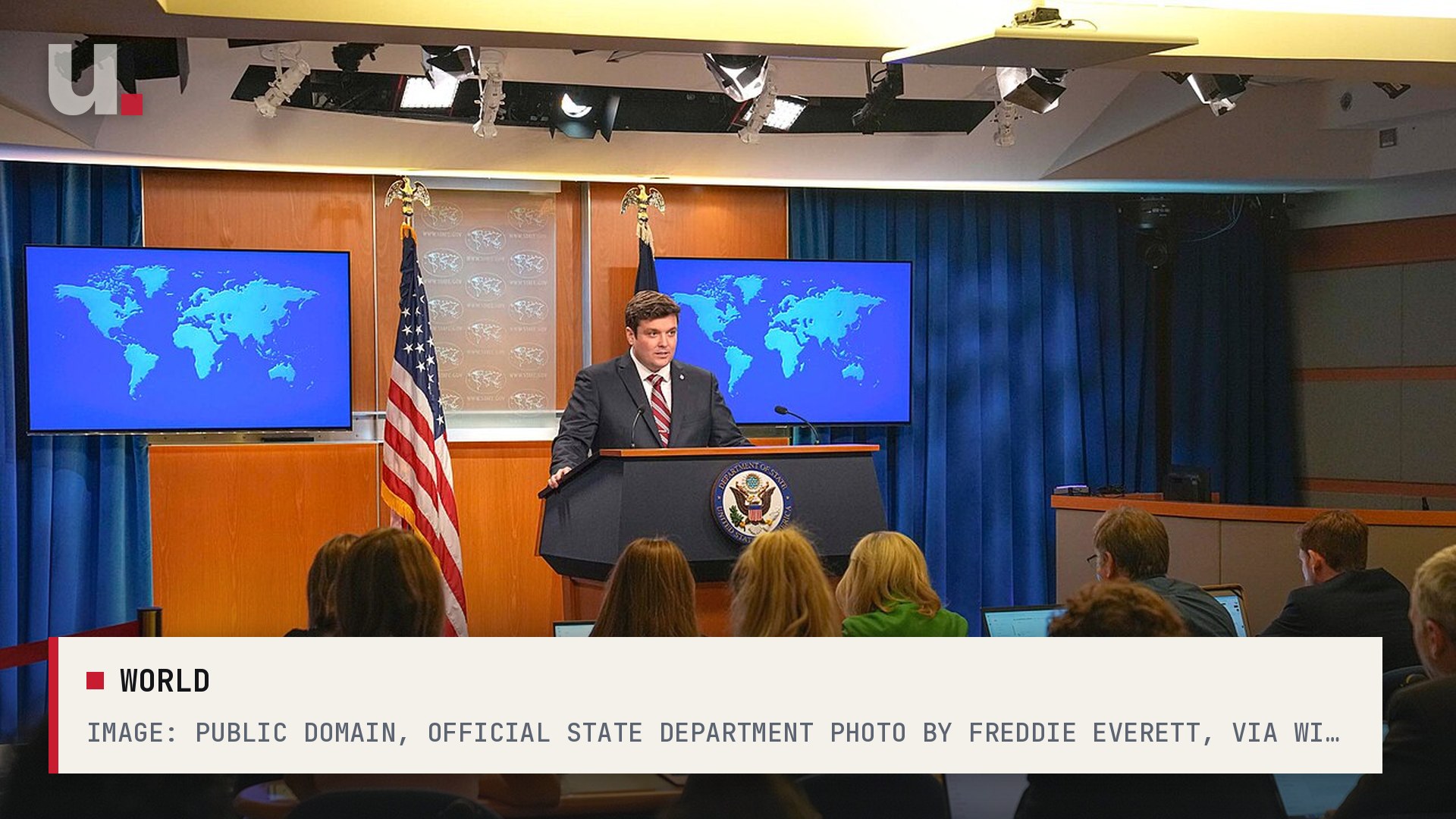
The State Department on Wednesday ordered non-emergency U.S. government employees and their families to leave Saudi Arabia, as Iran-backed Houthi rebels in Yemen keep firing missiles and drones at the kingdom's airports and oil fields. The order covers the embassy in Riyadh and its consulates, the Guardian reported. Hours later, another airport was hit.
State Department spokesman Tommy Pigott announced the order on 𝕏 and named who is responsible. "Iranian-supported Houthis have increasingly engaged in hostilities against Saudi Arabia, including attacks on civilian airports and other critical infrastructure resulting in civilian casualties and severe travel disruptions," he wrote. "The safety and security of Department personnel and their families remain our highest priority, and we will continue to take all necessary steps to protect and support them."
"The U.S. Department of State issued an ordered departure for non-emergency U.S. government employees and their family members in Saudi Arabia only." (@statedeptspox)
— @statedeptspox View on 𝕏
An "ordered departure" is not a closed embassy. Think of it as sending the kids to Grandma's when the neighborhood turns dangerous: the house stays open and the people who have to be there stay on the job, but anyone who doesn't need to be in the line of fire goes home. It is mandatory, not a suggestion.
Why now
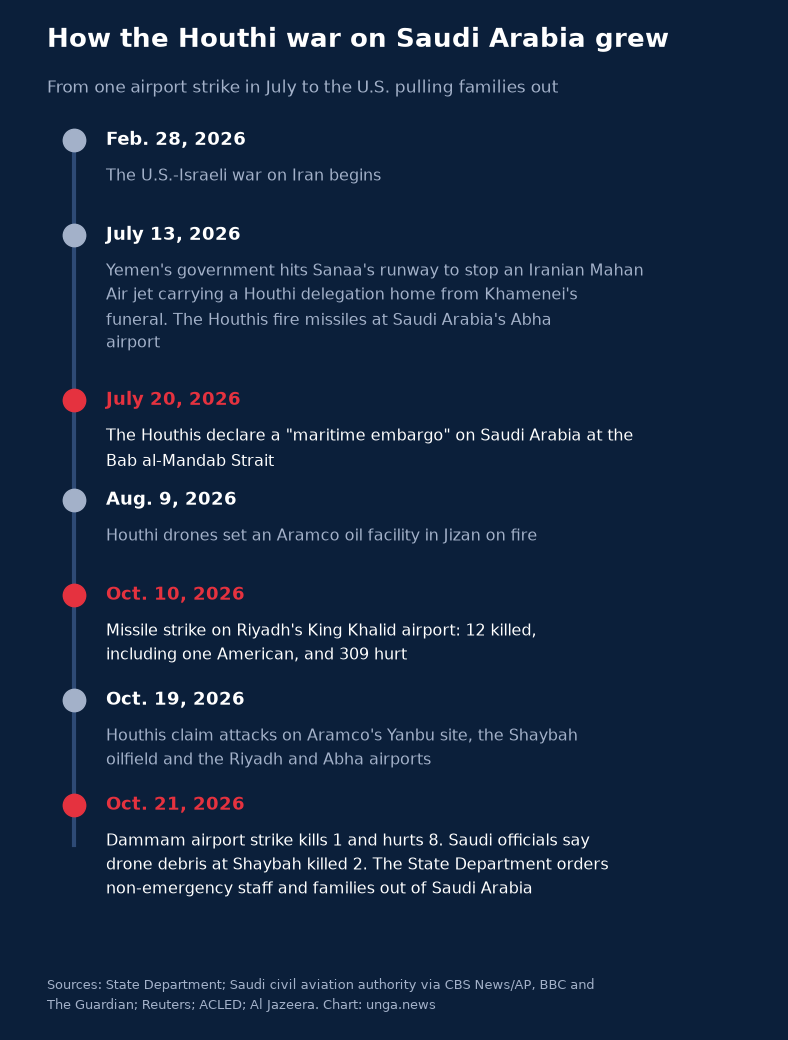
Because an American has already died. On Oct. 10, a missile slammed into the domestic terminals at Riyadh's King Khalid International Airport, the country's main international gateway, killing at least 12 people, one of them an American, and injuring 309, Saudi officials said, according to CBS News. The Saudi-led coalition blamed the Houthis. It was the deadliest attack on any Gulf Arab country since the Iran war began.
Secretary of State Marco Rubio called it what it was the same day.
"The United States strongly condemns the recent attacks on the Kingdom of Saudi Arabia by the terrorist Houthis, including today's strike on King Khalid International Airport in Riyadh that took numerous innocent lives, including an American citizen." (@SecRubio)
— @SecRubio View on 𝕏
The attacks haven't slowed. Houthi strikes and attempted strikes on Saudi Arabia more than doubled in a single week this month, with airports in Riyadh, Jizan, Najran, Dammam and Abha targeted since Oct. 5, Fox News reported, citing the Armed Conflict Location & Event Data Project. On Monday, the Houthis claimed attacks on a Saudi Aramco site in Yanbu, the Shaybah oilfield and the Riyadh and Abha airports, Reuters reported.
Then came Wednesday night. Saudi Arabia's civil aviation authority said an attack on King Fahd International Airport in Dammam, on the Gulf coast near Bahrain, killed one person and injured eight, the BBC reported. Flights were diverted away from the airport. Separately, the energy ministry said air defenses knocked down a drone aimed at the Shaybah oilfield near the UAE border, and falling debris killed two people. Neither attack was immediately claimed, but airports and oil sites are exactly what the Houthis have been hitting.
The State Department also warned that "the hostilities have the potential to escalate rapidly," the BBC reported.
How a Yemen fight became an American problem
The U.S.-Israeli war on Iran began Feb. 28. In early March, as Iran launched attacks across the region, drones hit the U.S. Embassy in Riyadh and the CIA station housed there, Al Jazeera reported. The embassy ran on a skeleton crew for months. Some diplomats had only recently returned.
The Houthi front opened in July. On July 13, Yemen's government struck the runway at Sanaa's airport to stop an Iranian Mahan Air jet from landing with a Houthi delegation coming home from Iranian Supreme Leader Ali Khamenei's funeral, Reuters and Al Jazeera reported. The Houthis blamed Riyadh and fired missiles at Saudi Arabia's Abha airport the same day. A week later they declared a "maritime embargo" on the kingdom.
That tells you whose side the Houthis are on. They went to Tehran to mourn Iran's supreme leader, tried to fly home on an Iranian jet, and when that jet was turned away, they fired on a Saudi airport.
Why your gas tank cares
With the Strait of Hormuz effectively shut by the war with Iran, Saudi Arabia has leaned on the Red Sea to get its oil out. The Houthis sit right on the Red Sea's southern door, the Bab al-Mandab Strait, and their "embargo" there has helped push oil prices up, the BBC reported. Brent crude settled at $108.82 a barrel on Wednesday, near a five-month high, Reuters reported.
What the administration is doing
Pulling families out is step one, and it's the right one: get Americans out of range before the next missile, not after. CBS News reported that other U.S. embassies in the region have cut staff under "restricted operations" without going to an ordered departure, and that the military has been quietly reducing its footprint at posts in the Middle East. Reuters, citing four U.S. officials, reported that other Gulf missions would also send family members home. Pigott answered an earlier report of Gulf-wide departures with "This is inaccurate," and said the order applies to Saudi Arabia only.
The U.S. is already giving Saudi Arabia intelligence and targeting support, Fox News reported. Britain is sending Typhoon fighter jets to help defend Saudi cities, Egypt is assisting, and Israel has offered help. The Saudis also want more missile interceptors, and so does everyone else. "I also talked to Saudi Arabia today; they'd like interceptors. Israel would like interceptors. We would like interceptors. Every country in the world would like interceptors," Rubio said Tuesday.
That is the math problem. "The Houthis can impose enormous costs without having to spend very much themselves," Farea Al-Muslimi, a research fellow at Chatham House, told Fox News.
What's next
President Trump has kept U.S. strikes on the table. Asked on Oct. 10 whether America would join Saudi strikes on the Houthis, he said: "We may. We're gonna look at it. We'll make a decision. We move very quickly." He has done it before: the U.S. pounded the Houthis for about two months in 2025 until Trump halted the operation after an Oman-brokered agreement.
For Americans in Saudi Arabia who aren't on the government payroll, the State Department's advisory is already at Level 3, "Reconsider travel," citing "drone and missile targeting of American interests by Iran and the Iranian-supported Houthis." The area near the Yemen border is Level 4, "Do not travel." U.S. government employees already needed special permission to use any airport in the country. One more warning from that page is worth knowing: don't photograph missile or drone interceptions. Saudi authorities have detained U.S. citizens for it.
Washington's message is plain. Iran's proxies are the ones shooting at airports full of civilians. The Trump administration's first job is making sure no more Americans are standing in the terminal when they do.
Sources
- 𝕏 / State Department — Tommy Pigott (@statedeptspox): ordered departure for Saudi Arabia only
- CBS News — U.S. ordering some government staff to depart Saudi Arabia, reducing military footprint in Middle East
- Fox News — Trump orders US government staff out of Saudi Arabia amid Houthi attacks
- BBC News — US State Department orders some staff to leave Saudi Arabia as attacks escalate
- The Guardian — Some US diplomats told to leave Saudi Arabia amid Houthi attacks
- Al Jazeera / Reuters — US orders departure of personnel from Saudi Arabia, citing Houthi threat
- AP — US orders some diplomats to leave Saudi Arabia during Houthi fight
- Politico — State Department orders nonessential employees to leave Saudi Arabia amid Houthi attacks
- CBS News / AP — At least 12 people killed, more than 300 injured in strike on Riyadh airport, Saudi officials say
- Reuters — Oil prices steady as investors weigh geopolitics, lower US stockpiles
- Reuters — Houthis fire missiles at Saudi Arabia, breaking years of calm
- U.S. State Department — Saudi Arabia Travel Advisory
- ACLED — How have Houthi-Saudi tensions evolved in the last month?
- Al Jazeera — On July 13, Yemen's government struck the runway at Sanaa's airport to stop an Iranian Mahan Air jet from landing with a Houthi delegation coming home from Iranian Supreme Leader…