

Ukraine Burned a Russian Jet Drone Out of the Sky With a Laser for the First Time
A small laser built by a private Ukrainian company, running on about twice the power of a kitchen kettle, held its beam on a fast Russian attack drone until it fell. It fires on electricity, not missiles.

The drone was flying at about 400 meters, nearly half a mile out, and it was one of the fast ones. Russia’s jet-powered attack drones are the ones that slip through Ukraine’s defenses most often. This one didn’t make it. A small laser locked onto it, held its beam on one spot for a few seconds, and the drone fell out of the sky.
Serhii “Flash” Beskrestnov, the radio expert who advises President Volodymyr Zelensky on defense tech, posted the 21-second video on his Telegram channel on Nov. 25. His claim is simple and big. A combat laser guarding a piece of critical infrastructure had, “for the first time in the world,” shot down a jet-powered Geran, Russia’s name for its Shahed-style attack drone.
The weapon is called Blysk, Ukrainian for “flash” or “gleam.” It wasn’t built by a giant defense contractor or a government arsenal. It came from Carmine Sky, a private Ukrainian company that runs air defense under a state program literally called Private Air Defense, with backing from Brave1, the government’s defense-tech startup hub.
A laser that runs on a kettle’s worth of power
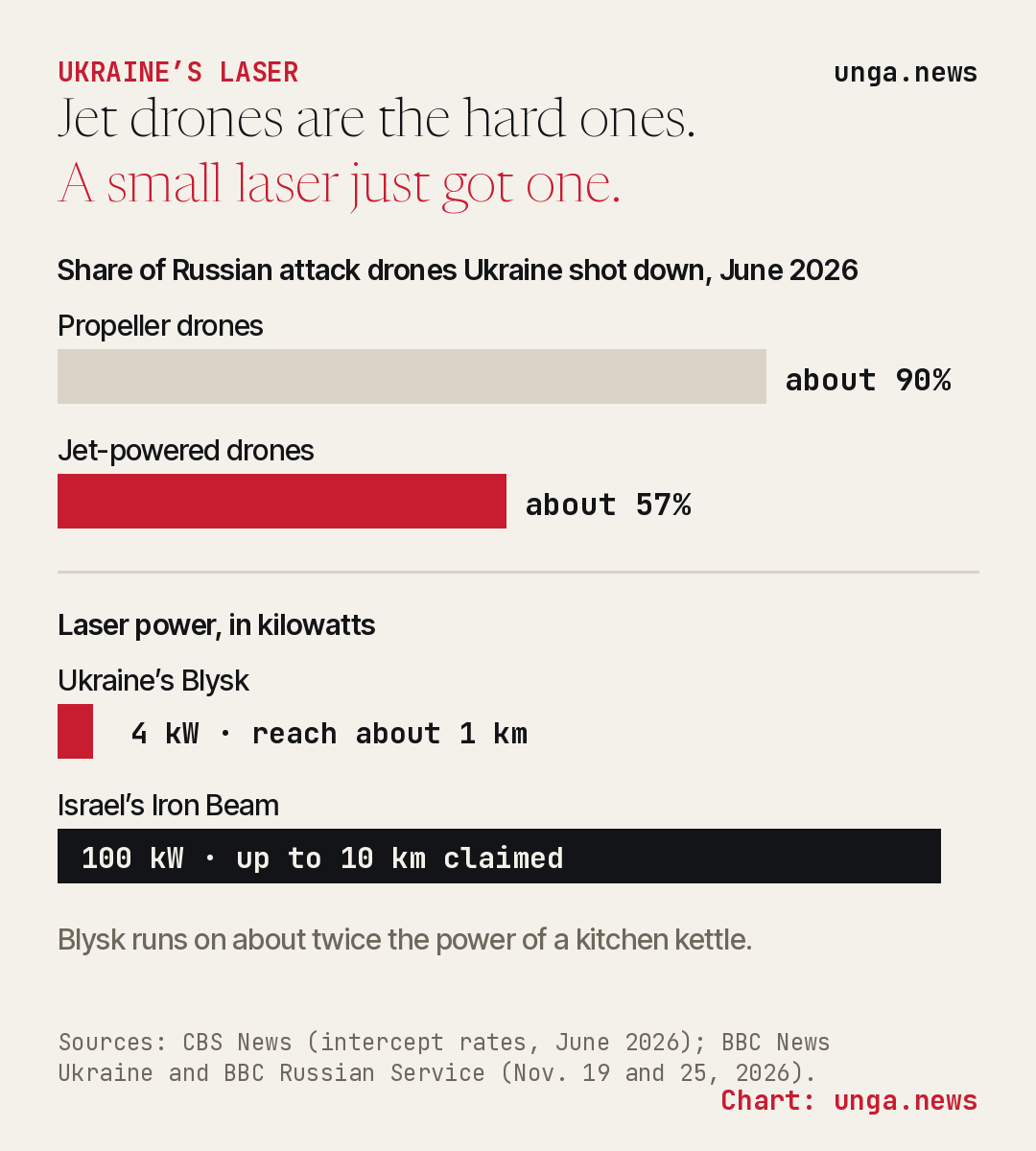
What makes Blysk remarkable is how modest it is. Carmine Sky told BBC News Ukraine the system puts out a 4-kilowatt beam with a useful range of about one kilometer. The BBC’s Russian service pointed out that’s only about twice the power of an ordinary kitchen kettle. Israel’s Iron Beam, the best-known battlefield laser, runs at 100 kilowatts and is said to reach targets up to 10 kilometers away.
Blysk is a small unit on a rotating turret, run by an operator from a distance. According to the company, it burns through a little FPV drone in a fraction of a second. A Shahed takes several seconds, because its body is wrapped in several layers of different materials, rubber among them.
Beskrestnov followed up with a second post to clear up the movie version of how this works. Many people, he wrote, picture a laser punching holes in a drone and slicing its wings apart in midair. In reality, the job is to hold the laser spot on one fixed point so the drone’s insides overheat and fail. More power means more reach and a shorter hold.
That fits what the BBC saw in the footage: the laser grabbed the target at roughly 400 meters up and close to 800 meters away, burned it for several seconds, and the drone started to drop. BBC News Ukraine said the target was likely a Geran-4.
Why the fast drones matter
Russia has leaned harder on jet-powered drones this year because they fly faster and give gun crews and interceptor drones far less time to react than the slower, propeller-driven Shaheds. CBS News reported that in June, Ukraine was stopping only about 57% of the jet-powered drones, compared with roughly 90% of the conventional ones.
The volume is the scary part. Come Back Alive, a Ukrainian military nonprofit, told CBS in September that Russia was likely to build about 1,200 Geran-4s and 800 Geran-5s that month alone, with numbers expected to keep climbing.
When every one of those has to be met with a missile or an interceptor drone, the defender runs out of money before the attacker runs out of drones. A laser flips that math. It fires on electricity. As long as the power stays on and the sky is clear, it doesn’t run out of ammunition.
The weather is the enemy, too
Nobody involved is pretending this is solved. When Blysk went on combat duty in early November, it went days without a hit. Carmine Sky told the BBC that cloud and fog over the Kyiv region kept it from engaging, and the Kyiv Independent noted that bad weather can scatter a beam before it reaches the target. Keeping a steady spot on a fast, twisting drone is hard, too.
Beskrestnov was careful as well. Laser technology is “very complex and expensive,” he wrote, “so it’s nice when someone has good news.” But “it is still too early to talk about serial production of the laser.” Testing goes on, with the lasers guarding critical sites in the meantime.
So this is one kill from one unit, announced by the government’s own adviser, with no date or place given. That’s worth saying plainly. It’s also worth saying that one kill against the hardest target in the sky is exactly how every new weapon starts.
Private companies, public sky
The part of this story I like best is who built it. Carmine Sky got permission to run private air defense in January 2026, and it says it has been protecting Kyiv and several other cities on a volunteer basis, without charging. The BBC reported that private crews now guard dozens of sites across seven regions. According to CBS, about 100 Ukrainian companies have joined the program.
That’s competition doing what bureaucracy can’t. A machine-gun turret alone costs about $150,000, plus another $50,000 for the Browning gun, a Carmine Sky representative told the BBC. Companies with skin in the game have every reason to find something cheaper that works, and a 4-kilowatt laser is about as cheap as air defense gets.
America should be paying close attention. Israel showed in May 2025 that its laser prototypes could knock down Hezbollah drones, AeroTime noted. Now a private Ukrainian outfit has done it against a jet drone with a fraction of the power. Cheap drones are the threat every military, ours included, is racing to answer, and the cheapest answer anyone has found so far just passed its first real test.
Sources
- Serhii “Flash” Beskrestnov on Telegram — Blysk laser air defense from Carmine Sky shows first combat results (Nov. 25, 2026)
- Serhii “Flash” Beskrestnov on Telegram — How a combat laser actually takes down a drone (Nov. 25, 2026)
- BBC News Ukraine — Ukrainian laser weapon shoots down a Russian drone for the first time (Nov. 25, 2026)
- BBC News Russian — Report from the positions of private air defense in Kyiv (Nov. 19, 2026)
- CBS News — Ukraine says it has intercepted a Russian jet-powered drone with a laser for the first time (Nov. 26, 2026)
- Kyiv Independent — Ukraine deploys experimental laser air defense system in Kyiv
- AeroTime — Ukrainian laser downs Russian jet-powered Geran drone (Nov. 26, 2026)
- Militarnyi — Ukrainian Blysk laser system shoots down Geran jet-powered drone for the first time (Nov. 25, 2026)