

Utah Leads 32 States Telling the Supreme Court Apple Can’t Dodge a Judge to Protect Its App Cut
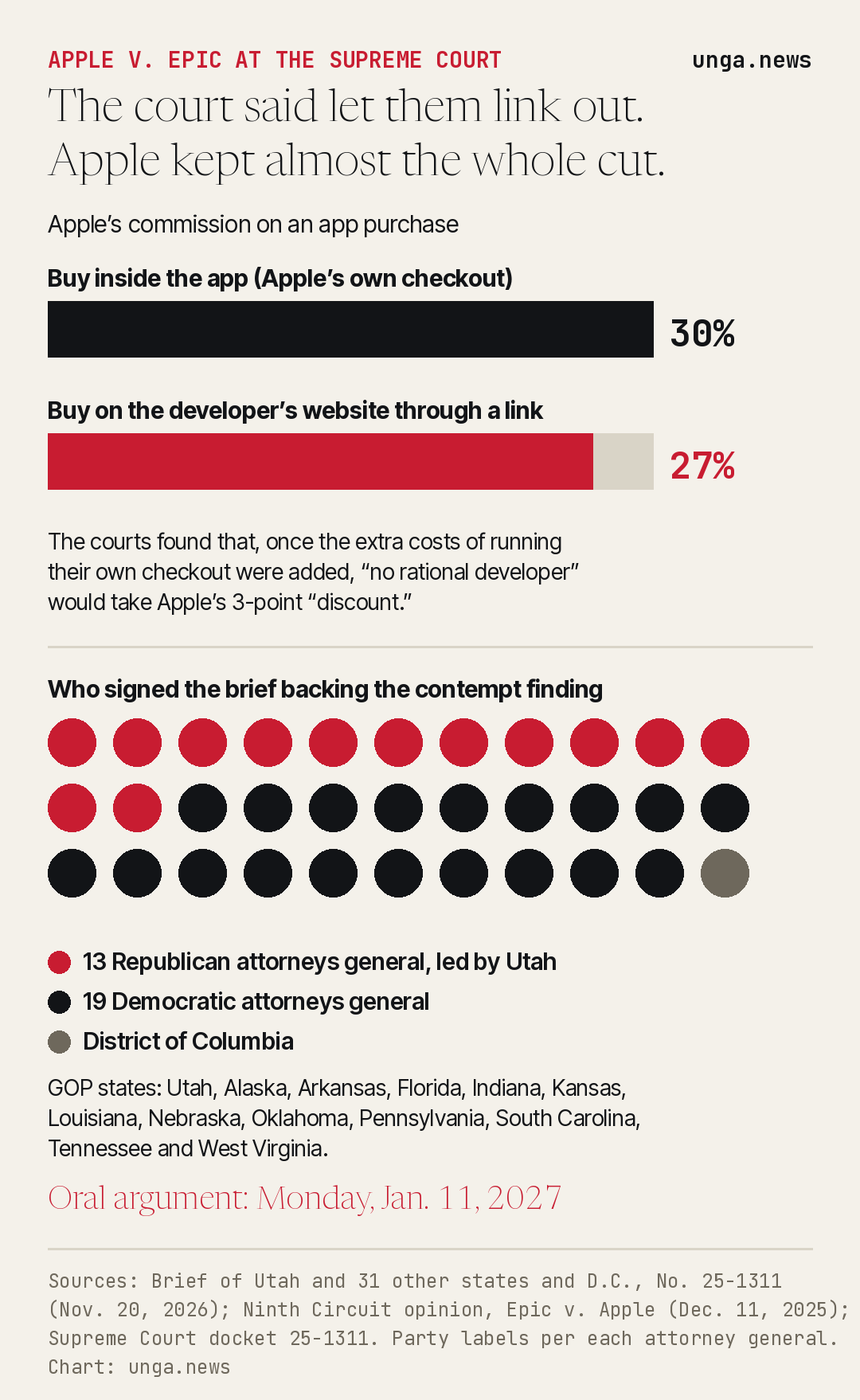
Utah’s Republican attorney general wrote the brief, and 12 other GOP states signed it. Their message: Apple shouldn’t get to keep a 27% toll on cheaper outside payments after a judge ordered it to stop blocking them.
Every time you buy a dating-app subscription, a stack of game coins or a streaming plan on an iPhone, Apple has traditionally taken a cut of up to 30%. A federal judge told Apple years ago that it had to let app makers point you to a cheaper way to pay. Apple said yes, then found a way to keep charging nearly the same toll anyway.
Now Utah is leading a 32-state charge at the Supreme Court to make sure that trick doesn’t pay off.
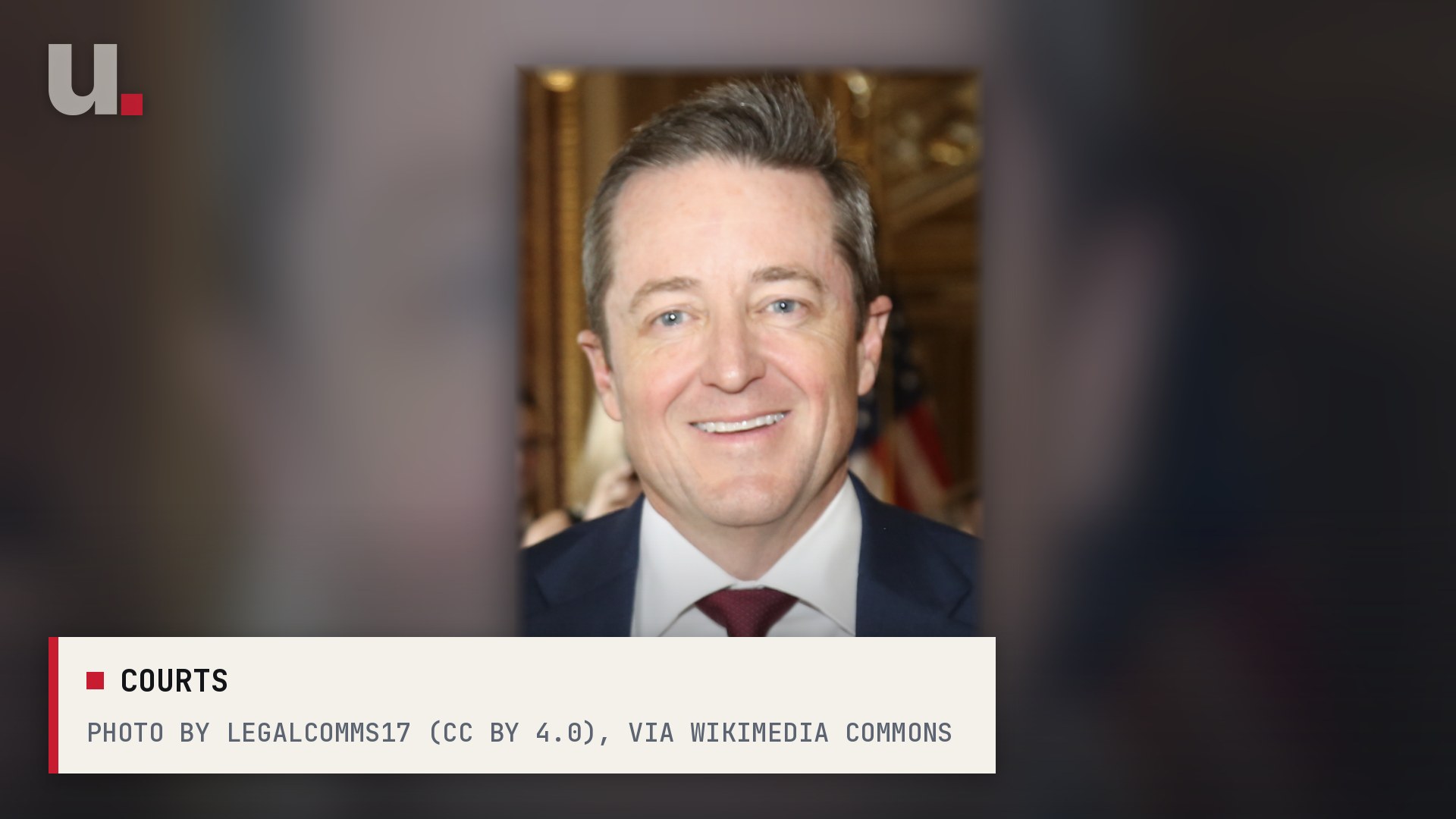
Utah Attorney General Derek Brown, a Republican, filed a friend-of-the-court brief on Nov. 20 backing Epic Games, the maker of Fortnite, in Apple’s appeal of a contempt finding. Thirty-one other states and the District of Columbia signed on, and California’s attorney general publicized the filing Monday. The justices hear the case on Jan. 11.
The coalition’s message is simple and very conservative at heart: a court order means what it says, and a trillion-dollar company doesn’t get to play word games with a federal judge.
A toll by another name
The fight goes back to 2020, when Epic sued Apple. Epic lost most of its case, but a judge found that Apple’s “anti-steering” rules broke California’s unfair competition law. Those rules barred developers from putting a button or link in their apps that sent you to a cheaper checkout on their own website. They couldn’t even email you about it, or tell you that Apple was skimming 30% off the top.
So the court ordered Apple to stop blocking those buttons and links. The order survived appeal and took full effect in early 2024.
According to the states’ brief, here is what Apple did next. It announced developers could now link out, but it would charge a 27% commission on purchases made through those links, even though Apple wasn’t processing the payment. Apple could pitch it as a 3% discount. The courts found it was nothing of the kind, because a developer that runs its own checkout pays card fees and other costs on top. In the brief’s words, Apple’s own documents and testimony showed it knew “no rational developer” would choose the new option.
The fee wasn’t the only roadblock. The brief says Apple allowed only “plain buttons” that blended into the screen, limited developers to five premade link templates, and kept links away from the spots where shoppers expect to see buying options. It then put a warning screen in front of every outside link telling users Apple was “not responsible for the privacy or security of any purchases made on the web.” Internal documents showed that wording was written to be as scary as possible.
“In practical effect at least,” the courts found, those rules “prohibited linked-out purchases.”
Caught, then caught again
Judge Yvonne Gonzalez Rogers held Apple in civil contempt in April 2025. The states point to her findings, which Apple hasn’t challenged on appeal, that the company tried to mislead the court with testimony full of “misdirection and outright lies,” stalled with tens of thousands of baseless privilege claims, and handed over a “sham” report built as a “show piece” that never actually drove its decisions.
In December 2025, a three-judge panel of the Ninth Circuit upheld the contempt finding. The panel held that “charging a 27% commission had a prohibitive effect, in violation of the injunction,” and that Apple’s link-design rules blocked purchases too. It did trim parts of the judge’s remedy, ruling that some restrictions were overbroad and that her outright ban on any commission didn’t work as a contempt sanction in its current form. Apple’s bad faith, though, stood.
The Supreme Court agreed in June to take one narrow question: whether the lower courts used the right test for contempt. Apple argues it can’t be in contempt because nothing it did was actually forbidden by the order’s words. The Justice Department filed a brief supporting neither side, asking the justices to give lower courts clearer examples of how the contempt test works.
Why red states are in this fight
California’s name on the list might make this look like a progressive crusade against business. Look at who’s running it. Utah wrote the brief. Florida’s James Uthmeier, Tennessee’s Jonathan Skrmetti, Kansas’s Kris Kobach, Indiana’s Todd Rokita, Louisiana’s Liz Murrill, Oklahoma’s Gentner Drummond and South Carolina’s Alan Wilson all signed it, along with the Republican attorneys general of Alaska, Arkansas, Nebraska, Pennsylvania and West Virginia.
Their argument is about the rule of law. States are front-line antitrust enforcers, and they say Apple’s reading would gut every court order they win.
“Apple’s approach would allow an enjoined party free rein to accomplish the same anticompetitive ends by implementing marginally different means,” the brief says. “Even a modestly creative violator could effortlessly evade accountability—and keep reaping ill-gotten gains—by slightly tweaking its methods to keep preventing competition.”
It quotes a 1947 Supreme Court case that fits Apple’s strategy almost perfectly: when a company has clearly broken the law to restrain trade, “it is not necessary that all of the untraveled roads to that end be left open and that only the worn one be closed.”
That principle matters well beyond iPhones. Utah has spent years fighting Big Tech over app stores and kids’ online safety. If a company can obey an order in name only, every one of those wins can be quietly undone by a few lawyers and a new fee schedule.
Your subscriptions pay the toll
Apple says its rules keep iPhone users safe from scams, and plenty of customers value that. Nobody here is asking Apple to stop protecting people. The question is whether Apple can charge app makers nearly the same toll on sales it doesn’t even process, and dress up roadblocks as safety warnings, after a judge told it to stop.
Those fees get baked into the price of your subscriptions, your kids’ game purchases and the apps you use every day. When an app can openly send you to its website and charge less, you keep the difference.
The states also have a backup ask. If the justices decide to tweak the legal test, the brief says, they should send the case back to the lower courts to apply it, rather than wiping out the contempt finding themselves. As the states see it, Apple “does not challenge the district court’s findings or deny that it intended to” nullify the order.
Apple will get its day in court on Jan. 11. It will be standing across from a Fortnite company, the Golden State and a long list of red-state conservatives who don’t usually agree with California on much of anything. On this one, they agree that a court order isn’t a suggestion.
Sources
- Supreme Court of the United States — Brief for Amici Curiae State of Utah and 31 Other States and the District of Columbia in Support of Respondent, Apple Inc. v. Epic Games, Inc., No. 25-1311 (Nov. 20, 2026)
- Supreme Court of the United States — Docket No. 25-1311, Apple Inc. v. Epic Games, Inc.
- U.S. Court of Appeals for the Ninth Circuit — Epic Games, Inc. v. Apple Inc., No. 25-2935, opinion (Dec. 11, 2025)
- California Attorney General — Attorney General Bonta Files Amicus Brief in Epic v. Apple, Asks U.S. Supreme Court to Affirm That Apple Cannot Sidestep Court Order (Nov. 23, 2026)
- Supreme Court of the United States — Brief for Respondent Epic Games, Inc. (corrected, Nov. 19, 2026)