

Venezuela’s Oil Money Used to Disappear. The U.S. Just Showed Where All $12 Billion Went.
A State Department report, checked by an outside auditor, says about 99 percent of the cash from Venezuelan oil sales since Maduro’s capture went back to Venezuela, through buyers vetted for terror and money-laundering ties.
For decades, Venezuela’s oil money had a way of vanishing. It went to the ruling party, to the generals, to friends of the regime and to bank accounts nobody in Caracas would ever see. Ordinary Venezuelans got shortages, blackouts and a currency that lost value faster than you could spend it.
On Thursday, the State Department showed what happened to that money once America took charge of it. The answer, dollar for dollar, is that almost all of it went back to Venezuela.
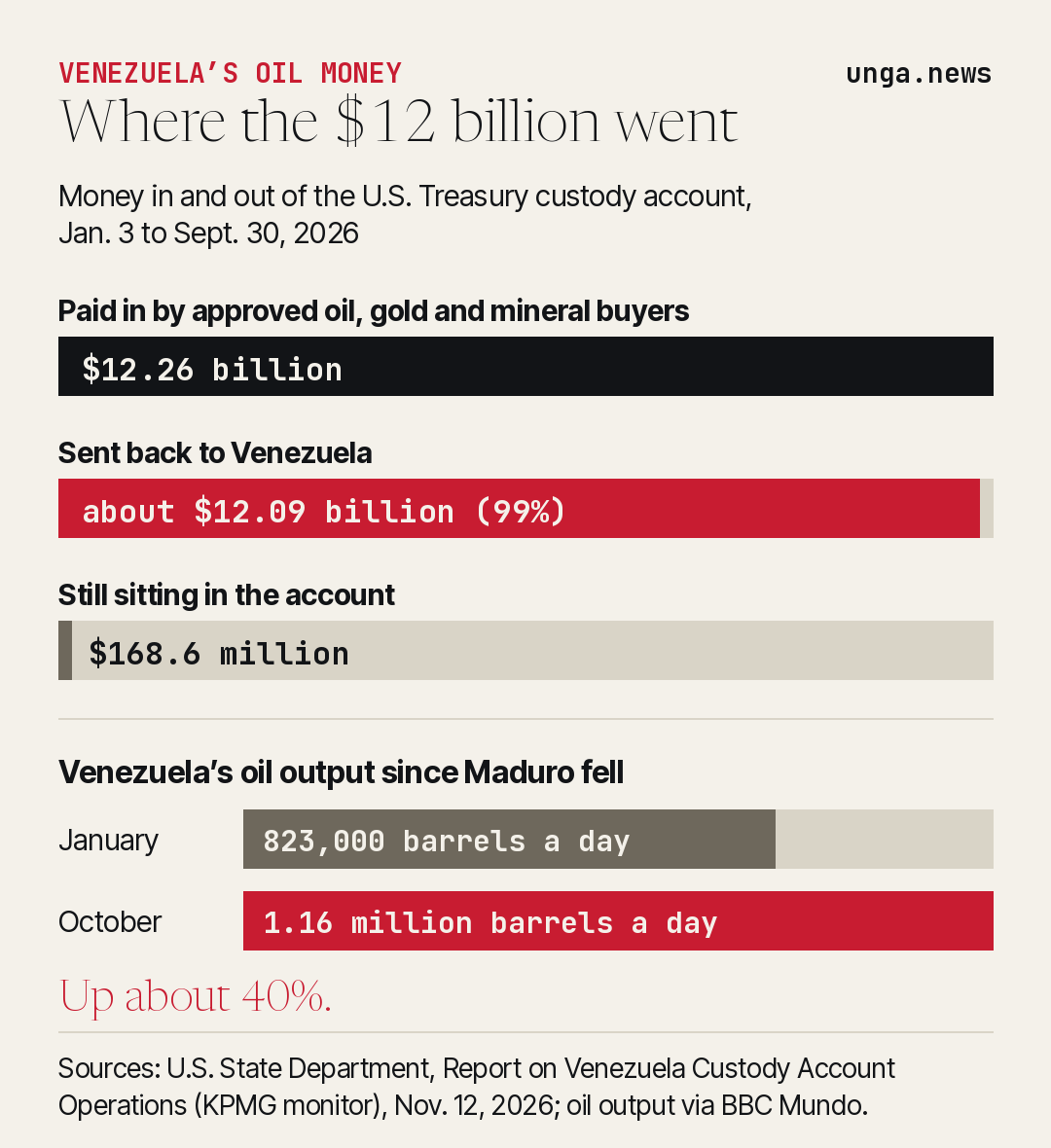
A 53-page report from State, built with the accounting firm KPMG acting as an outside monitor, covers every dollar that flowed through the U.S. Treasury’s Venezuela Custody Account from Jan. 3, the day American forces captured Nicolás Maduro, through Sept. 30. Buyers of Venezuelan crude, along with smaller amounts of gold, minerals and fertilizer, paid in $12.26 billion. By the end of September, all but $168.6 million had been sent back to the country. That’s about 99 percent.
How the money moved
The setup came out of an executive order President Trump signed in January with a title that says exactly what it’s for: “Safeguarding Venezuelan Oil Revenue for the Good of the American and Venezuelan People.” Instead of oil cash landing in the hands of whoever controlled the state oil company, it now lands in an account Washington controls. Venezuelan officials ask for it back for specific needs, and the U.S. signs off.
It started fast. Right after Maduro fell, the first payments went into an account at Qatar National Bank. About $500 million came in, and nearly all of it went back to Venezuelan entities by late January, Al Jazeera reported. Then the operation moved to a dedicated Treasury-controlled account, which took in the rest from roughly 20 approved buyers. About 99 percent of what they paid was for oil.
Most of the money went back through Venezuela’s commercial banks, which sold the dollars to businesses and families. That matters more than it sounds. A country with a broken currency needs dollars in circulation to keep the bolivar from collapsing completely, and those sales put hard currency where people could actually use it. By the report’s breakdown, roughly $9.4 billion went to businesses and about $2.9 billion to individuals.
A much smaller slice, about $133 million, went straight to paying for things the Venezuelan government needed. The Associated Press went through those line items: nearly $24 million for dialysis and coal-mining equipment, $8.7 million to settle Venezuela’s vaccine debts with the Pan American Health Organization, and $5 million to the Miami law firm Greenberg Traurig.
Every buyer gets checked
The bigger change is who gets to buy. Every company had to clear U.S. vetting for sanctions compliance and money laundering before a dime moved, and AP called that “a sharp break from past practice when Venezuela’s government faced little scrutiny in the management of its oil funds.”
According to BBC Mundo’s reading of the report, each authorized deal goes through several layers of control: screens for ties to foreign terrorist organizations, anti-money-laundering reviews and identity checks on the customers. The report also states plainly that the money belongs to Venezuela. These are the country’s sovereign assets, it says, held and managed only for the benefit of the Venezuelan people.
Compare that with what came before. The day after Maduro’s capture, Secretary of State Marco Rubio said Venezuela’s oil wealth had been stolen, that it ended up with oligarchs in Venezuela and around the world, and that a small circle benefited while the people got nothing. Now there’s a monitor, a ledger and a published report.
The names of the 20 buyers are blacked out, and the report doesn’t trace each dollar down to the final business or family that received it. Some critics will seize on that. But this is a first public accounting covering nine months of money that under Maduro never got any accounting at all.
Democrats asked. They got an answer
Back in September, Democratic Sens. Ron Wyden, Elizabeth Warren and Sheldon Whitehouse wrote to Rubio and Treasury Secretary Scott Bessent demanding to know where the oil money had gone and what was stopping anyone from steering it to political favorites. Thursday’s report is the answer, and it says the money went back to Venezuela, through vetted buyers, under an outside monitor.
Venezuela’s side tells a matching story. On the same day the report came out, Delcy Rodríguez, who has led the country as acting president since Maduro’s capture, said 99 percent of the oil and mining revenue it received from January through November, about $15.6 billion by her government’s count, went to paying public workers’ salaries and pensions. Her figure covers more months than State’s report, so the two numbers don’t line up exactly, but they point the same way: the money is reaching the payroll, not a dictator’s cronies.
The oil is flowing again
The cash is only half of it. Venezuela was pumping about 823,000 barrels a day at the start of the year. By October that was 1.16 million, a jump of roughly 40 percent, BBC Mundo reported.
The big oil companies are noticing. This week ExxonMobil signed a preliminary agreement with the Venezuelan government and the state oil company to look at new projects, almost a year after its CEO, Darren Woods, called the country a place that wasn’t viable to invest in, citing a lack of legal and commercial protections. Italy’s Eni, Spain’s Repsol and Britain’s Shell have also announced plans to invest. Investors don’t come back to places where the money disappears.
None of that means Venezuela is fixed. Experts warn that keeping production climbing will take huge investment in fields and pipelines left to rot for years. The International Monetary Fund still projects average inflation of nearly 468 percent there in 2026, the worst in the world, and plenty of Venezuelans say they haven’t felt the oil boom at the grocery store yet.
Still, this is the first time in a generation that anyone can look up how much Venezuela earned from its oil and where that money went. Maduro is in New York facing narco-terrorism charges. The oil money that used to vanish under him now comes with a receipt, and the receipt says it went home.
Sources
- U.S. Department of State — Report on Venezuela Custody Account Operations (Nov. 12, 2026)
- Associated Press (via BusinessLine) — US returns over $12 billion in oil proceeds to Venezuela since Maduro's ouster, report says
- BBC News Mundo — EE.UU. afirma que transfirió a Venezuela más de US$12.000 millones por sus exportaciones petroleras y de otros recursos
- Al Jazeera — US releases report on $12bn from Venezuelan oil, mineral resources (Nov. 12, 2026)
- The Washington Post — U.S. managed $12 billion in Venezuelan oil revenue, State Department says (Nov. 12, 2026)