

Verizon, AT&T and T-Mobile Wouldn’t Let Musk In. Now SpaceX Is Reportedly Eyeing Boost Mobile
SpaceX already has the airwaves, FCC approval for 15,000 phone satellites and 22 million users worldwide. The carriers say it’s no big threat. Musk says they “don’t see” the new pieces on the board.
Verizon, AT&T and T-Mobile have all said no to letting SpaceX run a phone service on their networks. Now Elon Musk’s company is reportedly looking at another way in.
SpaceX has held talks with EchoStar about buying its Boost Mobile wireless service or getting access to its network, The Washington Post reported Monday, citing people familiar with the negotiations. According to the Post, Musk first asked the heads of the country’s top telecom companies to open their networks to SpaceX, then discussed a deal personally with EchoStar chairman Charlie Ergen last month. No deal has been announced, and SpaceX and EchoStar did not immediately respond to Reuters’ requests for comment.
Boost doesn’t own its own cell towers. It rents capacity from AT&T and T-Mobile, and the Post reported those leases may not transfer to a new owner without the two carriers’ approval. EchoStar had about 7.4 million wireless subscribers at midyear, mostly Boost and Gen Mobile customers, Reuters reported. EchoStar’s shares rose in premarket trading Monday while T-Mobile’s slipped about 2%.
It wouldn’t be a first date. When SpaceX bought EchoStar’s AWS-4 and H-block airwaves for about $17 billion in September 2025, the two companies also signed a long-term commercial agreement giving Boost subscribers access to SpaceX’s next-generation Starlink Direct to Cell service, according to EchoStar’s announcement.
What SpaceX already has
Airwaves. The EchoStar deal gave SpaceX exclusive 2 GHz spectrum built for reaching phones from space. On Oct. 8, SpaceX added a nationwide block of up to 14 megahertz of paired 800 MHz low-band spectrum from Grain Management, the kind of signal that gets through walls and into buildings. SpaceX says most phones already support the band. The deal needs FCC approval and is expected to close in the first half of 2027, the company told investors in its third-quarter results. The Wall Street Journal reported the price at about $8 billion in cash.
Musk called it “the last critical piece of the spectrum puzzle needed for SpaceX to provide complete phone coverage in America.” A few minutes later he added: “Very big deal.”
Elon Musk on X, Oct. 8, 2026: This is the last critical piece of the spectrum puzzle needed for SpaceX to provide complete phone coverage in America
— @elonmusk View on 𝕏
Satellites. The same week, the FCC approved SpaceX’s application to launch 15,000 next-generation Starlink Mobile satellites, which SpaceX says will deliver more than 100 times the bandwidth of the current generation to ordinary, unmodified phones. “Once we receive final FCC approval, Starlink Mobile will deploy a flexible architecture combining our satellite-to-mobile constellation in space with an advanced terrestrial deployment that can seamlessly connect devices everywhere,” SpaceX wrote.
Users. Starlink Mobile already reaches phones today through partner carriers around the world. SpaceX President Gwynne Shotwell told investors on Oct. 20 that it passed 22 million monthly users at the end of September, up 37% in one quarter. Six days later, Starlink announced a nationwide launch in Brazil with Vivo, covering 50 million customers.
‘Several hundred billion dollars’
On the earnings call, Musk said SpaceX will be building out a ground network alongside the satellites, with “broad-based connectivity anywhere that SpaceX and Starlink are allowed to operate.” Shotwell said SpaceX could put smaller radios on homes and businesses that already have Starlink, and on towers.
When an analyst pressed on how SpaceX can compete with the incumbents, Musk said the full answer needs its own presentation.
“I can say we do see a clear path to several hundred billion dollars a year in connectivity revenue,” he said. For scale, SpaceX’s connectivity business brought in $5.2 billion last quarter, up 69% from a year earlier.
Later that afternoon he put it more bluntly on X: “Veterans of the cellular industry look at the chess board of existing pieces and don’t see a solution. They don’t understand that SpaceX is developing entirely new pieces that fundamentally alter the strategic landscape.”
Towers on the ground
Two days after the call, Bloomberg reported that SpaceX is in talks to secure at least 80,000 U.S. cell sites, citing people familiar with the matter, with tower owner Crown Castle among the companies involved. Asked about satellite customers on his own earnings call, Crown Castle CEO Chris Hillabrant wouldn’t name names: “you can assume that we’re talking to all parties.”
Shares of AT&T, Verizon and T-Mobile fell between 4.2% and 5% in after-hours trading on the Bloomberg report, Reuters reported.
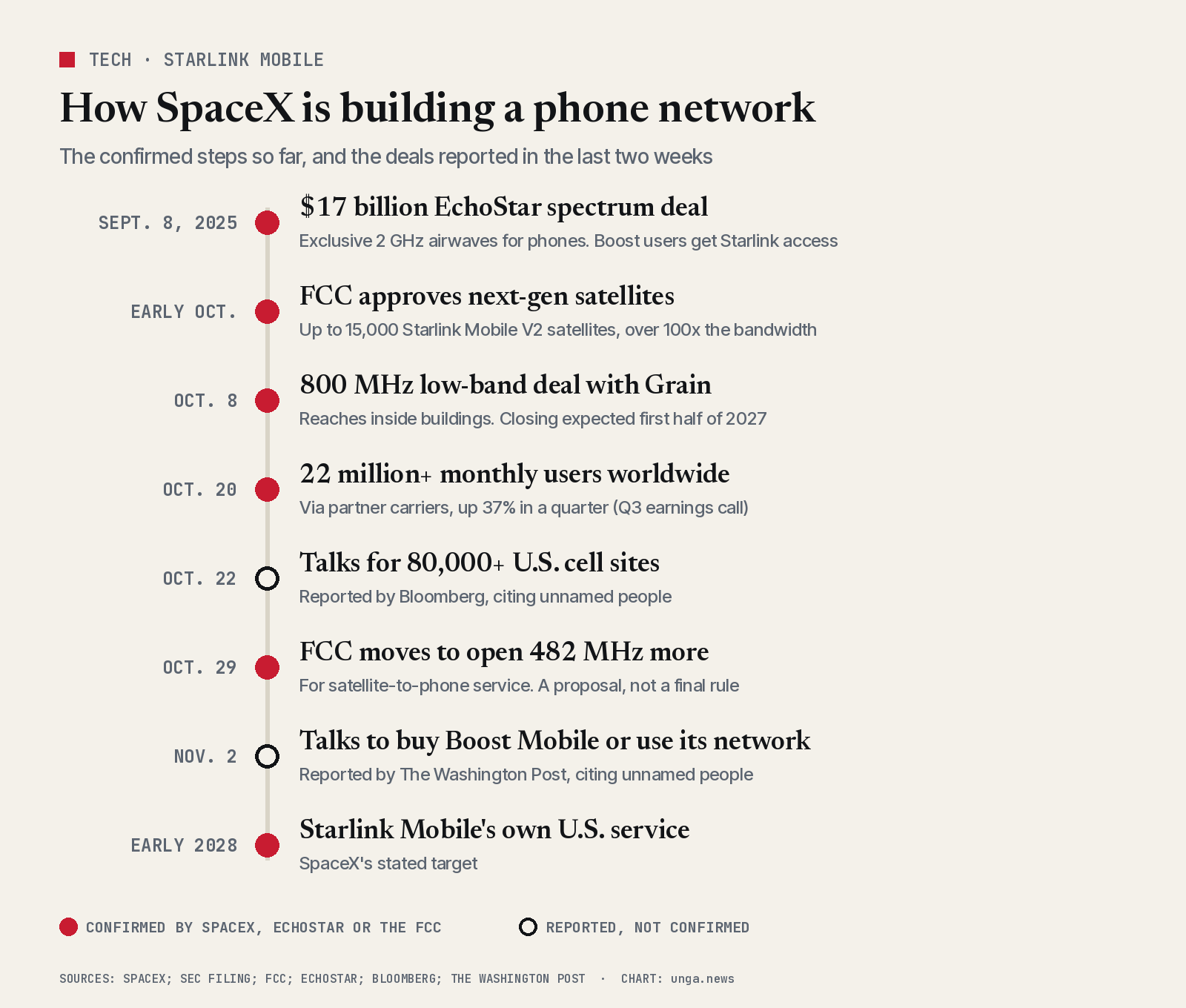
SpaceX’s stated timeline: launch the next-generation mobile satellites through 2027, fold in the new spectrum and turn on its own U.S. service in early 2028.
The carriers say don’t worry
The incumbents insist they aren’t worried. Verizon CEO Dan Schulman told analysts last week that it would take SpaceX at least four to six years and a minimum of $300 billion to possibly become a viable competitor. “There’s no magic wand,” he said, adding that “there are no back doors to any of our MVNO agreements.” T-Mobile CEO Srini Gopalan said “we don’t really see the room for an MVNO for satellite or SpaceX.” AT&T CEO John Stankey has said Starlink Mobile might work in rural areas but would struggle where fiber and wireless coverage already exist.
Investors keep reacting differently. The carriers’ stocks dropped on the spectrum deal, dropped again on the tower report and dipped again Monday on the Boost report.
Washington is clearing the way
On Oct. 29, the FCC voted 3-0 to propose opening another 482 megahertz of licensed spectrum to satellite-to-phone service, raising the number of eligible bands from five to 13 and eliminating what the agency called “burdensome” requirements. It is a proposal, not a final rule, and it goes out for public comment first.
What to watch
The FCC still has to sign off on the 800 MHz purchase. The next-generation satellites start flying in 2027. Musk has promised a longer presentation on the connectivity plan. And if the Boost talks turn into a deal, AT&T and T-Mobile will have to decide whether to let their leases go with it.
The carriers say there’s no shortcut. Musk says they’re missing the new pieces.
Sources
- Elon Musk on 𝕏 — “This is the last critical piece of the spectrum puzzle needed for SpaceX to provide complete phone coverage in America” (Oct. 8, 2026)
- Elon Musk on 𝕏 — “Veterans of the cellular industry look at the chess board of existing pieces and don’t see a solution” (Oct. 20, 2026)
- SpaceX on 𝕏 — Agreement to acquire nationwide low-band spectrum to “pave the way for @Starlink to become a major mobile carrier in the US” (Oct. 8, 2026)
- SpaceX — Building the world’s most advanced mobile network (Oct. 8, 2026)
- SpaceX (SEC filing) — SpaceX Reports Third Quarter 2026 Results
- SpaceX on 𝕏 — Q3 2026 Financial and Operational Results (earnings webcast, Oct. 20, 2026)
- Starlink on 𝕏 — “Starlink Mobile is now live in Brazil with @vivobr” (Oct. 26, 2026)
- EchoStar — EchoStar Announces Spectrum Sale and Commercial Agreement with SpaceX (Sept. 8, 2025)
- Federal Communications Commission — October 2026 Open Commission Meeting: Modernizing the Supplemental Coverage from Space Rules (Oct. 29, 2026)
- The Washington Post — Inside Musk’s plan to upend the wireless phone industry (Nov. 2, 2026)
- Bloomberg — SpaceX in Talks to Access 80,000 Cell Sites for New Network (Oct. 22, 2026)