

Virginia Requires Three Doctors to Sign Off on a Third-Trimester Abortion. Its New Amendment Needs One, and ‘Mental Health’ Counts
Question 1 passed with 62%. State law today needs three doctors and a hospital for an abortion after the second trimester. The amendment bars any ban when “a physician” says it protects the mother’s “mental health,” and Senate Democrats voted down born-alive protections to get it on the ballot.

Virginia voters put a right to abortion into their state constitution Tuesday, and almost every headline called it “reproductive freedom.” Read the text. In the state’s unofficial count Thursday morning, Question 1 passed with 2,194,741 votes to 1,318,179, or 62.48%. All 133 localities have reported. It takes effect Jan. 1, 2027.
The new Section 11-A of the Bill of Rights says the state “may regulate the provision of abortion care in the third trimester.” Then comes the catch: “in no circumstance shall the Commonwealth prohibit an abortion (i) that in the professional judgment of a physician is medically indicated to protect the life or physical or mental health of the pregnant individual or (ii) when in the professional judgment of a physician the fetus is not viable.”
Three doctors, then one
Here’s what Virginia law says right now. Under Va. Code § 18.2-74, an abortion after the second trimester is legal only in a state-licensed hospital, and only if “the physician and two consulting physicians” certify in the woman’s hospital record that continuing the pregnancy “is likely to result in the death of the woman or substantially and irremediably impair the mental or physical health of the woman.” The law also says life support “must be available and utilized if there is any clearly visible evidence of viability.”
The amendment asks for one doctor, not three. It doesn’t say “likely to result in the death” or “substantially and irremediably.” It says “medically indicated to protect” health, and it names mental health outright. It says nothing about a hospital.
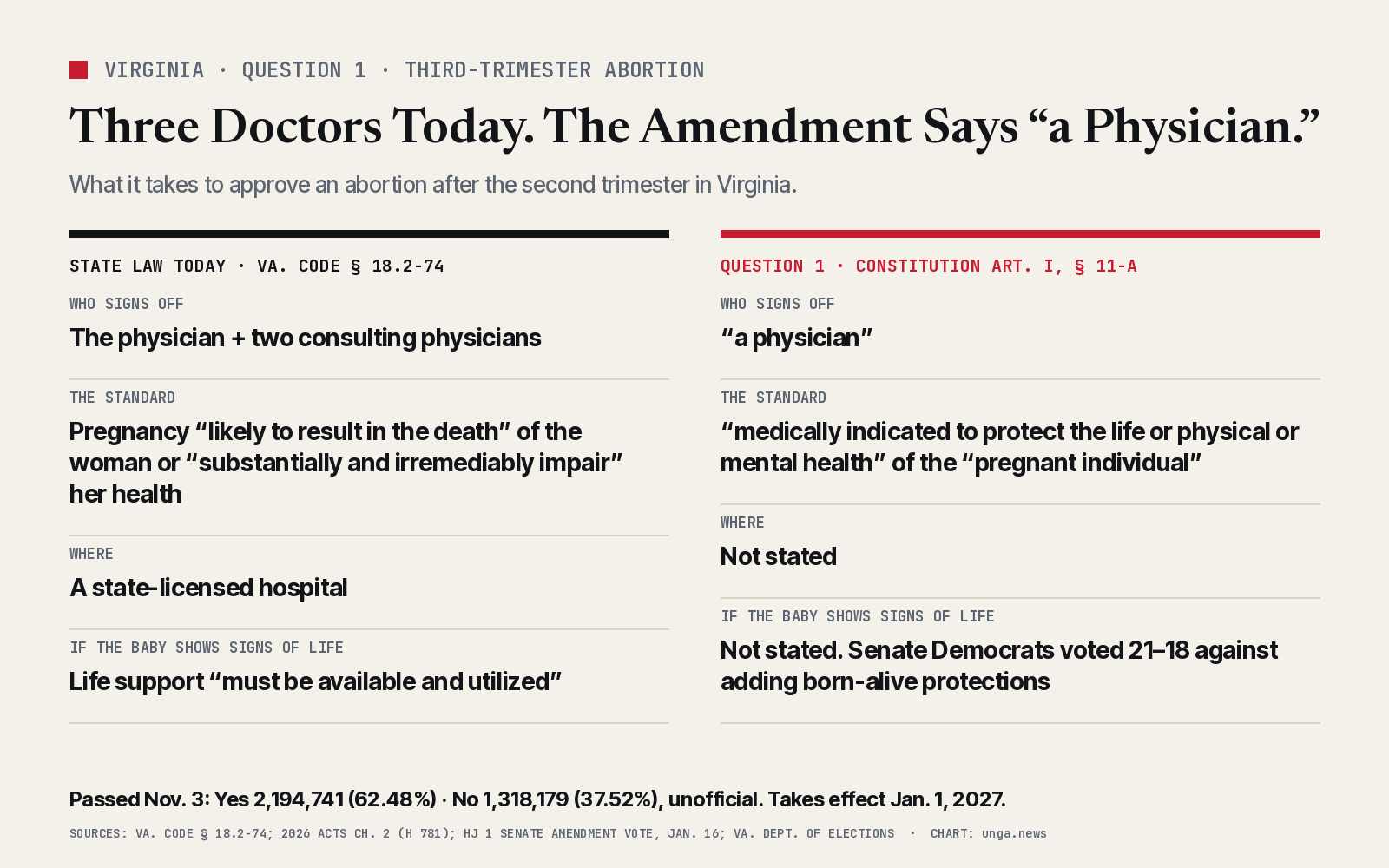
Lawmakers can still write third-trimester rules, but from now on every one of them has to get past the constitution. Under the amendment, any law that “directly or indirectly” burdens the right has to be justified by a “compelling state interest achieved by the least restrictive means.” And the amendment defines the only interest that counts as compelling: “maintaining or improving the health of an individual seeking care.” The unborn child isn’t on that list. The text mentions a fetus only once, to say when abortion can’t be banned at all.
It also says the state can’t “penalize, prosecute, or otherwise take adverse action” against anyone who helps another person get an abortion with her consent. And it’s “self-executing,” so it doesn’t wait for the General Assembly to act.
The vote Democrats took in January
The amendment had to pass the General Assembly twice. On the second pass, on Jan. 16, Republican Sen. Emily Jordan offered one more paragraph. It said that when “an abortion procedure results in the live birth of an infant, such infant shall be considered a legal person” and “shall be provided the same level of care and treatment as any infant or person seeking care and treatment in a medical facility.”
The Senate rejected it 21–18. All 18 votes for it were Republican, and all 21 votes against it were Democratic, according to the LegiScan roll call. The House had already approved the amendment 64–34 two days earlier. It went to the ballot with no born-alive language in it.
What voters actually read
The words “fundamental right” and “mental health” never appeared on the ballot. Here’s what Virginians were asked: “Should the Constitution of Virginia be amended to (i) protect the freedom to make personal decisions about prenatal care, childbirth, postpartum care, birth control, abortion, miscarriage management, and fertility care; (ii) protect doctors, nurses, and patients from being punished for these decisions; and (iii) allow for restrictions on access to abortion during the third trimester of pregnancy except when the patient’s health is at risk or the pregnancy cannot survive?”
That gap is part of a lawsuit. The Founding Freedoms Law Center sued in the spring, and a Tazewell County court will hear the case next Friday, WTOP reported. The group’s executive director, Josh Hetzler, said one problem is procedural: the copies of the amendment were never posted on courthouse doors before the election. That requirement was repealed after the amendments had already started through the process. The other problem is the ballot itself. “When you read the amendment, it says it establishes a fundamental right to reproductive freedom. That’s a very broad right, and that has important legal meaning,” Hetzler told WTOP. “Those words are never on the ballot.”
“We believe that if you’re going to amend the constitution, you must first follow the constitution, and we believe that did not occur,” he said. The group is also challenging the amendment that removes Virginia’s same-sex marriage ban, on the same procedural grounds.
Gov. Abigail Spanberger said Wednesday she’s confident all three amendments on this fall’s ballot “will be sustained.” Virginia courts threw out a redistricting amendment this spring over its timeline.
What to watch: The Tazewell County hearing next Friday, the state’s official certification of Question 1, and whether § 18.2-74’s three-doctor rule can survive the new amendment when it takes effect Jan. 1.
Sources
- Virginia Department of Elections — 2026 November General, unofficial results: Proposed Constitutional Amendment Question 1
- Virginia General Assembly — 2026 Acts of Assembly, Chapter 2 (H 781): amendment text, ballot question and Jan. 1, 2027 effective date
- Virginia General Assembly — HJ 1 (2026): Constitutional amendment (second reference); fundamental right to reproductive freedom
- Virginia Senate — HJ 1, Sen. Jordan floor amendment (born-alive infants), rejected Jan. 16, 2026
- LegiScan — Virginia HJR 1 roll call: Senator Jordan amendment rejected (18-Y 21-N)
- Code of Virginia — § 18.2-74. When abortion lawful after second trimester of pregnancy
- Virginia Department of Elections — Explanation for voters: Question 1
- WTOP — Virginians approve reproductive freedom amendment. It will be challenged in court next week. (Hetzler, Spanberger)