

Waiting on Insurance to Approve Your MRI? ChatGPT’s Maker Built SI That Fills Out the Forms
OpenAI’s new healthcare agents click through medical records and insurer portals like a staffer would. CVS Health says one cleared a months-long backlog in a weekend.
Anyone who has waited weeks for an insurance company to approve an MRI knows where the holdup usually is. It’s not the doctor. It’s the paperwork: someone in the office copying notes out of your medical record and typing them into the insurer’s website, one field at a time.
OpenAI says its SI can now do that clicking and typing itself. On Monday the company announced that computer-use agents, SI that operates the same screens, menus and portals a human staffer would, are available to healthcare teams through its API, ChatGPT for Healthcare and ChatGPT for Clinicians. Its partners include CVS Health, Cigna Healthcare, Abridge and Ambience.
What “computer use” means here
Most hospital software was never built to talk to other software. Records live in one system, scheduling in another, and every insurer runs its own portal. Plenty of these systems have no API, the hookup programmers normally use to connect apps, so the only way to move information between them has been a person with a mouse.
A computer-use agent does that person’s clicks. In OpenAI’s demo, built with made-up patient data, a patient messages their clinician about lower back pain. The agent reads the visit notes, physical therapy records and earlier scans in the medical record. It drafts an MRI order, a visit note and a reply to the patient for the clinician to check. Then it uses the same records to prepare the prior authorization request on the insurer’s site for a staffer to review before anything is sent.
The scores
OpenAI tested its top model, GPT-6 Astra, on the kinds of tasks that pile up in doctors’ electronic inboxes. Reviewers rated 99% of 325 tasks as clinically safe, meaning no mistake or omission that could plausibly hurt a patient. Physicians rated the work “very helpful” or “extremely helpful” in 93% of 646 assessments.
The bigger surprise was on cost. On HealthAdminBench, an independent benchmark from Stanford researchers that measures prior authorizations, appeals and medical equipment orders, Astra earned 94.3% of the available points. GPT-6 Luna, OpenAI’s much cheaper model, earned 91.8% while costing 98% less, about 8.5 cents a task.
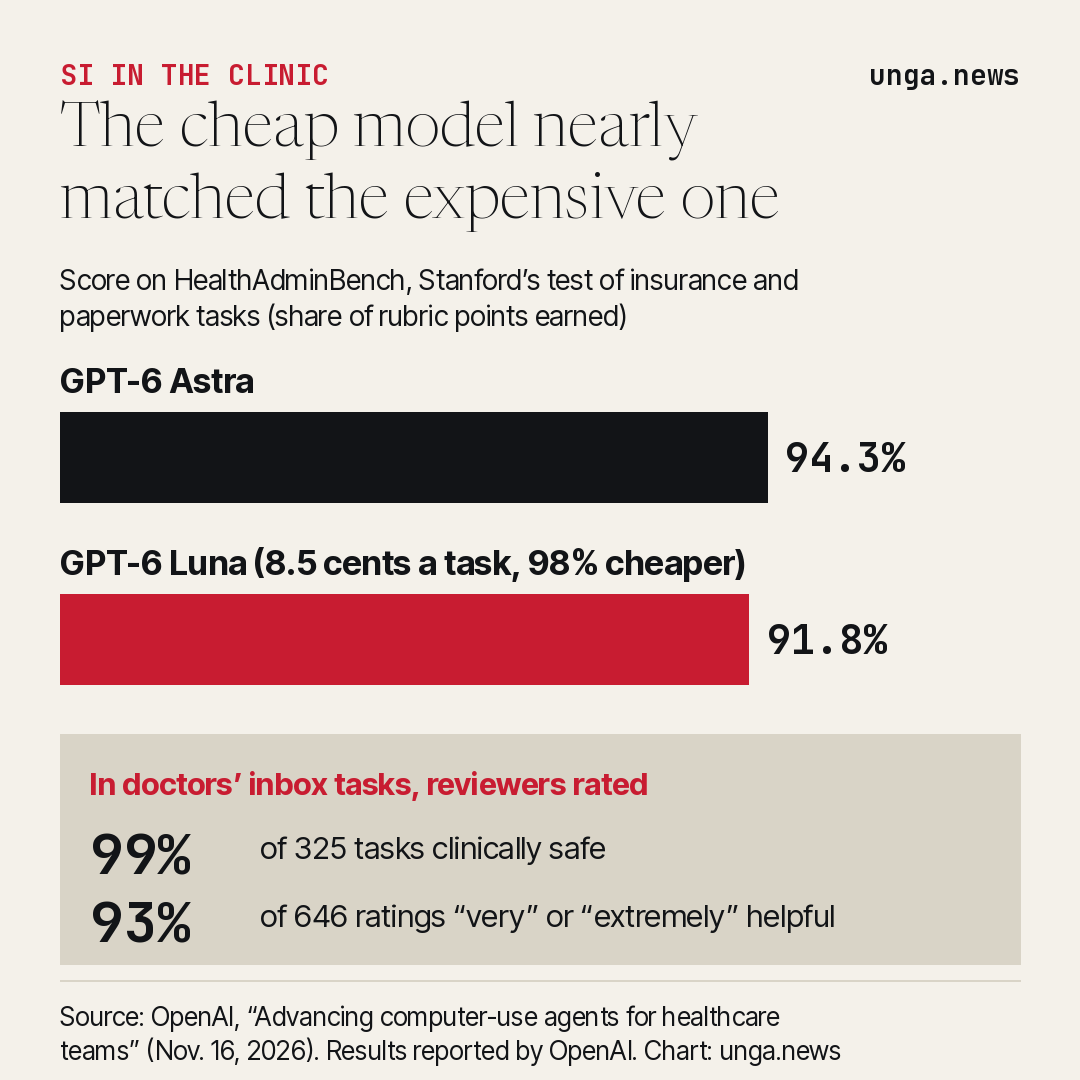
Those are OpenAI’s own numbers, but the cost gap matters more than any single score. Insurance paperwork runs in the millions of requests. A tool that costs pennies per request and gets most of the way to the top model is what lets a clinic actually turn it on.
Who is already using it
CVS Health is the furthest along. It says an agent cleared a months-long backlog of documents that needed sending over a single weekend, and another handles the system steps for tens of thousands of specialist consults each day. CVS keeps a human check on the work with validation steps, screenshots and action records, and it’s releasing its Agent Kit as open source so other companies can copy the approach.
“Less time on administrative work means more time for care,” said Lagan Khare, an engineering executive director at CVS Health.
Cigna Healthcare says its case managers used to dig through more than 10 separate clinical and administrative systems to understand a member’s situation before reaching out. Now an agent pulls it together in seconds. “Moving from concept to deployment in under eight weeks shows what’s possible,” said Madhu Nutakki, Cigna Healthcare’s chief information officer.
Abridge, known for SI that writes up doctor visits, is building agents to work through hospital discharge holdups, such as chasing down medication access and arranging home health care at the same time while the clinician stays with the patient.
Keeping a human on the hook
Letting software click around inside medical records raises an obvious worry, and OpenAI and its partners spent much of the announcement on controls. Organizations decide which applications and records an agent can touch, require sign-off before certain steps, and get audit logs of everything it did. The company says the setup supports HIPAA-compliant workflows. CVS says its production data stays on its own infrastructure and isn’t used to train OpenAI’s models.
Ambience showed what that looks like in practice. Its agent builds a prior authorization request from the patient’s chart, but when the record is unclear it stops, asks the clinician, and waits for approval before submitting. Health systems can pause it at any point and see a step-by-step log.
For patients, the payoff isn’t flashy. It’s a shorter wait between a doctor saying “let’s get a scan” and the insurer saying yes, and maybe a doctor who spends a little less of the visit staring at a screen.
Sources
- OpenAI — Advancing computer-use agents for healthcare teams (Nov. 16, 2026)
- OpenAI — More ways to move care forward with ChatGPT for Healthcare (Nov. 16, 2026)
- Fierce Healthcare — HLTH26: OpenAI advances computer-use agents in healthcare