

Walz’s Paid Leave Law Had 4 in 10 Minneapolis 911 Workers Off the Job. New Hires Can Take It and Quit
A city official told the Minneapolis City Council that 41% of 911 call center staff were out on Minnesota’s new paid leave program, forcing overtime and a $1.5 million budget bump, and that new hires can take the leave on day one and then walk away.

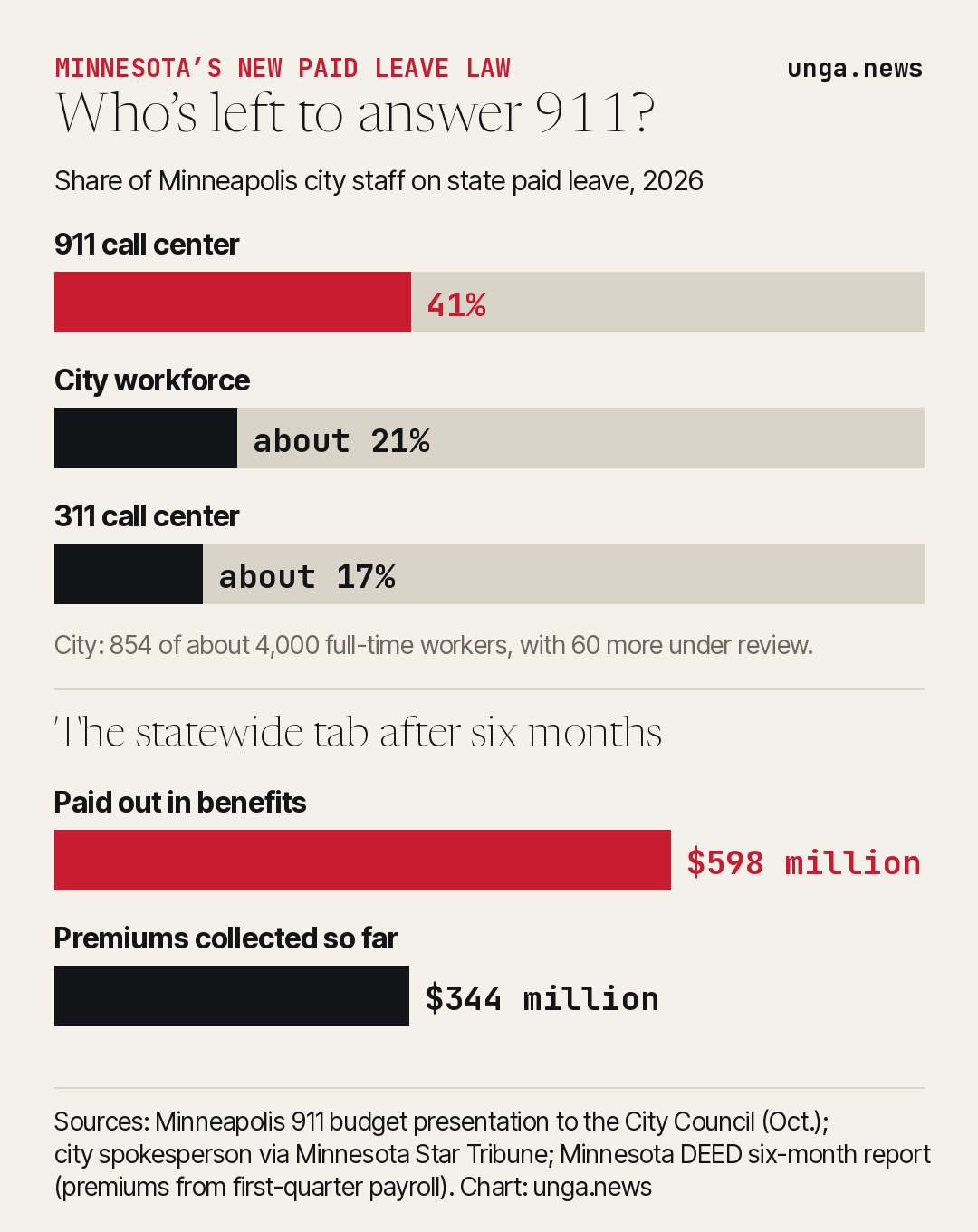
Call 911 in Minneapolis this fall and the person who picks up was probably working overtime. That is because, by the city’s own account, 41% of the staff at its emergency call center were out on Minnesota’s brand-new paid leave program.
Leticia Cardenas, assistant director of the Minneapolis Emergency Communications Center, gave that number to the City Council’s budget committee in October. It sat mostly unnoticed until this week, when Alpha News posted the clip and the Minnesota Star Tribune reported that nearly one in four city employees have now used the program. Then it caught fire, and for good reason. It is the clearest look yet at what Gov. Tim Walz’s signature law does once it leaves the bill-signing ceremony and hits a real workplace.
“Yes to both of those”
The moment that set people off came when Council Member Linea Palmisano asked the obvious question. Can a new city hire take the paid leave right away, and then quit when it runs out?
“Yes to both of those,” the official answered, according to the clip Alpha News posted. Cardenas laid it out plainly: “upon hire with the city, PFMLA can be utilized by any city employee. And then if they decided they wanted to quit working, they can choose to do that.”
That is not a loophole somebody found. It is the law as written. Minnesota’s Paid Leave program, passed by the DFL-controlled Legislature in 2023 and signed by Walz, started paying benefits on Jan. 1. It gives workers up to 12 weeks of partly paid leave to bond with a new child or care for a sick relative, and up to 12 weeks to recover from their own serious illness. A worker’s eligibility rides on past wages earned anywhere in Minnesota, not on time put in at the current job.
Cardenas did not pretend the rollout has been smooth. “PFML has created a new challenge for us because it doesn’t have the parameters around it fully built in yet and so, as we navigate that, we’re learning new rules and new ways people are able to utilize it,” she told the committee, as quoted by the Star Tribune.
A call center that cannot close
A city office with a fifth of its staff gone can push paperwork to next week. A 911 center cannot. Somebody has to answer every line, every shift, all year long, so every empty chair becomes somebody else’s overtime.
The numbers show it. The center’s budget is set to climb by $1.5 million next year, to $16.5 million, with salaries and benefits rising about 20%, according to a breakdown of the presentation by the local newsletter Better Minneapolis. The center has 92 employees against 84 budgeted positions, because it deliberately hires extra people expecting some to quit or go on leave. Training a new operator takes three to eight months. Over the past year, the center handled about 266,848 calls.
Deputy City Controller Rob Lange told the council the 911 department went over budget in the second quarter “for the first time in a long time,” driven by overtime and paid leave that it was using at a higher rate than other departments. The city’s 311 line reported about 17% of its 23 call takers on some form of leave.
Citywide, spokesperson Jess Olstad told the Star Tribune that 854 Minneapolis employees are using the program, with another 60 cases under review, out of about 4,000 full-time workers. Lange said most departments can shuffle the work or lean on salaried staff. The ones that keep people alive do not have that luxury.
Republicans saw it coming
Minnesota Republicans warned about exactly this when the bill was moving, and they are not shy about saying so now. Rep. Tom Emmer, the Minnesota Republican who represents the suburbs and exurbs northwest of the Twin Cities, put it bluntly.
Tom Emmer on 𝕏 — “41% of Minneapolis 911 dispatchers out on paid leave because of a ridiculous Democrat program. New hires can take it on day one and then quit.” (Nov. 24, 2026)
— @tomemmer View on 𝕏
State Sen. Michael Holmstrom, a Republican, needed only one line: “This program is working exactly as it was designed.”
Bill Glahn, a policy fellow at the conservative Center of the American Experiment who has tracked the program from the start, told Fox News Digital the result was predictable. “In the real world, people respond to incentives,” he said. “Workers will take advantage of a program with the rules as they are written, rather than how advocates originally sold the program to lawmakers.” Next, he warned, come “double-whammy tax increases: first to cover the cost of the leave benefit, next to hire more workers to backfill the missing staff.”
Nobody is saying a dispatcher with a newborn or a cancer diagnosis should be shamed for taking leave. The problem is a law that lets anyone start the clock on day one, hands a city no tools to plan around it, and leaves taxpayers covering both the benefit and the overtime.
The bill is bigger than the premiums
The program is paid for with a 0.88% payroll tax that employers can split with workers. Demand has run well ahead of what the state planned. In its first six months, the Department of Employment and Economic Development received 126,373 applications and approved 74,687, according to its July update. State officials had expected about 130,000 approvals for the entire year. By then the program had paid out roughly $598 million while collecting $344 million in premiums from first-quarter payroll, with more collections due.
The state’s own actuaries project the program will pay out more than it takes in for 2026 and 2027 at today’s rate. Their July report shows the fund starting the year at $685.3 million, sliding to an expected $570.4 million by Dec. 31, and to $412.7 million by the end of 2027. DEED left the rate unchanged for next year anyway and called the program sustainable. State law lets the agency raise the payroll tax as high as 1.1% without a vote of the Legislature.
Walz is on his way out. The law he signed is not, and neither is the bill. Minneapolis residents are already paying for it twice, once through the payroll tax on their checks and again through the overtime it takes to keep someone on the other end of a 911 call. The next Legislature can fix the day-one rule and give employers like the city a way to plan for absences. Until it does, the people of Minneapolis are the ones left on hold.
Sources
- Minnesota Star Tribune — Nearly a quarter of Minneapolis city employees taking paid leave this year (Nov. 23, 2026)
- Alpha News on 𝕏 — “WATCH: A Minneapolis official said in October that 41% of staff in the Emergency Communications Center were out on Paid Family and Medical Leave…” (Nov. 23, 2026)
- Tom Emmer on 𝕏 — “41% of Minneapolis 911 dispatchers out on paid leave…” (Nov. 24, 2026)
- Michael Holmstrom on 𝕏 — “This program is working exactly as it was designed.” (Nov. 24, 2026)
- Better Minneapolis — 911 Call Center Reports 41% of Staff on Minnesota Paid Family and Medical Leave (Oct. 7, 2026)
- Fox News — Troubling side effects of Walz’s signature legislation triggering local outrage as he heads for the exit (Nov. 25, 2026)
- Minnesota Star Tribune — High demand for Minnesota paid family leave in first six months (July 7, 2026)
- Minnesota DEED — Paid Leave premium rate unchanged for 2027 (July 31, 2026)
- Minnesota Legislative Reference Library — State of Minnesota Paid Family and Medical Leave Program: 2026 Annual Actuarial Report (July 27, 2026)