

Washington Passed a Millionaires Tax and Still Faces a $4 Billion Budget Hole
Gov. Bob Ferguson admits the state is about $4 billion short next year, after $9 billion in new taxes and a tax on the rich. The state’s own numbers show Olympia spends more than it brings in.

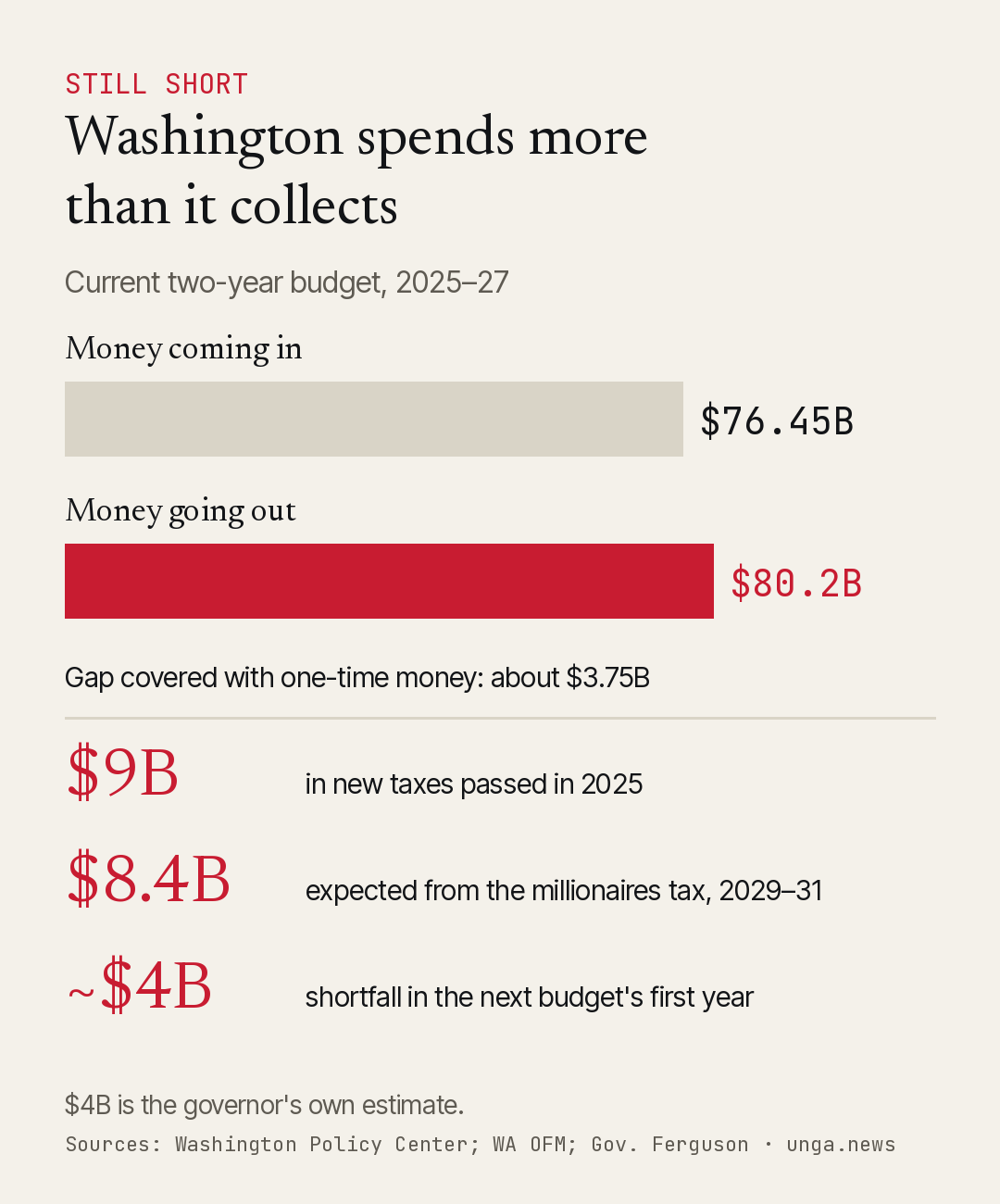
Washington was supposed to be the state that finally fixed its budget by taxing the rich. Voters upheld a new income tax on millionaires. Lawmakers had already piled on $9 billion in new taxes the year before. And on Monday, Gov. Bob Ferguson admitted the state is still about $4 billion short.
“The bad news is: We now project an approximately $4 billion shortfall in the first year of the next budget,” Ferguson said in a statement after the state’s final revenue forecast of the year. His promise is that things settle down after that. “The good news is our budget situation will be stable beginning July 1, 2028.”
That is a lot of faith to put in one tax that hasn’t collected a dime yet and is still being fought in court.
The money didn’t go missing
Start with the forecast itself, because it isn’t the problem. The state’s Economic and Revenue Forecast Council barely moved its numbers. Revenue for the current two-year budget went up $195 million, to $76.45 billion. The next two-year budget is now projected at $82.52 billion, down $75 million from September, according to the state’s Office of Financial Management.
So Washington isn’t broke because the money dried up. Next cycle’s revenue is 7.9% more than the state expects to collect this cycle. It is short because it spends more than it brings in.
Ryan Frost, budget and tax director at the Washington Policy Center, laid the numbers out in a breakdown Monday. The current budget spends $80.2 billion against $76.45 billion in revenue. The state covers the roughly $3.75 billion gap with one-time money: leftover balances, fund transfers and a draw on the rainy-day fund. That rainy-day fund is down to $1 billion, and the general fund is $497 million in the red.
Cuts on paper, spending in practice
Ferguson’s statement says the state “made significant budget reductions and found efficiencies to save money.” Some programs did get cut. But Frost points to the Washington Research Council’s tally of the 2025–27 budget Ferguson signed: $7 billion in cuts through 2029, $8.4 billion in new spending and $9 billion in new taxes. This year’s supplemental budget cut $970 million, with $432 million of that coming from moving costs into other accounts, while adding $1.59 billion in new spending.
Cutting one line and adding a bigger one somewhere else isn’t cutting. Any family that tried budgeting that way would have the same $4 billion problem, just with fewer zeros.
What makes it worse is that the things that usually drive state spending are shrinking. State Sen. Chris Gildon, the top Republican on the Senate budget committee and a member of the forecast council, noted that the number of K-12 students, the number of people on taxpayer-funded health care and the prison population are all expected to fall. Fewer kids, fewer patients and fewer inmates should mean a cheaper state government. In Olympia, it hasn’t.
“The predictions for the current and upcoming budget cycles barely twitched, which means state government is still firmly on the path to another multibillion-dollar shortfall – just as Republicans had warned many months ago, after the majority Democrats failed to get control of their spending,” Gildon said. He called it Olympia’s third budget shortfall in as many years.
Blaming the other Washington
Ferguson spent part of his statement pointing east. He blamed “billions of dollars in draconian cuts imposed by the Trump Administration,” including health care, and said voters had elected a new Congress that would “help return us to budget sanity.”
That is a convenient story, but it doesn’t square with the state’s own books. Olympia was already spending billions more than it collected, and it raised taxes by $9 billion along the way. Washington, D.C., trimming federal spending is the responsible move. States that built their budgets on ever-growing federal checks are now finding out what that habit costs.
The millionaires tax is carrying a lot of weight
The plan to get back to stable ground rests on the new income tax on millionaires kicking in. The state’s budget director said the budget “will be more stable due to the revenue from the millionaires tax” starting in fiscal 2029.
The numbers underneath that promise are already slipping. Forecasters now expect Washingtonians to earn $18.8 billion less in 2031 than they did two months ago. Based on a smaller estimate for an account that gets 5% of the tax, Frost figures the state expects roughly $130 million less from the millionaires tax in 2029–31, out of about $8.4 billion. Forecasters also rate their pessimistic scenario, which knocks $5.1 billion off next cycle’s revenue, as more likely than the optimistic one.
Rich people can also move. Idaho is a short drive from Spokane.
Ferguson says his budget proposal, due by Dec. 20, won’t rely on new taxes. Gildon’s answer is that state law already requires that, and the real question is whether the governor offers a second plan that reaches “even deeper into taxpayers’ pockets.” Frost estimates the real gap for the full 2027–29 budget is likely closer to $6 billion to $7 billion unless spending slows sharply.
Washington already ran the experiment of raising taxes to fix the budget. It tried it in 2025, tried it again this year with the millionaires tax, and it is still billions in the hole. The answer coming out of Olympia keeps being more of somebody else’s money. The answer the numbers point to is spending less of it.
Sources
- Office of Gov. Bob Ferguson — Governor Ferguson statement on November revenue forecast
- Washington Office of Financial Management — November forecast shows little change in state revenue projections
- Washington Policy Center — Final revenue forecast of 2026 shows Washington still spends more than it collects
- Washington State Senate Republicans — STATEMENT: Budget shortfall remains likely as new revenue forecast shows little change in state’s finances