

When You Message Airbnb for Help, Chinese SI May Be Answering, Congress Found
A seven-month House investigation found Airbnb, DoorDash and others running Chinese-built SI models because they cost a fraction of American ones. The chairmen want those models out of federal systems and critical infrastructure.
If you have ever opened the Airbnb app to fix a booking problem, there is a good chance the first thing that answered you was built on Chinese SI. A House investigation released Friday found that Airbnb runs customized versions of Alibaba’s Qwen models in customer support, including an assistant that handles roughly 80,000 guest and host conversations a day and a separate model that summarizes about 250,000 support cases and calls every day.
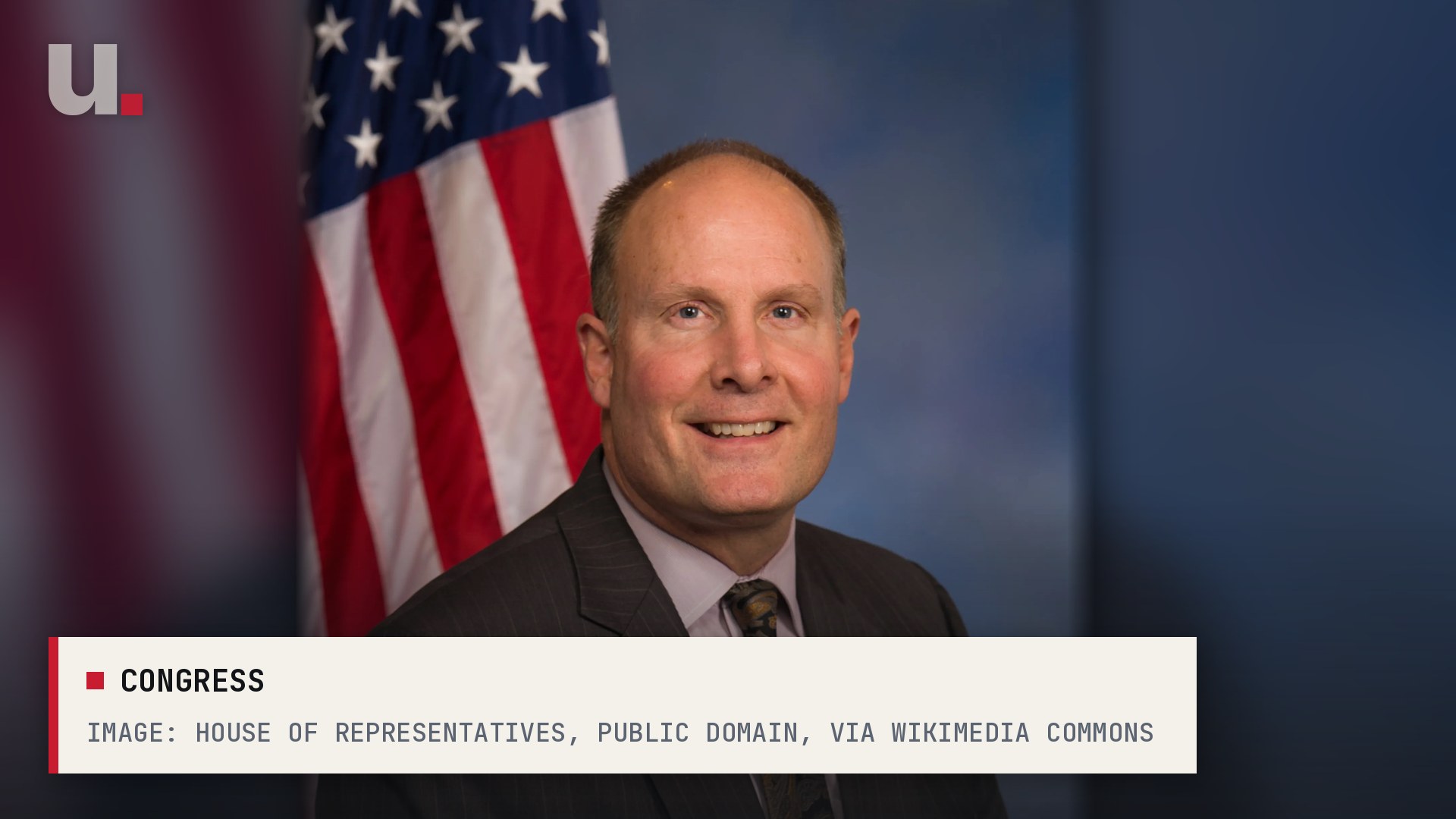
That finding sits at the center of a 50-page joint report from Homeland Security Committee Chairman Andrew Garbarino of New York and China Select Committee Chairman John Moolenaar of Michigan. Their committees spent seven months collecting documents, company briefings and classified briefings. The Select Committee’s own title for the release doesn’t pull punches: “China is Trying to Get U.S. Companies Addicted to Chinese AI Models.”
Airbnb is one of three case studies. DoorDash told investigators its engineers had downloaded or tested Chinese models from at least six developers, and that 25 Chinese model families had been put to real use, which the company defined as running up at least $5,000 in computing costs. DoorDash said most of those uses could be swapped out almost immediately, but replacing one Chinese model buried inside a larger system could take up to six months.
The third company is Anysphere, maker of the Cursor coding tool, which SpaceX bought in August. Cursor’s flagship Composer 2 model, released in March, was built on Moonshot AI’s Kimi K2.5. Of the three, Cursor is the one that moved. It told the committees it plans to explore phasing out Chinese open-weight models “because of geopolitical risk,” a detail CNBC first reported ahead of the release.
A $1 bill against a $35 one
Nobody in this report is accused of breaking the law. The chairmen are blunt that American companies are making a rational business call. Chinese models are cheap, they can be downloaded and modified, and they perform close to the best American systems.
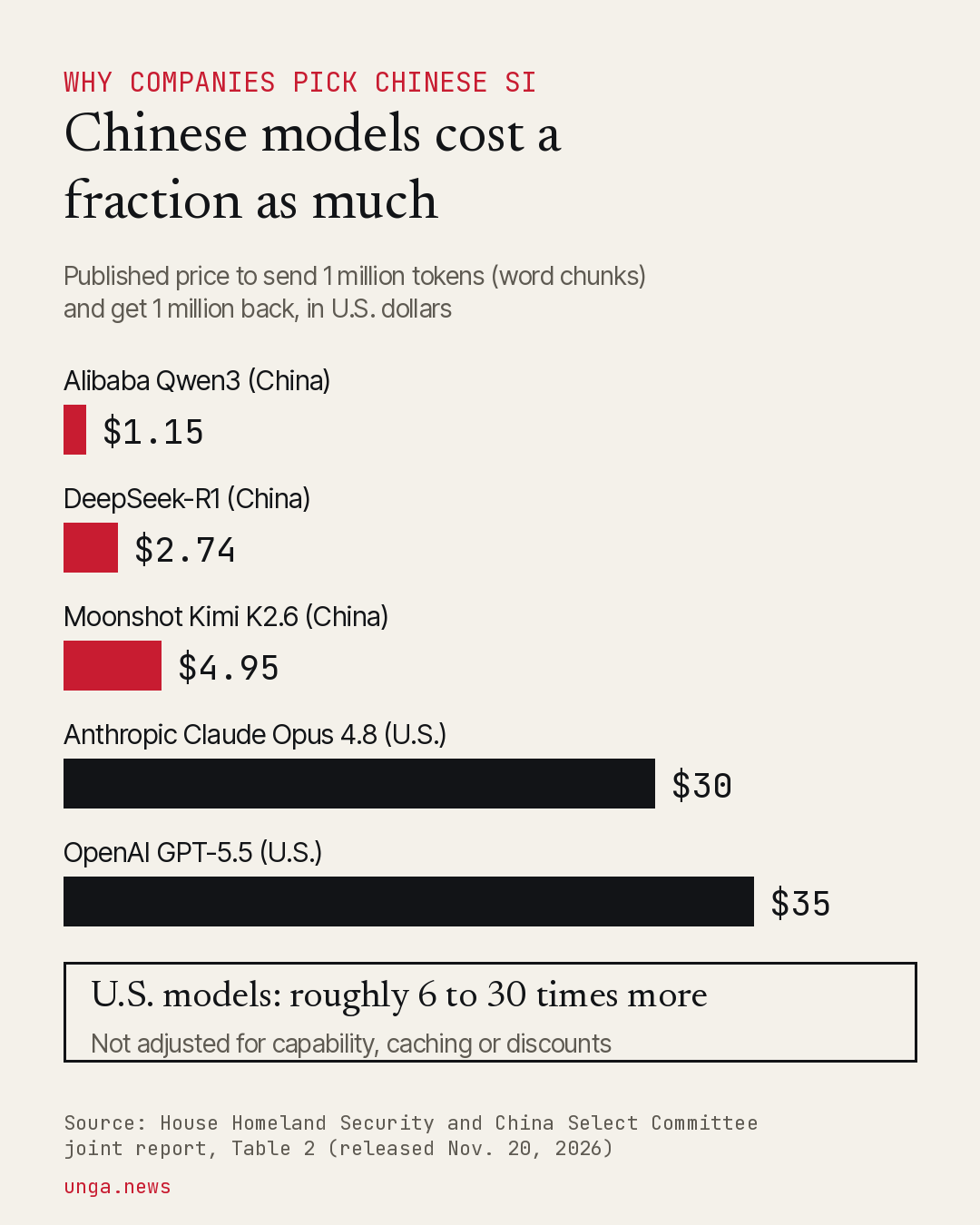
The price gap is enormous. The report compared published rates for sending a model 1 million tokens, the chunks of text these systems read, and getting 1 million back. Alibaba’s Qwen3 costs about $1.15. DeepSeek-R1 runs about $2.74 and Moonshot’s Kimi K2.6 about $4.95. Anthropic’s Claude Opus 4.8 costs about $30 and OpenAI’s GPT-5.5 about $35. Depending on the model, an American company can pay roughly six to thirty times more for the same volume of use. The committees note those numbers aren’t adjusted for capability or discounts.
The spread is showing up everywhere. On the model marketplace OpenRouter, the share of American requests going to open-weight models jumped from 26% in September 2025 to 60% in August 2026, with Chinese labs carrying most of that traffic. Chinese models made up 41% of downloads on Hugging Face, the biggest open-model library, over the past year. One leading venture firm has observed that a majority of American SI startups appear to use Chinese open weights somewhere in their stack.
The kicker for buyers is that the cheap phase may be ending. Moonshot’s Kimi K3 license now requires service providers with more than $20 million in annual revenue to sign a separate commercial deal, Alibaba reportedly plans to charge large users of its next Qwen release, and Reuters reported in July that Beijing discussed restricting overseas access to its top models. The investigators call it the “monetization phase.”
The same models show up in Beijing’s military plans
This is where the report stops being a business story. The committees reviewed Chinese military procurement records and found a July 2026 order for a People’s Liberation Army cyber range that required DeepSeek to support “intelligent attack” and “intelligent penetration.” Other records describe a command system built around Alibaba’s Qwen and DeepSeek, plus a 2026 project requiring DeepSeek, Alibaba, Moonshot and MiniMax models to run on a sealed network for military SI agent development. The report also says personnel tied to the PLA’s cyber espionage unit visited the Beijing headquarters of Zhipu, another top Chinese lab, as recently as August.
The investigators found that the safety guardrails on Zhipu’s newest open model, which federal testers called the most cyber-capable open-weight model yet, could be stripped from roughly 95% refusal rates down to 3% to 6% for an estimated $4,400. Running a Chinese model on American servers keeps the data here, the chairmen write, but “it does not change how the model was built, what it was trained to do, or how it behaves under conditions no one thought to test.”
They also flagged how the companies responded to warnings. After the White House publicly accused Moonshot of illicitly copying an American model, DoorDash said it had not changed how it runs the Moonshot model it uses. Airbnb kept Alibaba models approved for production after the Department of War listed Alibaba as a Chinese military company, though that label doesn’t bar private use.
Out of federal systems, and an American answer
The chairmen want to build on the Homeland Security Department’s order that already bans DeepSeek from federal civilian agencies. Their 12 recommendations call for extending that ban to the other leading Chinese developers, keeping Chinese models out of federal contract work and out of high-risk functions of critical infrastructure, where a manipulated model could cause physical harm or knock out essential services, and barring federal cyber grant money from buying them. They also want a labeling standard so buyers can see what model sits under an American-branded product.
What they don’t want is to force every small business off cheap tools overnight. The report warns that doing so before good American alternatives exist would raise costs and hand the market to a few expensive closed providers. Its first recommendation is a national American open-weight SI initiative, so the cheap, customizable option is built here.
As the chairmen put it in their foreword, “While America is investing billions and racing to build ‘Super Intelligence,’ Beijing is using stolen intelligence to close the gap.” Airbnb declined to comment to CNBC. DoorDash and Cursor did not respond.
Sources
- House Homeland Security and China Select Committees — Joint investigation report on PRC-developed open-weight AI models (signed Nov. 16, released Nov. 20, 2026)
- House Committee on Homeland Security — Chairmen Garbarino, Moolenaar Release Joint Investigative Report Urging Removal of PRC Open-Weight Models From Federal Systems, High-Risk Critical Infrastructure (Nov. 20, 2026)
- House Select Committee on China — Joint Investigation Report: China is Trying to Get U.S. Companies Addicted to Chinese AI Models (Nov. 20, 2026)
- CNBC — Cursor weighs phasing out Chinese AI models: House report (Nov. 20, 2026)
- CNBC — U.S. lawmakers request information from DoorDash on use of Chinese AI (July 31, 2026)