

Who Picks the People Who Set Your Electric Bill? North Carolina’s Top Court Now Has to Decide
Republican lawmakers say the state constitution never gave the governor control of every board. Gov. Josh Stein says it did. The elections board could be next.
If you live in North Carolina and pay a Duke Energy bill, a fight in Raleigh this week is about you. On Tuesday the state Supreme Court heard two lawsuits brought by Democratic Gov. Josh Stein against the two top Republicans in the legislature, Senate leader Phil Berger and House Speaker Destin Hall. The question sounds dry. The stakes aren’t: who gets to pick the people who sit on the boards that approve your power rates, write the building codes for your house and, down the line, run your elections.
Stein says those picks belong to him. The Republican-led General Assembly says the state constitution never said so, and that two court rulings from 2016 and 2018 invented a governor’s power that isn’t in the text. Lawmakers want those rulings thrown out, and they asked a court with a 5–2 Republican majority to do it.
Ten elected bosses, one porch
North Carolina doesn’t run its executive branch the way Washington does. The governor is one of ten statewide elected officials who make up the Council of State, alongside the treasurer, the auditor, the labor commissioner, the agriculture commissioner and others. Lawyers call it a plural executive. In plain words, the governor is the biggest dog on the porch, not the only one.
In December 2024, right after Stein won, the legislature passed Senate Bill 382. Among many other things, it moved some of the governor’s board appointments to other members of the Council of State, who happened to be Republicans. The most visible example is the Utilities Commission, the five-member panel that approves or rejects Duke Energy’s rate hike requests. The governor used to name a majority. Now he names two, Republican Treasurer Brad Briner names one, and lawmakers name the other two.
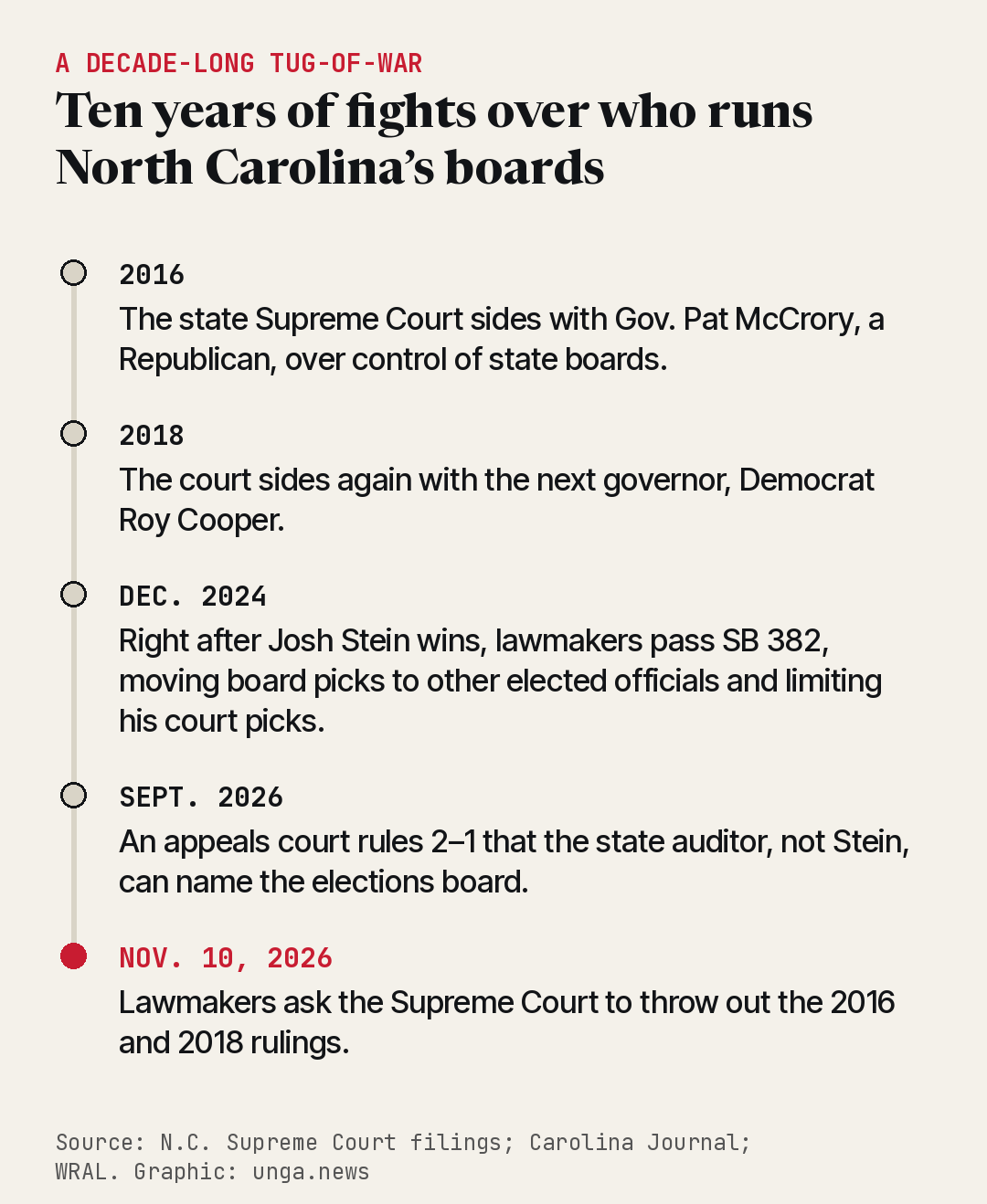
The same law changed how vacancies on the state’s two top courts get filled. Before, if a justice or appeals judge died or resigned, the governor picked whoever he wanted. Now he has to choose from three names sent by the departing judge’s political party. A three-judge trial panel blocked that piece. The state Court of Appeals reversed that panel and sided with lawmakers, and Stein appealed.
“Distributing appointments … is itself a form of accountability”
The legislature’s argument is cleaner than it gets credit for. Nowhere does the constitution say the governor must control a majority of every board the legislature creates. What it does say is that the General Assembly can organize state agencies and hand out duties among the elected officers of the Council of State.
“The Governor is right that the Court must act to protect the separation of powers,” the legislative leaders’ lawyers wrote in an Oct. 30 brief quoted by Carolina Journal. “But the violation it must protect against comes from McCrory and Cooper I, not the challenged legislation.” Those are the 2016 and 2018 decisions that went for Republican Gov. Pat McCrory and then Democratic Gov. Roy Cooper. The brief went on: “The Governor defends that requirement in the name of accountability. But distributing appointments among multiple officials or expert groups is itself a form of accountability.”
Briner’s lawyers were even sharper. “Nothing in our constitution says the Governor must control the Utilities Commission,” they wrote, calling Stein’s position “an attempt to backdoor the unitary executive theory of the United States Constitution into the North Carolina Constitution.”
On the court-vacancy piece, the legislature’s lawyers say Stein still makes the appointment. He just picks from a list. “The Governor asks for more,” they wrote. He wants “an exclusive power to install jurists who share his views and priorities.”
Stein’s side calls the whole design a power grab dressed up as structure. His lawyers argue the legislature handed a “near-majority of appointments to themselves” and gave other seats to officials “aligned politically with the legislative majority,” and that a lame-duck legislature simply ignored the constitution. All five living former governors, Republicans Jim Martin and Pat McCrory included, filed a brief backing him.
Spider Sense on the bench
The toughest questions Tuesday came from Republican justices, and not all of them went the legislature’s way. Justice Richard Dietz asked whether lawmakers could, in theory, strip the agriculture commissioner of farm duties and hand them to the schools superintendent. Lawyer Matthew Tilley, arguing for Berger and Hall, said yes, and that voters could punish them for it at the polls. Dietz didn’t buy it. “That’s wrong. I think you know that’s wrong,” he said, according to WRAL. Justice Trey Allen asked whether the court’s “separation-of-powers Spider Sense” should go off, and whether a governor stuck with a Cabinet the legislature could approve and remove would be “sort of just a figurehead.”
But Dietz turned the same heat on Stein’s lawyer, Eric Fletcher. “I don’t understand why the governor is making such an aggressive argument here,” he said. “Surely, the governor does not have power over public education, agriculture — all of the things we have said in these past cases.” Allen pressed Fletcher too: if every Council of State member has a duty to see the laws carried out, “then what is the constitutional problem with dividing appointments among them?”
Tilley’s best moment came when Justice Tamara Barringer, a former state senator, asked him to answer Stein’s claim that gerrymandered districts leave voters no real way to fix a bad legislature. “We’re standing here a week after an election that changed control of at least one chamber of the General Assembly,” he said. “I think if that were really a concern, that couldn’t happen.” Hard to argue with. Control of the state House changed hands last week for the first time since 2010.
The elections board is next in line
What’s not in front of the court yet is the biggest prize: control of the State Board of Elections. SB 382 moved those appointments from the governor to Republican State Auditor Dave Boliek, and in September the Court of Appeals upheld that shift, 2–1. Stein has appealed. WRAL notes the legal arguments in that case track closely with the ones heard Tuesday, so whatever the justices decide here will be read as a preview.
Business groups, including the NC Chamber’s legal arm, the Farm Bureau, the home builders and the National Federation of Independent Business, sided with the legislature and asked for something everybody in Raleigh should want: a ruling clear enough to “put an end to the perennial intra-government litigation.”
The court didn’t say when it will rule. Berger leaves the Senate at the end of the year after losing his March primary, and Hall gives up the speaker’s gavel in January, so the men whose names are on the case may be gone before the answer comes.
Sources
- Carolina Journal — Stein, GOP lawmakers take separation-of-powers fight to top NC court (with Oct. 30 briefs from both sides and the treasurer)
- WRAL — NC Supreme Court hears balance-of-power fight between governor, state lawmakers
- North Carolina General Assembly — Senate Bill 382, 2023–24 session
- North Carolina Judicial Branch — Supreme Court of North Carolina