

Wisconsin Bans Election Clerks From Checking Voters' Citizenship Against Federal Records. 29 States Already Do
The state's elections commission says a privacy law puts the federal SAVE database off-limits to its 1,800 clerks. The same section lets clerks share voters' birth dates and Social Security numbers with law enforcement, and the guidance never mentions it.
Wisconsin has told its roughly 1,800 municipal election clerks they may not run voters through the federal government's citizenship check. Not before Election Day, and not even as a test.
The Wisconsin Elections Commission approved the order in a unanimous vote on Oct. 15, in a memo and FAQ sent to every clerk in the state. Asked whether clerks can choose to use the federal SAVE system, the commission's answer is one word: "Not as SAVE is currently constructed."
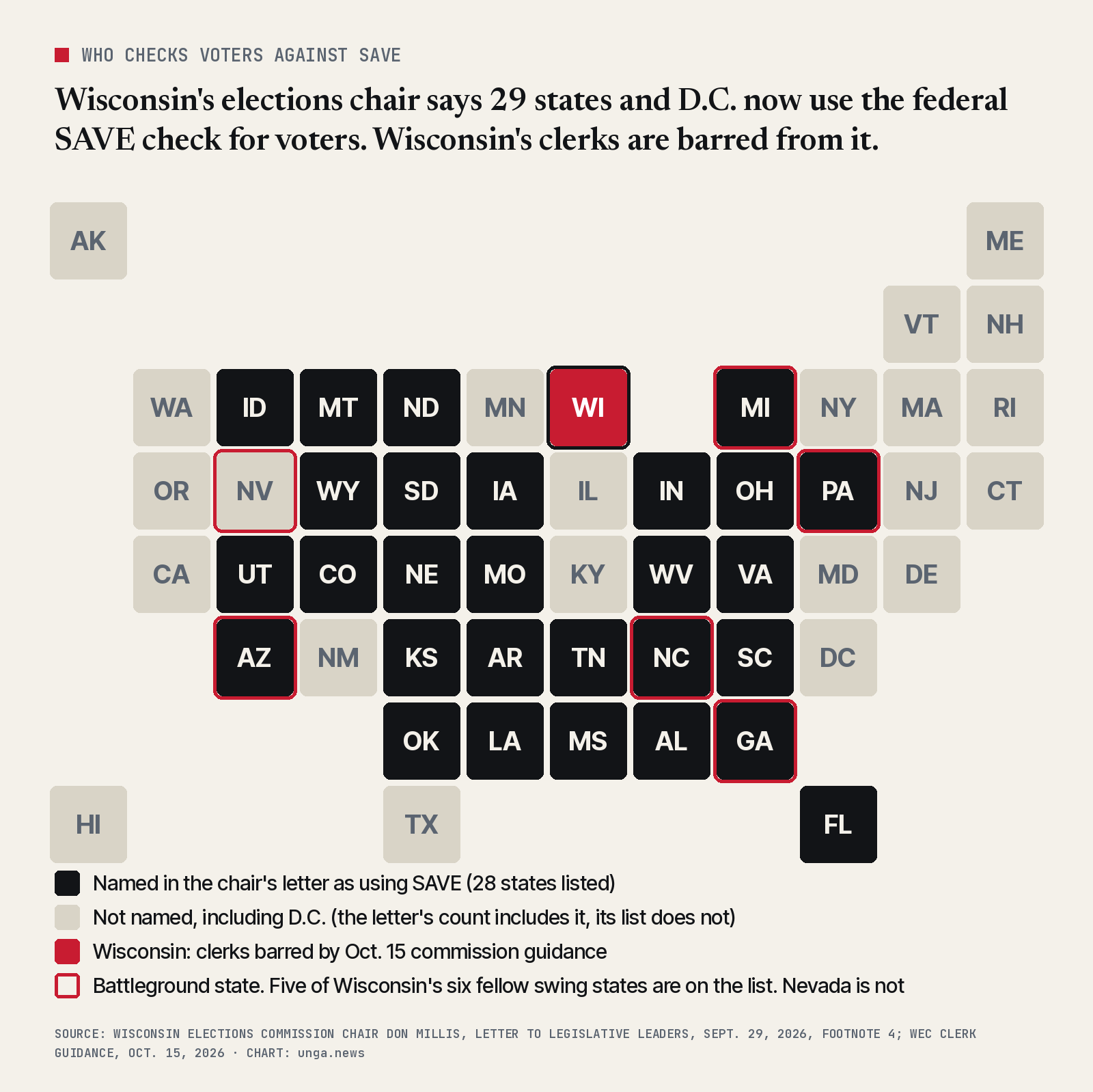
That puts Wisconsin on the outside of a fast-growing club. By the commission chair's own count, 29 states and the District of Columbia now use SAVE to vet voter registrations or clean their rolls. That includes five of the six other presidential battlegrounds: Arizona, Georgia, Michigan, North Carolina and Pennsylvania. Election Day is Nov. 3, and in-person absentee voting is already underway.
What SAVE is, and what changed
SAVE, short for Systematic Alien Verification for Entitlements, has existed since 1986. Government agencies use it to confirm a person's citizenship or immigration status before handing out benefits. For years it was slow, it cost money, and it took one name at a time.
That changed after President Trump's March 2025 executive order told Homeland Security to help states verify voters' citizenship. Commission chair Don Millis spelled out the upgrade himself in a Sept. 29 letter to legislative leaders: SAVE now pulls in Social Security and State Department records, it is "now free to states," and it "can accommodate bulk submissions of up to one million records." A clerk uploads a name, a date of birth or Social Security number, and gets back a match or a flag. If SAVE can't confirm someone is a citizen, the agency must contact that person and ask for proof.
Voting-rights groups led by the League of Women Voters sued, and a federal district judge froze the upgraded system. On Sept. 25 the U.S. Supreme Court lifted that freeze in Department of Homeland Security v. League of Women Voters. Three weeks later, Wisconsin's commission locked its own clerks out anyway.
The law the commission cited, and the part it skipped
The commission's reason is a state privacy rule, Wis. Stat. § 6.36(1)(b)1.a., which says only election officials may view a voter's date of birth, driver's license number or Social Security number. SAVE needs those numbers, so the commission says clerks can't send them.
But that rule opens with the words "Except as provided in pars. (ae), (bm), and (bn)." Paragraph (bm), a few lines down, says the commission "or any municipal clerk" may transfer any of that restricted information "to a law enforcement agency ... to be used for law enforcement purposes." State law defines a law enforcement agency to include federal units whose officers enforce federal law and can make arrests. Paragraph (bn) even lets the commission hand the same data to another state's government "for official purposes."
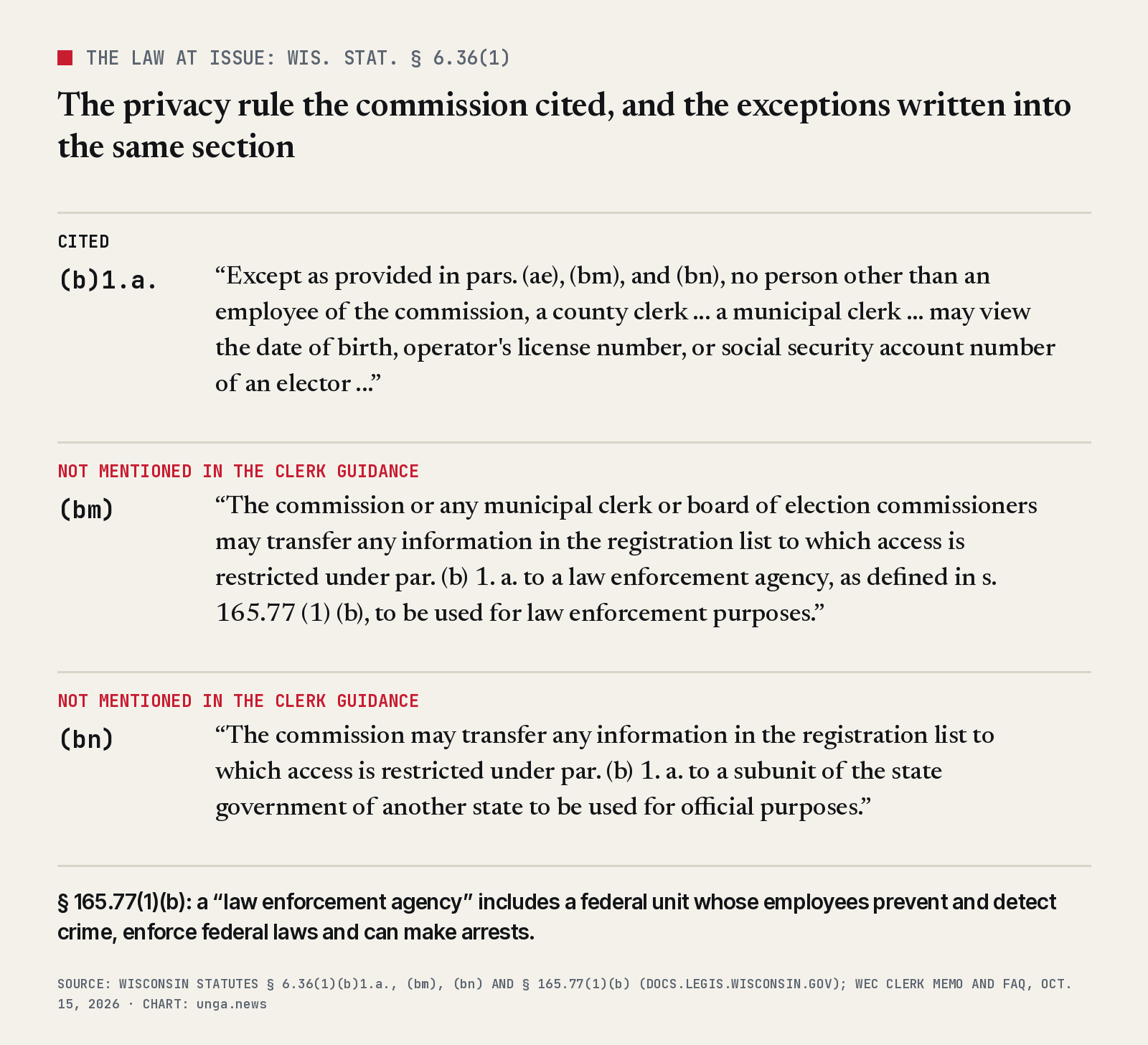
Neither the clerk memo nor the FAQ mentions paragraph (bm). Millis's letter says only that the privacy rule has "certain limited exceptions" and that "there is no exception for the SAVE program." Think of a landlord who won't let the fire inspector in because the lease protects tenant privacy, while the lease itself has a clause for fire inspectors.
Whether checking SAVE counts as a "law enforcement purpose" is a fair legal question. It's the commission's job to answer it out loud, and it didn't. Republican state Sen. André Jacque says the answer is obvious. "To see the WEC Board seemingly disregard the clear provision in Wisconsin law that specifically allows sharing of the voter list with bona fide law enforcement agencies like the Department of Homeland Security for situations such as this, how can that not be disheartening to the cause of election integrity?" he told the Daily Wire.
Millis also concedes in a footnote that federal law, 8 U.S.C. § 1373, already overrides any state rule blocking agencies from sharing "information regarding the citizenship or immigration status" of a person. His view is that it doesn't reach birth dates and Social Security numbers.
Who voted for it
The commission has six members, three picked by each party. All six voted yes, including Republican Robert Spindell, who said he went along with the clerk guidance but wants the state itself to work with the Justice Department and Homeland Security. "I believe we should take this problem seriously, as only if 1% or 2% of Wisconsin noncitizen voters could swing a state election or even a close national election, which is possible," Spindell said at the meeting, the Wisconsin State Journal reported. He said he hoped to "persuade my other two colleagues to cooperate with the federal departments to help ensure only U.S. citizens are permitted to vote in Wisconsin."
Those other two are fellow Republicans, Millis included, the State Journal reported. In his letter, Millis wrote: "We appreciate that not all lawmakers will support an independent citizenship verification process that provides Wisconsin voter data to federal agencies."
Spindell's math isn't far-fetched in this state. Trump carried Wisconsin by 22,748 votes in 2016 and 29,397 in 2024. Joe Biden won it by 20,682 in 2020. All three were decided by less than one percentage point.
So what stops a noncitizen from voting?
Mostly an honor system, by the commission's own description. When someone registers in Wisconsin, the FAQ says, "they swear under penalty of law that they are a U.S. citizen." Wisconsin lets people register at the polls on Election Day with proof of where they live. It does not ask for proof of citizenship. The commission says it relies on "the voter's self-certification of eligibility," plus a challenge process and prosecution after the fact.
This isn't Wisconsin's first standoff with Washington over voter data. The Justice Department sued the commission for the state's unredacted voter list, and on May 21 U.S. District Judge James Peterson threw the case out, ruling the voter list isn't a record DOJ can demand under the Civil Rights Act of 1960.
What's next
Millis's letter tells lawmakers what a fix would take: a law naming who must verify citizenship, explicitly allowing the data to be shared, and setting standards and notice rules for flagged voters. That needs the Republican Legislature and a governor's signature. Gov. Tony Evers, a Democrat, isn't on the ballot. The two men running to replace him, Republican Tom Tiffany and Democrat David Crowley, are. Whoever wins would sign or veto that bill.
Until then, on Nov. 3 Wisconsin will count ballots in a swing state where clerks can check a voter's address, but not whether that voter is a citizen.
Sources
- Wisconsin Elections Commission — FAQ: Clerk Use of Federal SAVE System (official guidance approved Oct. 15, 2026)
- Wisconsin Elections Commission — Special meeting open session packet, Oct. 15, 2026: staff memo and clerk communication on the federal SAVE system
- Wisconsin Elections Commission — Chair Don Millis, letter to legislative leaders, 'Citizenship Verification of Electors' (Sept. 29, 2026), via the Wisconsin State Journal
- Wisconsin Legislature — Wis. Stat. § 6.36(1)(b)1.a., (bm) and (bn), official registration list
- Wisconsin Legislature — Wis. Stat. § 165.77(1)(b), definition of law enforcement agency
- The Daily Wire — Wisconsin Blocks Election Clerks From Checking Voters' Immigration Status, with Sen. André Jacque statement (Oct. 26, 2026)
- Wisconsin State Journal — Election clerks prohibited from using Trump's federal voter database, WEC rules (Oct. 16, 2026), with Commissioner Spindell remarks
- U.S. District Court, W.D. Wis. — United States v. Wisconsin Elections Commission, No. 25-cv-1036-jdp, opinion and order (May 21, 2026)
- U.S. Code — 8 U.S.C. § 1373, communication between government agencies and the Immigration and Naturalization Service
- USCIS — SAVE verification process