

Writing Is Losing Ground in Freelance Work. Gigs That Use SI Carry 52% Bigger Budgets.
A new study from ChatGPT’s maker and Upwork found businesses hire out far less writing, while jobs that use SI come with bigger budgets and more hours, but barely higher hourly pay.
If you make money writing blog posts for other people, the numbers just got uncomfortable. If you can take an SI tool and turn it into a finished video, a working chatbot or an app, they got a lot better.
That is the short version of a new study OpenAI, the company behind ChatGPT, published Tuesday with Upwork, the biggest online marketplace for hiring freelancers. The researchers compared what people actually do in ChatGPT with what businesses are paying freelancers to do on Upwork. Content writing’s share of Upwork job postings fell about 31% from the first half of 2025 to the first half of 2026. Meanwhile, jobs that ask for SI skills came with fixed-price budgets about 52% bigger than similar jobs that didn’t.
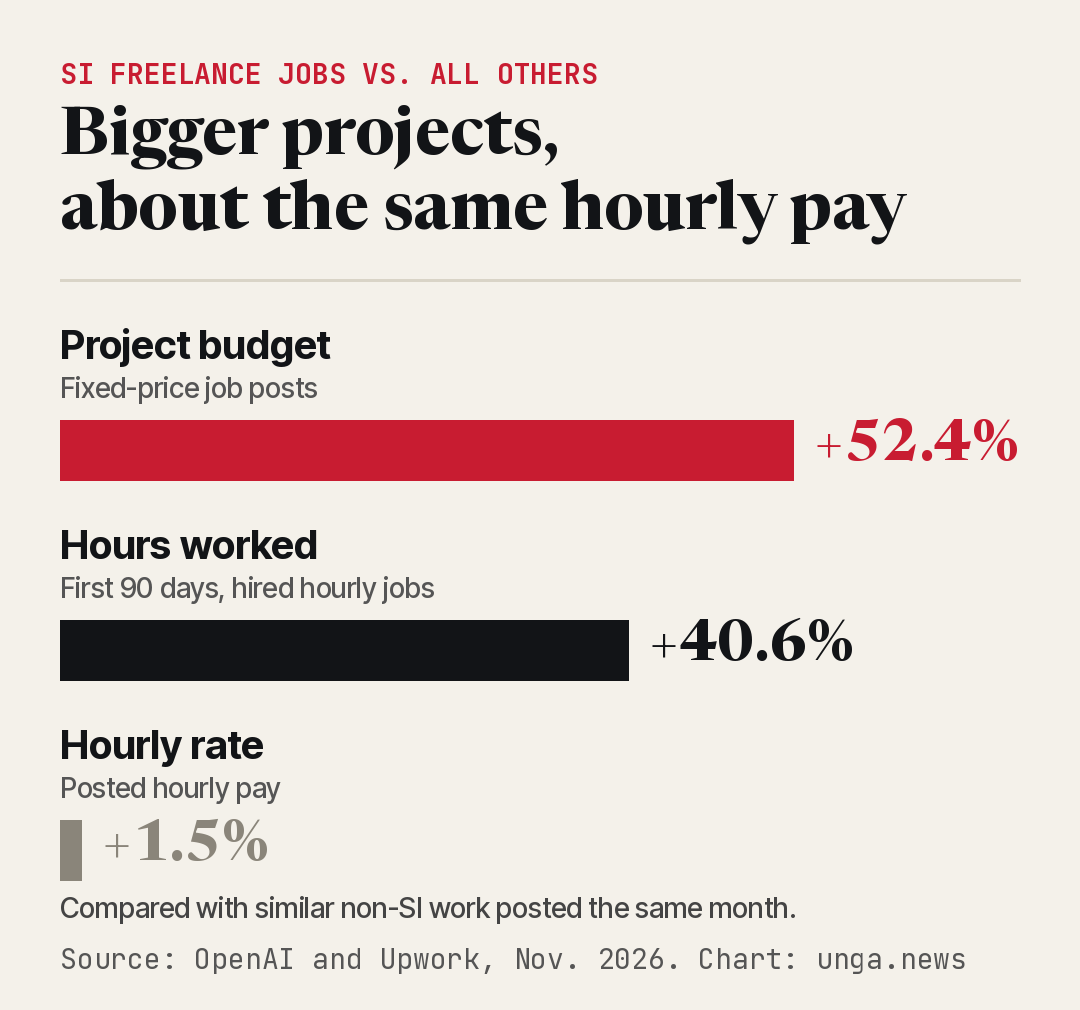
Read that chart closely, because it says something people miss in the “robots are taking our jobs” argument. Hourly pay for SI work was only about 1.5% higher once the researchers compared like with like. The money isn’t coming from a fancier rate. It’s coming from bigger jobs. Freelancers hired by the hour on SI-related work logged about 41% more hours in their first 90 days.
The blog post nobody hires out anymore
The most striking piece of the report is how different the two platforms look. Content writing makes up 14.5% of the sampled ChatGPT conversations the researchers matched to Upwork’s job categories. On Upwork, it’s only 1.3% of job posts. Business and professional writing shows the same gap: 10.2% of ChatGPT conversations, about 0.4% of Upwork posts.
Flip it around and you see what people still pay a human for. Video and animation is 10% of Upwork job posts but just 1% of ChatGPT conversations. Mobile app development is 7.8% of Upwork posts and 0.2% of ChatGPT chats. Graphic and presentation design sits at 10.5% on Upwork.
The report doesn’t claim ChatGPT killed the freelance writer. It says firms “may be using AI directly for this task instead of hiring remote workers,” and it’s careful to call its findings associations, not proof of cause and effect. But if you’re a small business owner who used to pay someone to write product descriptions and now types the request into a chat box, you already know how that story goes.
Same chatbot, very different results
This isn’t a simple scoreboard of winners and losers, though. The researchers sorted 63 kinds of freelance work by how heavily people use ChatGPT for them. In 43 of the 63, the pattern you’d expect held up: work that’s common in ChatGPT lost ground on Upwork, and work that’s rare in ChatGPT gained. The other 20 went the opposite direction. Six categories were both common in ChatGPT and growing on Upwork.
“ChatGPT use alone does not explain changes in freelance demand,” the OpenAI write-up says. Graphic design is the clearest example. People make plenty of images with SI, yet businesses still hire designers in big numbers, because turning a pile of generated pictures into a finished brand or a pitch deck is still real work.
OpenAI has a name for the space between what SI can do and what people actually use it for. It calls it the “capability overhang.” Video is the example the report points to: SI can help make video, but most people aren’t using ChatGPT for that, and video work remains a big slice of freelance hiring.
One posting, three old jobs
The other big finding is about how jobs are packaged. Clients posting SI-related work aren’t just asking for one skill. They’re gluing together tasks that used to belong to different specialists. One example in the report: a single posting asking for SI-generated video, plus video editing, plus motion graphics, with one freelancer delivering the finished product. Another: building a chatbot and wiring it into an existing app.
The researchers measured this. Task pairings that were rare before the SI boom, showing up in fewer than 200 earlier postings, made up 8.4% of task pairs inside SI-related jobs, compared with 2.4% in other jobs. SI-related postings listed slightly more tasks on average, 3.35 versus 3.19. And the variety of work inside SI-related postings widened by about 45% from 2023 to late 2025.
Put simply, the freelancer who can do the whole thing, start to finish, is the one getting the bigger check. That fits with what Upwork’s own research has said about the size of this market. Its 2026 Future Workforce Index found 38% of skilled American knowledge workers freelance, and its prior study estimated freelance knowledge work brought in $1.5 trillion in U.S. earnings in 2024.
Who wrote it, and the fine print
Readers should know who is grading the homework. The report was written by six researchers, three from OpenAI and three from Upwork, and OpenAI obviously has a stake in a story where SI makes work bigger rather than smaller. The ChatGPT data comes from a sample of more than 36,000 personal and work conversations, and the budget comparisons use a sample of job posts running through April 2026, with the top 1% of prices trimmed so a few giant contracts don’t skew the results.
The paper itself is upfront that its numbers “describe conditional associations and do not identify causal effects.” That means SI-related jobs come with bigger budgets, but the study can’t prove SI is the reason. It could be that clients who want SI also tend to want bigger, more ambitious projects to begin with.
Still, the lesson for anyone who freelances is pretty plain. The work that’s easy to type into a chat box is drying up as a paid gig. The work that takes SI output and turns it into something a business can actually ship is where the hours are. In the report’s own words, there is “a continuing role for workers who provide technical implementation, creative production, and finished deliverables.”
The full study, The Rebundling of Freelance Work in the AI Age, runs 24 pages, and OpenAI’s summary is here. It’s the second entry in OpenAI’s “Work at the Frontier” series. The first found that 43.5% of work-related ChatGPT messages involved tasks from a job other than the user’s own.
Sources
- OpenAI — Work at the Frontier: AI’s effect on freelance work
- OpenAI and Upwork — The Rebundling of Freelance Work in the AI Age (full report, PDF)
- OpenAI and Upwork — Work at the Frontier: How AI is changing the shape of freelance work (key takeaways, PDF)
- MLQ.ai — OpenAI and Upwork study finds AI projects get bigger budgets and more hours on freelance markets