

You Can Now Run a Top Free SI on Your Own Laptop, No Internet Needed
Thinking Machines Lab, the startup led by ChatGPT’s former tech chief, released a free model small enough for a 32-gigabyte Mac. It says Mini tops every free rival its size on key coding tests.

A week ago the knock on Thinking Machines Lab’s free SI was simple. It was great, and almost nobody could run it. Inkling 2 Small weighs in at 594 billion parts, which means a rack of data center chips, not the computer on your desk. On Friday the company answered the complaint head-on with a model small enough to fit on a laptop.
Thinking Machines on 𝕏 — “Some of you thought that Inkling 2 Small was too big at 594B parameters. We heard you.” (Nov. 20, 2026)
— @thinkymachines View on 𝕏
It’s called Inkling 2 Mini, and it is the new part of this story. When we covered the big model’s free release on Nov. 12, the takeaway was that an American lab had finally put out a free SI that could stand next to China’s best. The catch was the hardware bill. Mini cuts that bill down to a decent Mac.
A 20-gigabyte download that runs with the Wi-Fi off
According to the company’s launch post and model card, the whole model ships as one file of about 20 gigabytes. It runs on Apple computers with 32 gigabytes or more of memory, including MacBooks, Mac minis and Mac Studios, and on Nvidia’s DGX Spark desktop box. Other graphics cards work too if they carry 32 gigabytes of their own memory. On a Mac, the setup is one line typed into Ollama, a free app for running models at home. Ollama’s library already lists it.
It is released under the Apache 2.0 license. In plain English, you can download it, change it, sell a product built on it and owe the company nothing. It reads text and pictures, writes text, and can hold up to a million tokens of material in view at once, which is room for a pile of long documents or a big codebase.
The company’s favorite demo makes the point better than any spec sheet. Its researchers took Mini on an airplane, put a MacBook Pro in airplane mode, and had the model build a playable flight simulator in a few minutes. No cloud, no subscription and nobody else’s servers reading your files.
That last part is the real selling point for regular people and small businesses. Every question you type into a cloud chatbot goes to somebody’s data center. A model that lives on your own machine keeps your contracts, medical notes or half-finished business plan on your own machine.
The trick: running the same layers three times
Most SI models are built like a stack of floors, and each word passes through every floor once. Mini has 24 floors, but the middle 12 are a loop. Each word goes through that middle section three times, using the exact same weights each trip. That gives the model 48 passes of thinking out of 24 floors of parts.
The payoff, the company says, is more reasoning without more size. It is also a Mixture-of-Experts model, so for each word it wakes up only a small slice of itself, about 3.4 billion of its 26.4 billion parts, or roughly 5.4 billion once the loops are counted. Less work per word means faster answers on modest hardware.
Hugging Face, the site where most free models live, published its own walkthrough the same day. Its engineers called Mini “a refreshingly new great local model” and said in their own hands-on tests it was “at least comparable” with Alibaba’s Qwen3.8-27B, a Chinese model that has been the one to beat at this size. They also wrote, “More validation is needed.” That’s an honest line, and readers should hold onto it.
Where it wins, and where it doesn’t
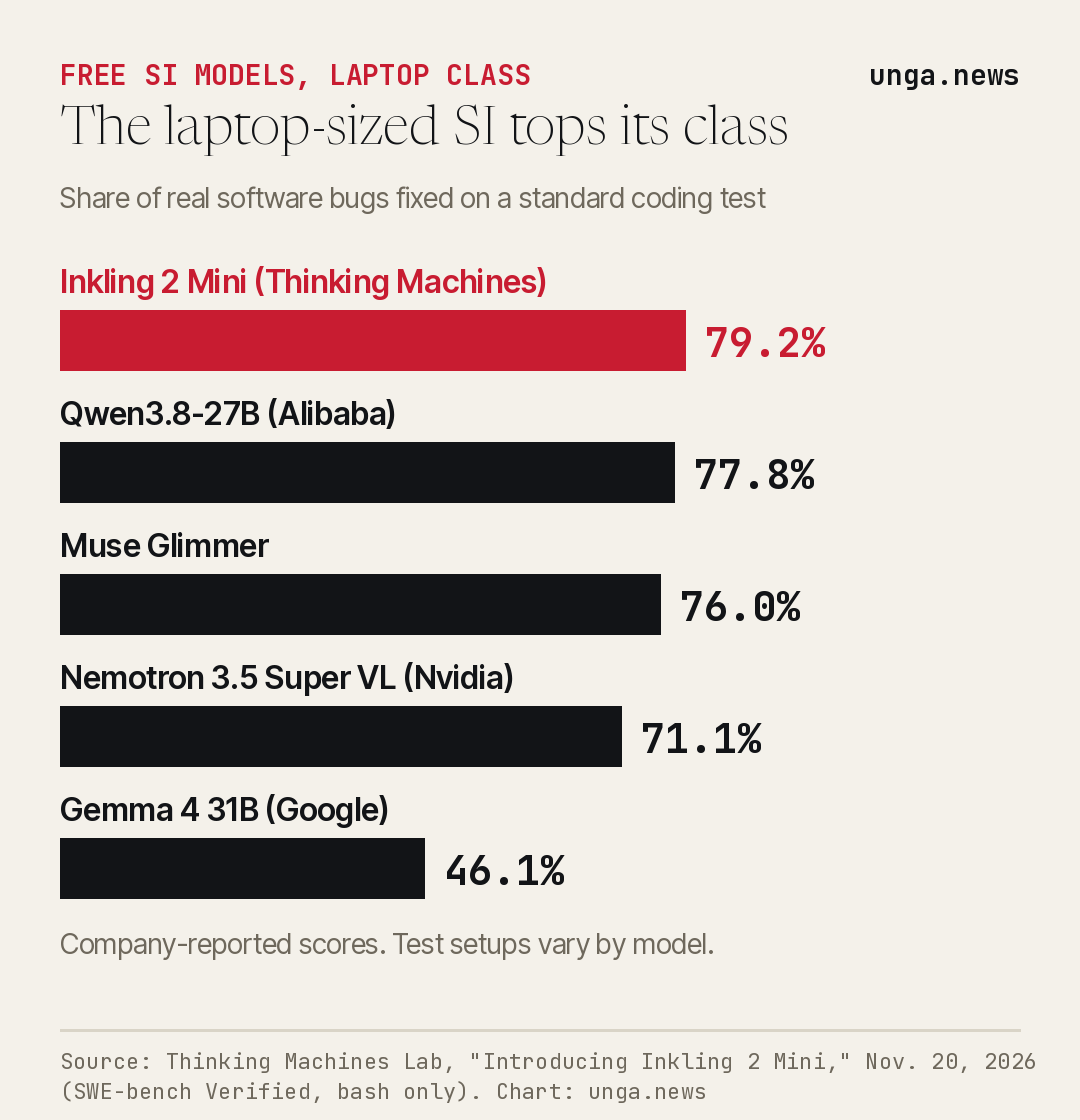
Thinking Machines says Mini leads every free model under 100 billion parts on its headline coding tests. On the most widely cited test of fixing real bugs in real software, it reports 79.2% solved, just ahead of Qwen’s 77.8% and far ahead of Google’s Gemma 4 at 46.1%. On a tougher, newer coding test it reports 48.2% against Qwen’s 42.2%.
Those are the company’s numbers, run on its own setup, and the fine print says evaluation setups vary from model to model. The margin over Qwen on the main bug-fixing test is only about a point and a half. On one terminal-skills test, Qwen actually edges it out, 73.0% to 71.6%, and the company says so in its own table. Call it a photo finish that an American lab now leads, not a blowout.
The company is also upfront about a weak spot. Looping helps a model reason, but it doesn’t give it more room to memorize facts, which depends mostly on raw size. So on trivia-style knowledge tests, Mini lands about where other models its size do. The fix is to let it look things up. On a hard test of hunting down answers on the web, it reports 79.0%, best among free models of its size by a hair.
Can you still read its mind?
There is one question safety researchers will care about more than the coding scores. Models today often write out their reasoning step by step before answering, and that written trail is one of the best tools people have for catching a model doing something it shouldn’t. A model that does more of its thinking inside a loop, without writing it down, could in theory get harder to watch.
Thinking Machines tested that with a second, research-only version where the number of loops can be dialed up or down. With more loops, the model could solve harder problems in its head without writing anything, stretching from tasks that take a person about 16 seconds at one pass to about 37 seconds at three. Its written reasoning got shorter but, the company says, stayed readable, and it did not score higher on tests designed to catch sabotage. It released that research version too, so outside labs can check the work rather than take its word for it.
Mira Murati, ChatGPT’s former chief technology officer, started Thinking Machines after leaving OpenAI. Last week her lab’s big model was something only people with server farms could use. Now the best free coding model in its weight class, by the company’s own scoreboard, runs on a laptop in a plane seat with the internet switched off. Independent testers will settle whether the scores hold up, and anybody with a 32-gigabyte Mac can join them tonight.
Sources
- Thinking Machines Lab — Introducing Inkling 2 Mini (Nov. 20, 2026)
- Thinking Machines Lab — Inkling 2 Mini Model Card
- Thinking Machines on 𝕏 — Inkling 2 Mini launch thread (Nov. 20, 2026)
- Hugging Face — Welcome Inkling 2 Mini, Cutting-edge Performance for your Local Setup (Nov. 20, 2026)
- Ollama — inkling-2-mini model library page
- unga.news — America Finally Has a Free SI That Can Hang With China’s (Nov. 12, 2026)