

Your SI Chatbot Can Write Code but Still Fumbles Counting Coffee Mugs, Google’s New Test Finds
Google’s new exam asks questions most people solve in about a minute. Top chatbots nearly ace them on one try, then slip when asked to get them right every time.
Ask a top SI chatbot to write a computer program and it will crank one out in seconds. Show it a photo of a few coffee mugs and ask how many in front have no steam rising from them, and it might get it wrong. Ask again, and it might get it right. Ask a third time, and who knows.
That gap is what Google DeepMind set out to measure with a new test it released Tuesday, Nov. 24, called Humanity’s First Exam. The name is a jab at “Humanity’s Last Exam,” a famous test built from brutally hard expert questions. This one goes the other way. It is 544 plain questions, with and without pictures, that ordinary people answer with pen and paper in about a minute. Count the objects. Name the colors in order. Follow a simple rule. Read the question as written instead of the one you expected.
The catch is in how it’s graded. Getting a question right once doesn’t count for much. Every question comes in a set of four close cousins, and each one gets asked over and over. To pass a set under the strict score, a model has to nail all four versions, four tries apiece, without a single miss.
Kaggle: Why can frontier AI models write complex code, yet still occasionally stumble when asked to identify the colors of five simple objects in order or verify what’s not in an image? That disconnect is called jagged intelligence and measuring it scientifically is critical to...
— @kaggle View on 𝕏
Right once isn’t the same as right every time
Google’s team ran 18 models from three companies: its own Gemini line, OpenAI’s ChatGPT models and Anthropic’s Claude models, all at their highest thinking settings. These are measured results from Google’s technical report, not marketing.
On a single try, the best models look nearly perfect. The top five scored between 96% and 98%. Give them four tries and nearly every one solves at least one version of every set at least once.
Ask for consistency and the picture changes. The best score for getting every version right every time was 92.4%, from OpenAI’s newest top model. Google’s own Gemini 4 Neon came in third at 85.8%, and its flagship Gemini 4 Carbon trailed its cheaper sibling at 80.5%. Anthropic’s Claude Opus 5.5 scored 91.2% on one try but just 63.0% on the every-time measure. At the bottom, a small, fast Gemini model fell from 68.7% on one try to 18.6%.
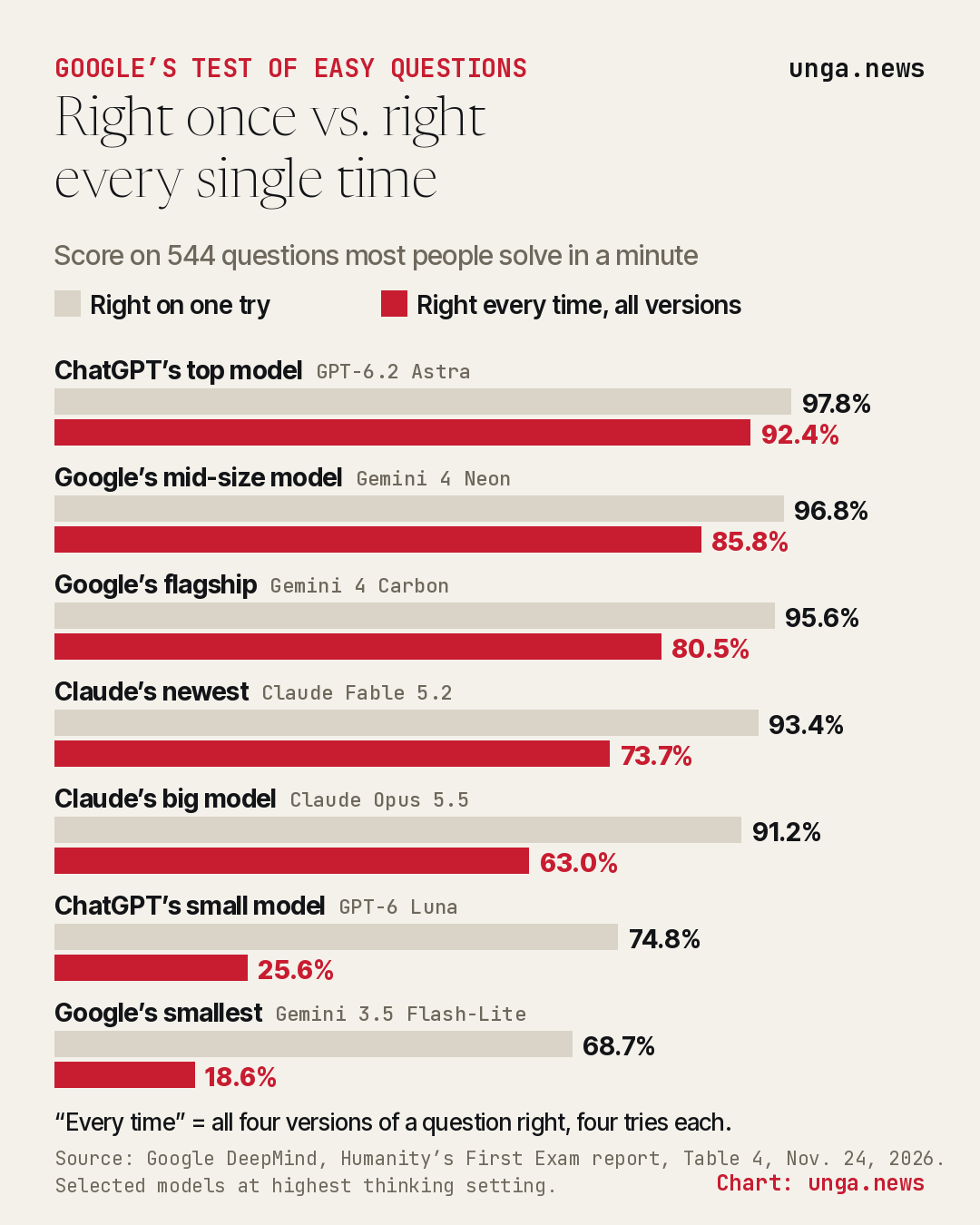
That’s the math of small mistakes. A model that slips 2% or 3% of the time looks great in a demo. But a set only passes after 16 straight correct answers, so tiny error rates pile up fast. Google’s researchers found that about half of the shortfall came from questions a model simply couldn’t do, and the other half came from plain flakiness: getting the same question right some of the time and wrong the rest.
For people, these were easy. Each starter question was checked by four people working without calculators or computers, and only questions that at least three of the four solved made the cut. The median person took about a minute.
Pictures trip them up
The report breaks down where the errors land, and one area stands out. About 73% of wrong answers were problems with seeing: misjudging where something sits or which way a path runs in an image (31%), and miscounting objects (23%). Many misses were close calls. In 40% of failed cases, the answer was off by one or had a single wrong item, the kind of mistake a tired person makes, not a broken machine. Things that overlap or hide behind each other, like keys bunched on a ring, caused trouble again and again.
More thinking time helped with math and word puzzles but barely moved the needle on pictures. When Google turned its flagship Carbon model from high effort down to low, its score on math-style questions crashed from 97.5% to 55.1%. On vision questions it slipped only from 69.9% to 66.8%. In other words, a chatbot can’t simply think its way into seeing better.
A few other findings will sound familiar to anyone who uses these tools. In 8% of wrong answers, the model answered the well-known version of a riddle instead of the changed one actually in front of it. Small models sometimes worked out the right answer step by step and then wrote down a different one, which happened in 42 of 132 such slips. And Claude models refused some of these harmless questions outright, which knocked Opus 5.5 down 4.4 points. The researchers counted those refusals as failures, saying models “should not refuse on the benign, basic tasks” in the test.
Why a test of easy questions is a big deal
Benchmarks usually chase the ceiling: the hardest math, the toughest code. Those make for great headlines. But a person deciding whether to let SI handle a refund, read a medical form or sort a delivery schedule doesn’t care whether it once solved an Olympiad problem. They care whether it gets the boring stuff right every single time.
Google says plainly that “real-world deployment requires evaluations that enable us to measure and raise the reliability floor, not just the capability ceiling.” Credit where it’s due: Google built a public scoreboard on which a rival’s model beats its own, and on which its flagship loses to a cheaper model in the same family. That’s more honest than most company-run scorecards.
There are limits worth keeping in mind. Google wrote the test, picked the questions and used its own Gemini model as the grader, though it says an audit using a Claude model found only about 3% of marked-wrong answers might have been defensible. The main results cover only Google, OpenAI and Anthropic models, so Elon Musk’s Grok and other chatbots aren’t in the headline table. Google’s line that frontier models “have made significant progress” over the past six months is its own claim. And only about 20% of the questions are public, so outsiders can’t check the rest yet.
Anyone can now help keep the test honest. Google posted a live leaderboard on Kaggle, its site for data-science contests, and opened a three-week competition through Dec. 15 asking the public to submit everyday questions today’s chatbots still get wrong.
Until those scores hit 100%, the practical advice is simple. Use these tools, they’re useful. But when the answer matters, like a count, a date, a dose or a dollar figure, check it yourself.
Sources
- Google — We’re launching Humanity’s First Exam and a Kaggle hackathon to test LLM reliability (Nov. 24, 2026)
- Google DeepMind — Humanity’s First Exam: Measuring the Reliability Floor of LLMs, technical report (Nov. 24, 2026)
- Kaggle — Humanity’s First Exam leaderboard
- Kaggle on 𝕏 — Why can frontier AI models write complex code, yet still occasionally stumble… (Nov. 24, 2026)