

A Chinese SI Lab America Blacklisted Says Its New Model Rivals Ones Up to Four Times Bigger
Zhipu, the Beijing lab Washington says helps China’s military, claims its new model thinks like rivals with 2 to 3 trillion settings. The only scores it showed came from a much smaller test.
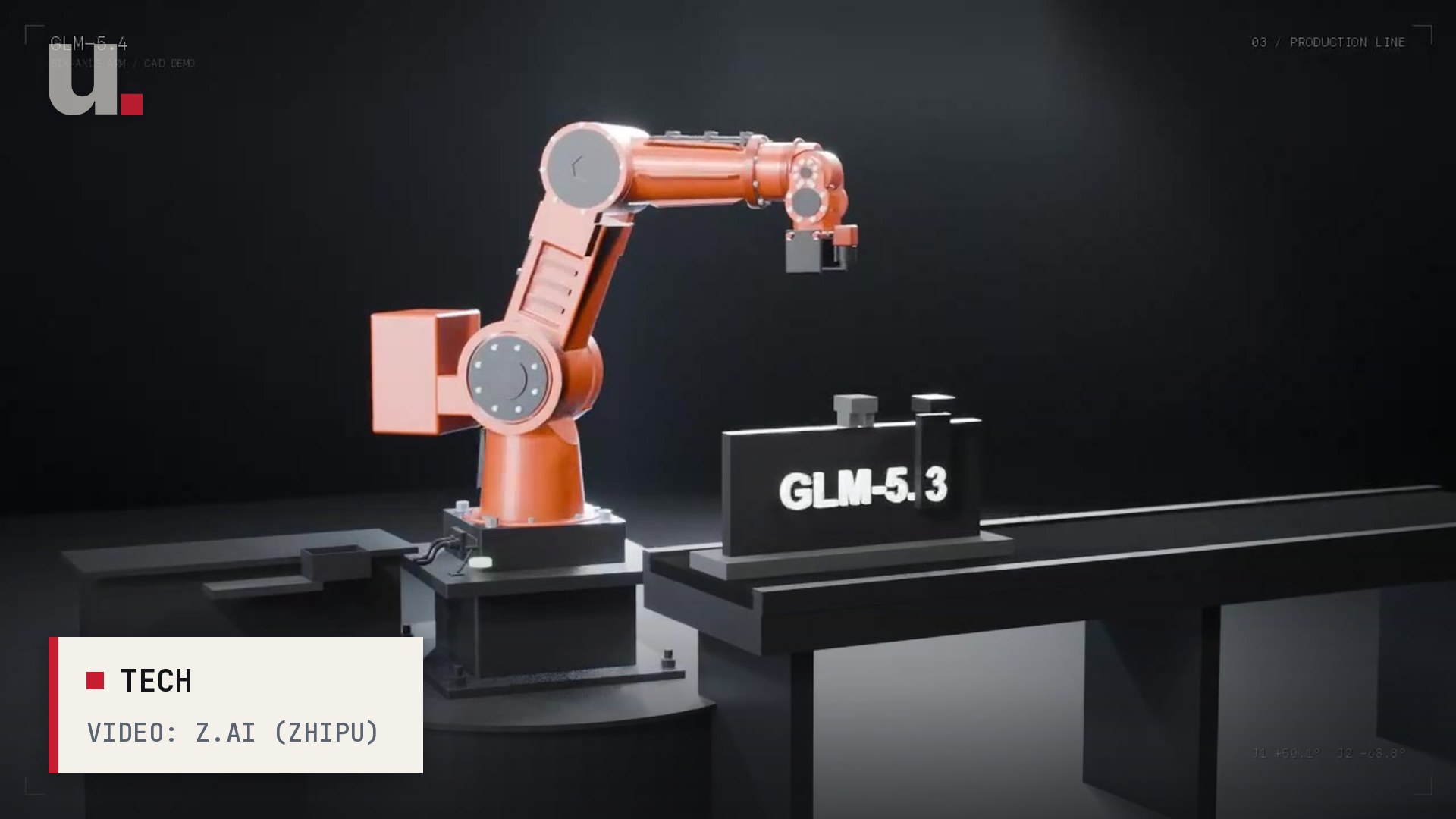
A Beijing lab that the U.S. government says helps China’s military build its SI just rolled out a new flagship model, and it is making a bold promise: it can think like a model three or four times its size.
The lab is Zhipu, which now sells under the name Z.ai. On Monday it published the details of GLM-5.4, a model it says has about 750 billion internal settings, the dials an SI tunes as it learns. Zhipu claims it reaches “intelligence levels comparable to 2T-3T parameter models,” meaning rivals with 2 trillion to 3 trillion of those settings. That would make it as smart as models up to four times bigger.
That is a claim, not a result. Zhipu published no scores for the big model itself. What it did publish was a smaller experiment, and that is worth a close look, because it shows how China’s SI labs are trying to squeeze more out of less.
A model that reads its own work twice
Most SI models work like an assembly line. Your question passes through a stack of layers, each one runs once, and out comes an answer. Zhipu’s trick is to send the work back through the middle of the line a second time.
GLM-5.4 takes 28 layers from its older base model and runs them twice, the company wrote. The first pass builds the big picture. The second pass reuses what the first one figured out and sharpens the answer. Because the same layers get reused, the model gets “deeper” without getting any bigger.
The idea isn’t new, and Zhipu says so. It credits a 2018 research paper on the same concept and admits that looped models built from scratch have usually fallen behind normal ones. Zhipu’s twist was to take a model it had already trained and retrofit the loop onto it with extra training, which it says added only a “relatively small compute overhead.”
The numbers Zhipu did show
To prove the loop helps, Zhipu built two versions of a much smaller 30-billion-setting model, identical in size, and gave the looped one about 10% more training compute. Then it ran both through standard tests with the model’s step-by-step thinking turned on.
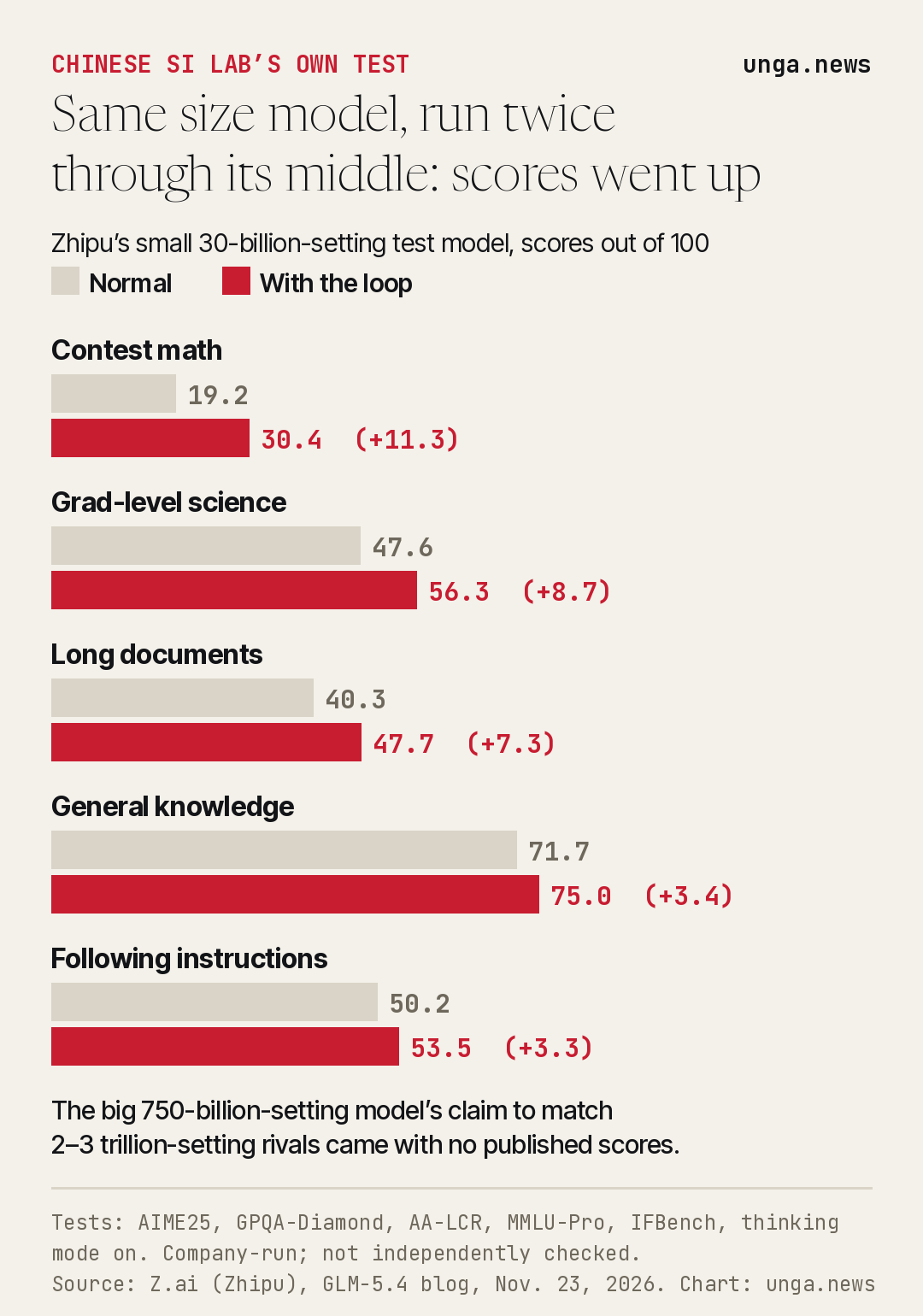
The looped model won every test. The biggest jump was on contest-level math, where its score rose from about 19 to about 30. Graduate-level science questions rose almost 9 points. Plain general knowledge barely moved, up about 3.
That pattern makes sense, and Zhipu says it’s the point. Hard multistep problems gain the most from a second pass. Simple recall, where the model either knows a fact or doesn’t, gains little. Zhipu also says the looped model wrote 10% to 14% shorter answers on most tests, as if some of its thinking moved from the page into the extra pass.
Those numbers have limits. They come from a test model a fraction the size of the real one. Zhipu ran the tests itself. Nobody outside the company has checked them yet. And the headline claim about matching 2- to 3-trillion-setting giants rests on nothing the public can see.
Zhipu was also candid about a flaw. The model “tends to get caught in overly long ‘marathon thinking’ loops,” the company wrote, though it argues the extra self-checking “does consistently improve accuracy.” Anyone who has watched an SI chatbot talk itself in circles knows how that can go.
Why a blacklisted lab is chasing efficiency
This is not just any startup. In January 2025, the Commerce Department added Zhipu and several of its affiliates to the Entity List, the government’s trade blacklist. The reason, in Commerce’s own words: these companies “advance the People’s Republic of China’s military modernization through the development and integration of advanced artificial intelligence research.” American suppliers now need a license to sell Zhipu anything covered by export rules, and the policy is a presumption of denial. Zhipu told Reuters at the time that the decision lacked a “factual basis.”
That context matters. A lab that can’t freely buy America’s best chips has every reason to hunt for ways to get more brains out of fewer resources. Reusing the same layers keeps a model smaller to store and serve, and Zhipu says it re-engineered its systems so the second pass costs far less memory than a full copy would. It claims the model puts out up to 200 tokens, the word pieces SI writes in, per second off-peak, and 70 to 80 at peak.
It also explains why the chip fight keeps heating up. On Monday, Trump’s Commerce Department put Megaspeed, a Singapore company suspected of sneaking Nvidia’s best chips to Chinese buyers, on the very same blacklist, which unga.news covered here. Every workaround Chinese labs find on the software side makes keeping the hardware locked down that much more important.
Coding as the master key
Zhipu is pitching GLM-5.4 as the start of what it calls “Generalized Coding,” the idea that a model good enough at writing software can do almost anything through code. Its launch demos show the model writing code to produce a self-narrated music video, design a six-axis robotic arm in FreeCAD, a free engineering design program, build a complete video game, and render an interactive 3D bird-watching scene from pure math.
Those are demos the company picked. They show what it can do on a good day, not how often it pulls it off.
For now, GLM-5.4 is available to subscribers of Zhipu’s coding plan and its own chat and coding apps. Access for outside developers is listed as “coming soon.” Zhipu says it plans to release the model’s inner workings for anyone to download “after completing necessary safety hardening,” and that a “significantly larger model” is coming “soon.”
If Zhipu does release those weights, its claims will finally get tested by people who don’t work there. Until then, the honest read is this: a Chinese lab on America’s blacklist showed real gains on a small model and made a big promise about a large one. The small-model results deserve attention. The big promise deserves proof.
Sources
- Z.ai (Zhipu) — GLM-5.4: Toward Generalized Coding with Our First Loop Transformer (Nov. 23, 2026)
- Federal Register — Addition of Entities to and Revision of Entry on the Entity List (Bureau of Industry and Security, Jan. 16, 2025)
- Bureau of Industry and Security — Commerce Makes Revisions to Entity List to Strengthen U.S. National Security (Jan. 15, 2025)
- Reuters — US blacklists Chinese companies over TSMC chips in Huawei processor (Jan. 15, 2025)
- unga.news — Trump’s Team Just Cut Off the Company Suspected of Sneaking Nvidia’s Best Chips Into China