

Trump’s Team Just Cut Off the Company Suspected of Sneaking Nvidia’s Best Chips Into China
The Commerce Department blacklisted Megaspeed and six related companies in Singapore, Malaysia and Thailand on Monday. Selling them American chips, software or parts now takes a license the government plans to deny.

The company at the heart of the Nvidia spy story just lost its pipeline to American technology. On Monday afternoon, the Commerce Department put Megaspeed, a Singapore data center firm suspected of passing Nvidia’s most powerful chips to Chinese buyers, on the federal trade blacklist known as the Entity List. Six of its affiliates and partner companies went on the list with it.
The move came just hours after Nvidia’s board brought Jensen Huang back as CEO at President Trump’s urging. Put the two together and the message from this administration is pretty clear. America wants its best chip company led by its founder and selling to the world, and it wants the side doors into China shut.
What the blacklist actually does
The rule filed with the Federal Register names seven companies across three countries. In Malaysia: MSFusion, PT Megaspeed International and Speedmatrix, the Megaspeed subsidiary that took in most of the chips. In Singapore: Megaspeed International itself, which also goes by the name 7Road International, plus Apex Enterprise Solutions and Swiftdata. In Thailand: Megaspeed (Thailand) Co.
The government doesn’t pull its punches on the reason. The companies were added “because of the significant risk of these entities being or becoming involved in the diversion of advanced computing commodities to unauthorized end uses or end users,” the rule says. In plain English, Washington believes there’s a real risk they’re routing top-shelf chips to people who aren’t allowed to have them.
The penalty is about as tough as export rules get. Any American company that wants to sell these seven firms anything covered by U.S. export law now needs a license first, and the government will start from “a presumption of denial.” That covers far more than chips. It reaches software, parts and technology too.
“The Commerce Department placed Megaspeed on the Entity List. This makes it unlawful to export any US-origin goods, software, or technology to Megaspeed,” Commerce spokesman Thomas Wackman told Semafor, which first reported the plan. “It is also now unlawful to export advanced SI chips to Megaspeed, even if the chips are produced outside the United States. Commerce will continue to vigorously enforce export controls, including these new Entity Listings.”
That last line about chips made outside the United States matters. Most of the world’s top chips are made in Taiwan, not here. Without that reach, a company on the blacklist could try to buy American-designed chips made overseas and call it legal. Commerce is saying that trick won’t work.
There’s one small grace period. Shipments that were already on a ship or plane when the rule was filed can still be delivered, as long as they arrive within 30 days. The rule was filed Monday at 4:15 p.m. Eastern and formally publishes Wednesday.
How billions in chips ended up near China
Megaspeed isn’t a household name, but its numbers are hard to ignore. Trade records from the data firm ImportGenius, cited by The New York Times, show Speedmatrix received at least $4.8 billion in equipment containing Nvidia chips between June 2024 and February 2026. Much of it went to data centers in Malaysia and Indonesia that appeared to serve customers in China, according to the Times.
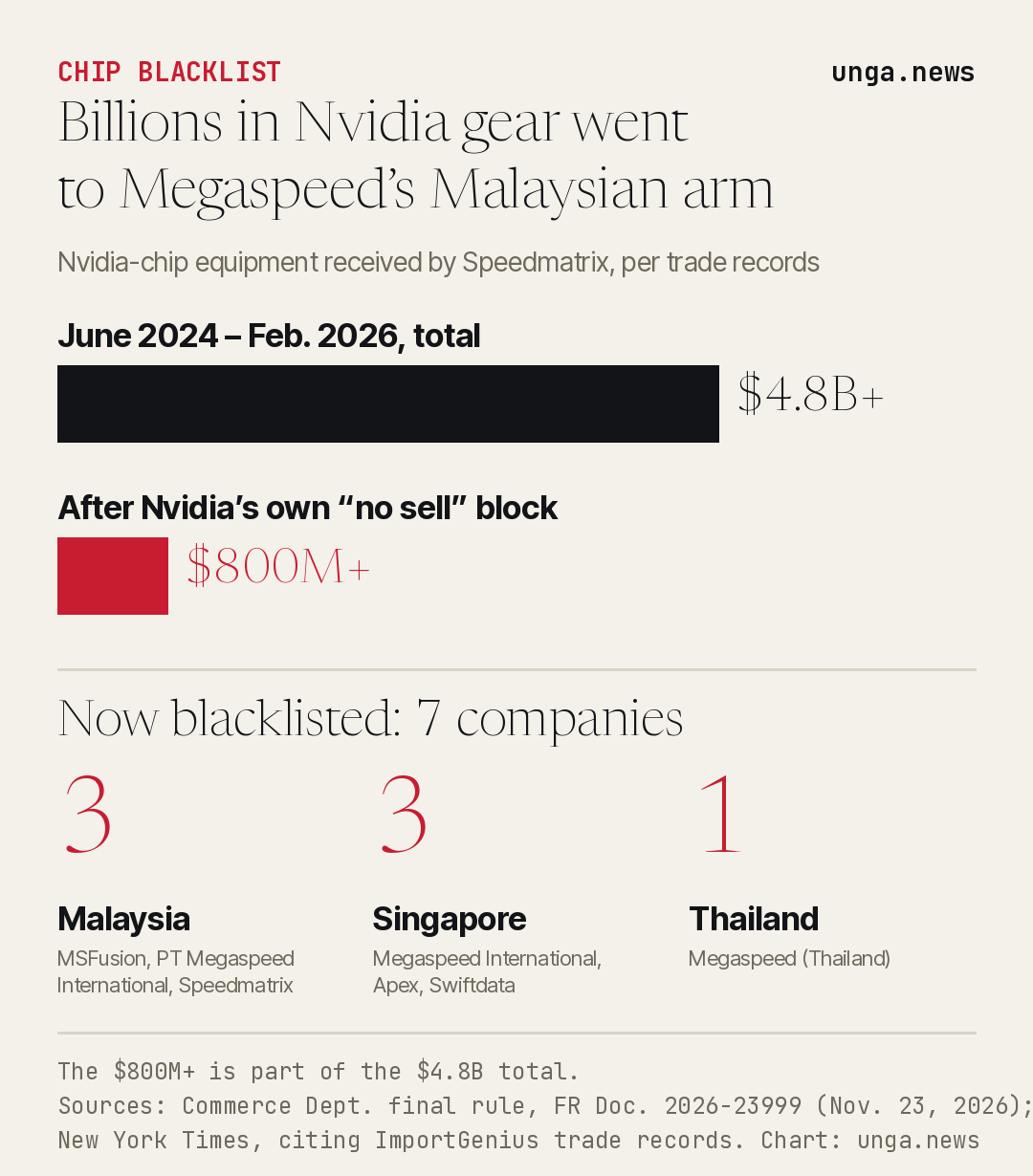
Nvidia says it put Megaspeed on its own “no sell” list in June 2025, a date Commerce has repeated. Yet the same trade records show Speedmatrix kept receiving more than $800 million of export-controlled Nvidia technology afterward, including Blackwell and H200 chips that are banned from China, the Times reported. Most of it came through server makers that buy Nvidia chips and build them into machines, which is exactly the kind of gap a blacklist is meant to close. A company block only covers what the company sells directly. The Entity List covers everyone.
Megaspeed says it follows all laws. Nvidia has said its own review found no sign Megaspeed was diverting chips to China. No one has been charged, and the Justice Department’s criminal investigation is still open. The blacklist isn’t a verdict. It’s a lock on the door while investigators finish the job.
The spy angle is what made this a national story. Megaspeed was created and run for a time by Alice Huang, a Chinese citizen whom U.S. officials believe China’s Ministry of State Security recruited as an intelligence asset, according to the Times. Her affair with Jensen Huang, who is not related to her, became public this month. China denies she’s a spy. Megaspeed says she no longer has any role there.
A crackdown that kept building
This didn’t come out of nowhere. Commerce says it opened its investigation into Megaspeed in 2024, asked Nvidia for its sales records in May 2025 and sent officials to interview Alice Huang that June. Last week, the Justice and Commerce departments took the unusual step of announcing a criminal investigation in public, promising to “bring the full extent of the law against Megaspeed for any criminal conduct that may have occurred.”
Treasury Secretary Scott Bessent had been pushing for the blacklist for months. He said Treasury, the Pentagon, the State Department and the U.S. trade office all backed it, but “Commerce holds the pen.” On Sunday he called Megaspeed a possible “pass-through company, a front company based in Singapore, to get the high-end chips to Chinese entities,” and unga.news covered his demand that Nvidia explain by Wednesday how its chips reached China. Monday, Commerce signed off.
It also lines up with the rule Commerce put out last week to stop Chinese companies from renting American chip power through data centers in Southeast Asia. Malaysia, Singapore and Thailand, the three countries named Monday, were all on that rule’s list. And Commerce says it has charged 17 defendants across six chip-smuggling investigations, with penalties sharply higher than under the Biden administration.
That’s the real story here. For years, the soft spot in America’s chip rules was never the factories. It was the middlemen: shell companies and rented servers in friendly countries a short hop from China. The Trump administration is going after them one by one, and on the same day it put Nvidia back in its founder’s hands.
Nvidia’s deadline to answer Treasury is Wednesday, the same day this blacklist hits the Federal Register. Megaspeed already has its answer from Washington. No more American chips.
Sources
- Federal Register (Commerce Department) — Additions to the Entity List, FR Doc. 2026-23999 (filed Nov. 23, 2026)
- Federal Register — Additions to the Entity List, public inspection text
- Semafor — Commerce adds Megaspeed to trade blacklist (Nov. 23, 2026)
- BBC News — US to blacklist Asian AI firm Megaspeed after Nvidia scandal (Nov. 23, 2026)
- New York Times via Philadelphia Inquirer — Facing criticism, Trump administration says it’s investigating Megaspeed (Nov. 17, 2026)
- The New York Times — A Mystery C.E.O. and Billions in Sales: Is China Buying Banned Nvidia Chips? (Oct. 9, 2025)
- CBS News — Transcript: Treasury Secretary Scott Bessent on “Face the Nation,” Nov. 22, 2026
- unga.news — Treasury Gave Nvidia Until Wednesday to Explain How Its Chips Reached China. It’s Still Waiting.
- unga.news — America Shuts the Back Door Chinese Companies Used to Rent Its Best SI Chips