

Treasury Gave Nvidia Until Wednesday to Explain How Its Chips Reached China. It’s Still Waiting.
Treasury Secretary Scott Bessent says the administration still has no answers on whether Nvidia used front companies to sell its top chips into China, or how high up it went.
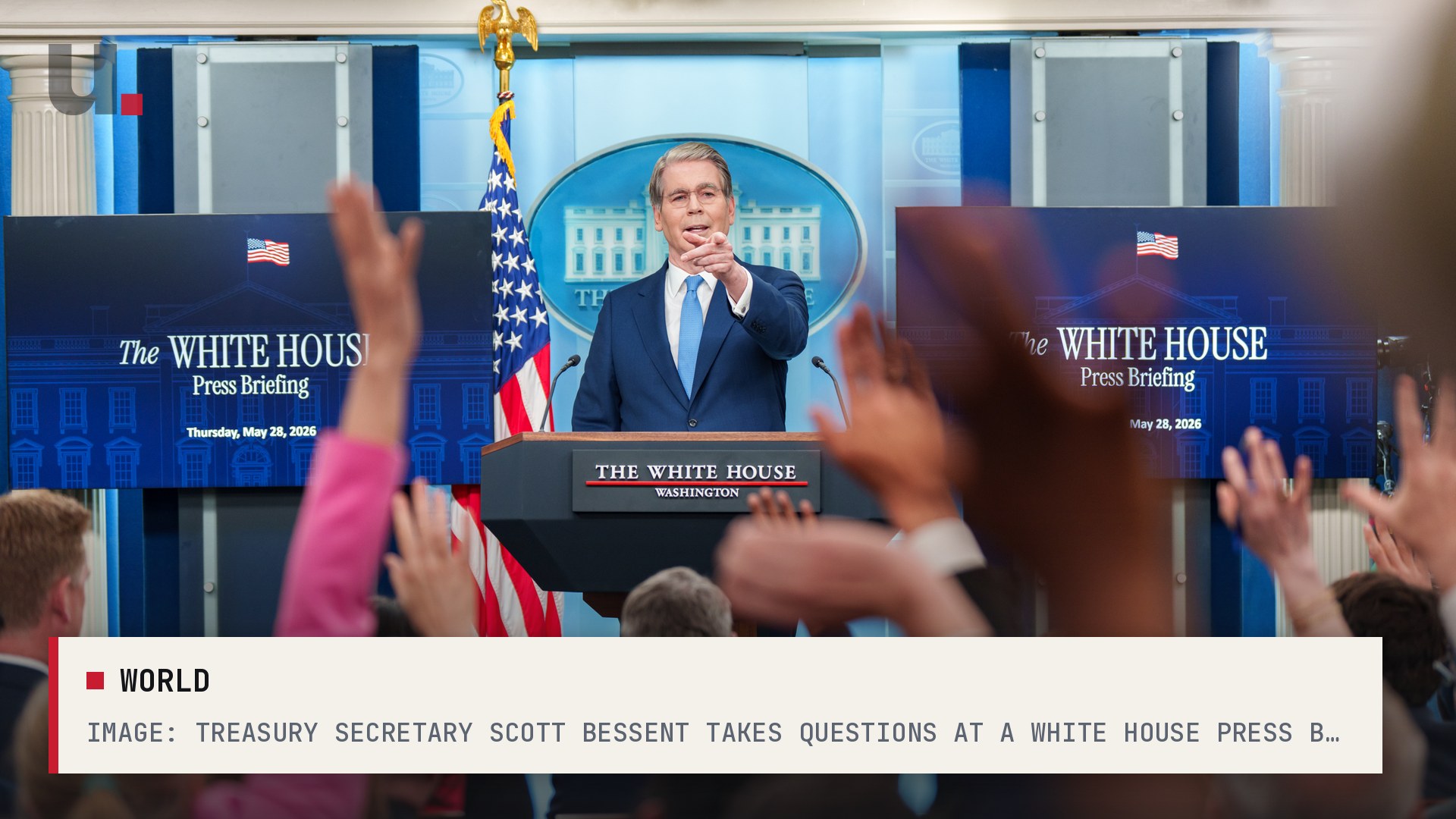
Treasury Secretary Scott Bessent went on national television Sunday morning with a blunt update on Nvidia: the administration is still waiting. Three days before the deadline his department set, the company whose chips power nearly every big SI system in the world has not explained whether it used front companies to get its most powerful hardware into China.
“We’ve been in touch with the temporary management, with the lead directors, with their lawyers, and we do need answers,” Bessent told Margaret Brennan on CBS’s “Face the Nation.” When she asked whether Nvidia had delivered, his first words were short: “We don’t, Margaret.”
Last week Bessent gave Nvidia until Nov. 25 to say whether it used shell companies to get around federal export rules and sell its best chips to Chinese buyers, Politico reported. On Sunday he laid out exactly what the administration wants to learn. “Was it at the lower levels? Was it the middle levels? Did it go all the way to the top?”
He also made clear that speed is in Nvidia’s own interest. “It behooves Nvidia to move quickly on this because we want to know what the culture was,” he said. Brennan noted that Bessent had talked last Sunday about a possible “culture of non-compliance” at the company. Bessent stressed that the key word was “possibility,” and said he has confidence the company’s board committees “will come up with some very fulsome and robust answers.”
A Singapore Company in the Middle of It
The company at the center of the fight is Megaspeed, a Singapore data center firm the government suspects of buying Nvidia chips to serve Chinese customers. Brennan described it as the company run by Alice Huang, the woman reportedly tied to Chinese security whose affair with Jensen Huang came out before he resigned as Nvidia’s CEO on Nov. 12. The company’s finance chief now runs Nvidia on an interim basis.
“We will see if Megaspeed was indeed a pass-through company, a front company based in Singapore, to get the high-end chips to Chinese entities,” Bessent said. He added that Nvidia pulled Megaspeed off its sales list in August 2025, “so they wouldn’t have gotten any chips since then,” and that Treasury and several other departments have pushed to put it on the federal blacklist.
Bessent brushed aside the idea that the truth is buried in handshake deals with no paper trail. “For deals that size, there’s no such thing as an untraceable handshake deal,” he said. “There are money movements.” He also said the question isn’t one man’s private life but whether a whole company looked the other way, calling the focus on Huang’s personal “foibles” a “canard” next to the compliance question.
Chipmakers Asked for 3.4 Million. Commerce Said Yes to About One in Four.
The numbers behind the fight came out Thursday, when House Foreign Affairs Chairman Brian Mast, a Florida Republican, used his power under the Export Control Reform Act to make Commerce Department licensing records public. His committee called it the most detailed disclosure in the law’s history.
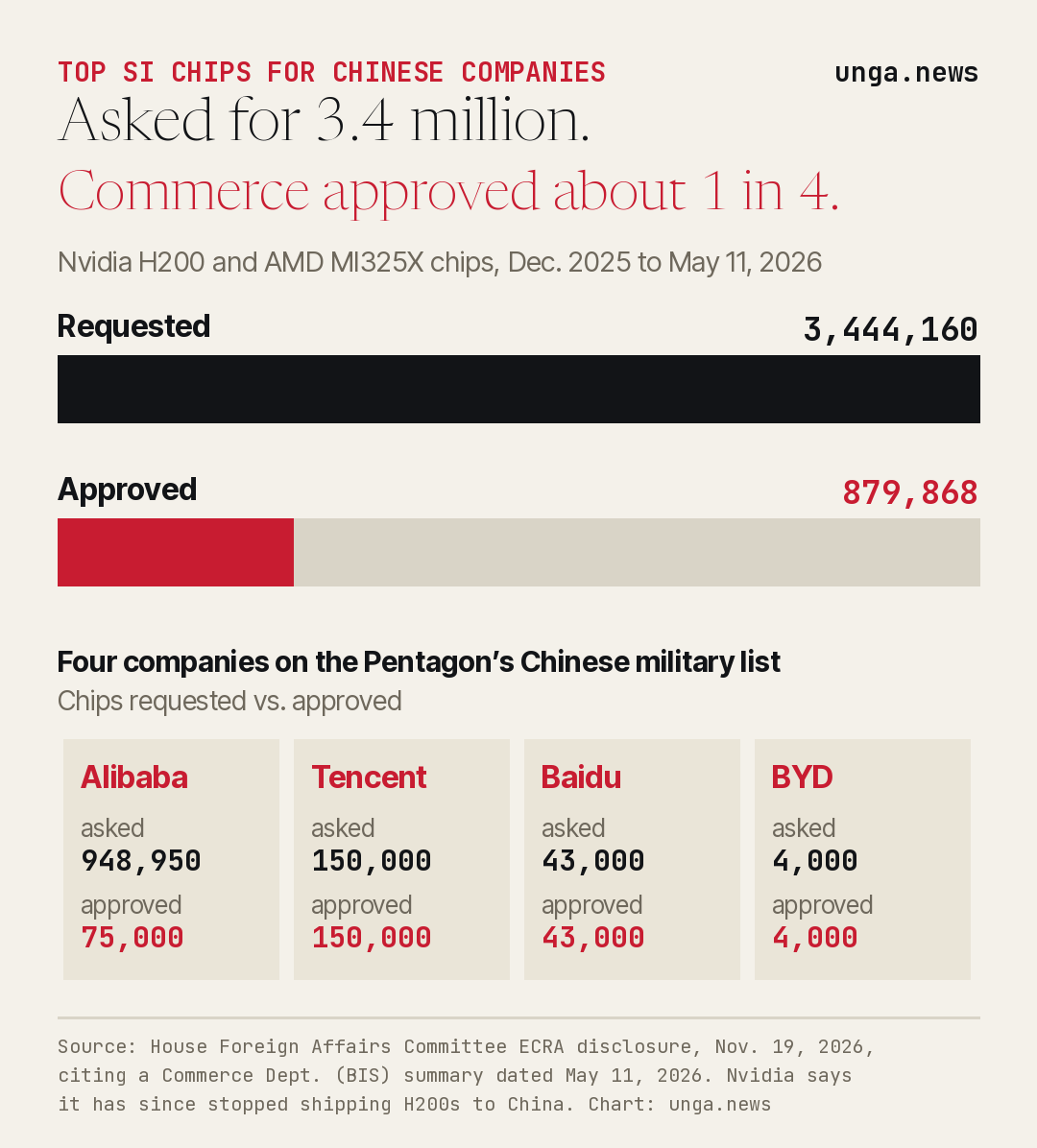
According to a Commerce summary dated May 11, Nvidia and AMD sought licenses to sell 3,444,160 of their top chips, Nvidia’s H200 and AMD’s MI325X, to Chinese companies. Commerce approved 879,868 of them across 21 licenses. That is roughly one chip approved for every four requested.
The biggest cut hit Alibaba. It asked for 948,950 chips and was cleared for 75,000. Tencent got all 150,000 it requested, Baidu 43,000 and BYD 4,000. All four companies sit on the Pentagon’s list of Chinese military companies. The committee also found that almost every Nvidia application named the same handful of Chinese firms, including Maginfra, Beijing New Matrix Information Technologies, ZTE Kangxun and Lenovo, as companies that “may install the systems in the datacenter.” Every Nvidia and AMD application rated the risk that chips would be diverted as “low.” Mast’s release said the files include requests by Nvidia “to depend on possible chip-smuggling fronts.”
Brennan pressed Bessent on why any chips went to companies on the Pentagon’s list. He said the president has “drawn a very hard line” at the H200 and that Alibaba is mainly an online platform. “This isn’t Chinese military,” he said. “These are companies that do business with the Chinese military.”
The Commerce Department told Reuters its H200 licensing rests on a January 2026 rule that “imposes significant additional national security-related requirements on license applicants,” replacing an automatic no with case-by-case review. Nvidia said the approvals were “subject to strict conditions and limited volumes” and that “despite receiving some licenses, we have since stopped shipping H200s to China.” It is not clear how many approved chips actually shipped.
Shutting the Rental Loophole and Bringing Chips Home
Bessent pointed to a move he called possibly more important than any blacklist: last week’s remote access rule, which stops certain countries and companies from renting American chip power through leased data center capacity. unga.news covered that rule when Commerce rolled it out. Brennan listed the countries affected as Singapore, Malaysia, Thailand, Indonesia and Brazil.
He tied the Nvidia fight to the president’s bigger goal of keeping America’s best technology at home. Trump said Friday he will put “tremendous penalties” on companies that build data centers in other countries. Bessent said the president is “very concerned that we don’t do a big technology transfer offshore,” and noted that 97% of the most advanced chips are now made in Taiwan, which he called “a strategic vulnerability.” With TSMC building large factories in Arizona, he said, “we hope to have substantial onshoring of the chip business by the end of this administration.”
None of that changed his view of Nvidia as a business. “Nvidia is one of our great companies,” he said, pointing to “near unlimited demand for their chips worldwide.” The company has until Wednesday to show Washington whether the rule-breaking, if it happened, stopped with a few bad actors or reached the people in charge. Bessent said Sunday he wants to know “where the buck stops.”
Sources
- CBS News — Transcript: Treasury Secretary Scott Bessent on “Face the Nation with Margaret Brennan,” Nov. 22, 2026
- Politico — Treasury Department still waiting for answers from Nvidia (Nov. 22, 2026)
- House Foreign Affairs Committee — Chairman Brian Mast Exercises Legislative Authority to Publicly Release AI Chip License Information for China (Nov. 19, 2026)
- House Foreign Affairs Committee — ECRA disclosure summary of BIS license decisions (Nov. 19, 2026, PDF)
- Reuters via Business Recorder — US signed off on sales of nearly 900,000 AI chips to China in six months (Nov. 22, 2026)
- CNBC — Commerce approved sales of more than 879,000 AI chips to China: Mast (Nov. 19, 2026)