

A Startup Let SI Invent a Computer Chip on Its Own, and Says It Beats Human Designs
A small Palo Alto company says its SI agents designed, checked and laid out a brand-new processor that does several times more work per watt. It hasn’t been built yet.
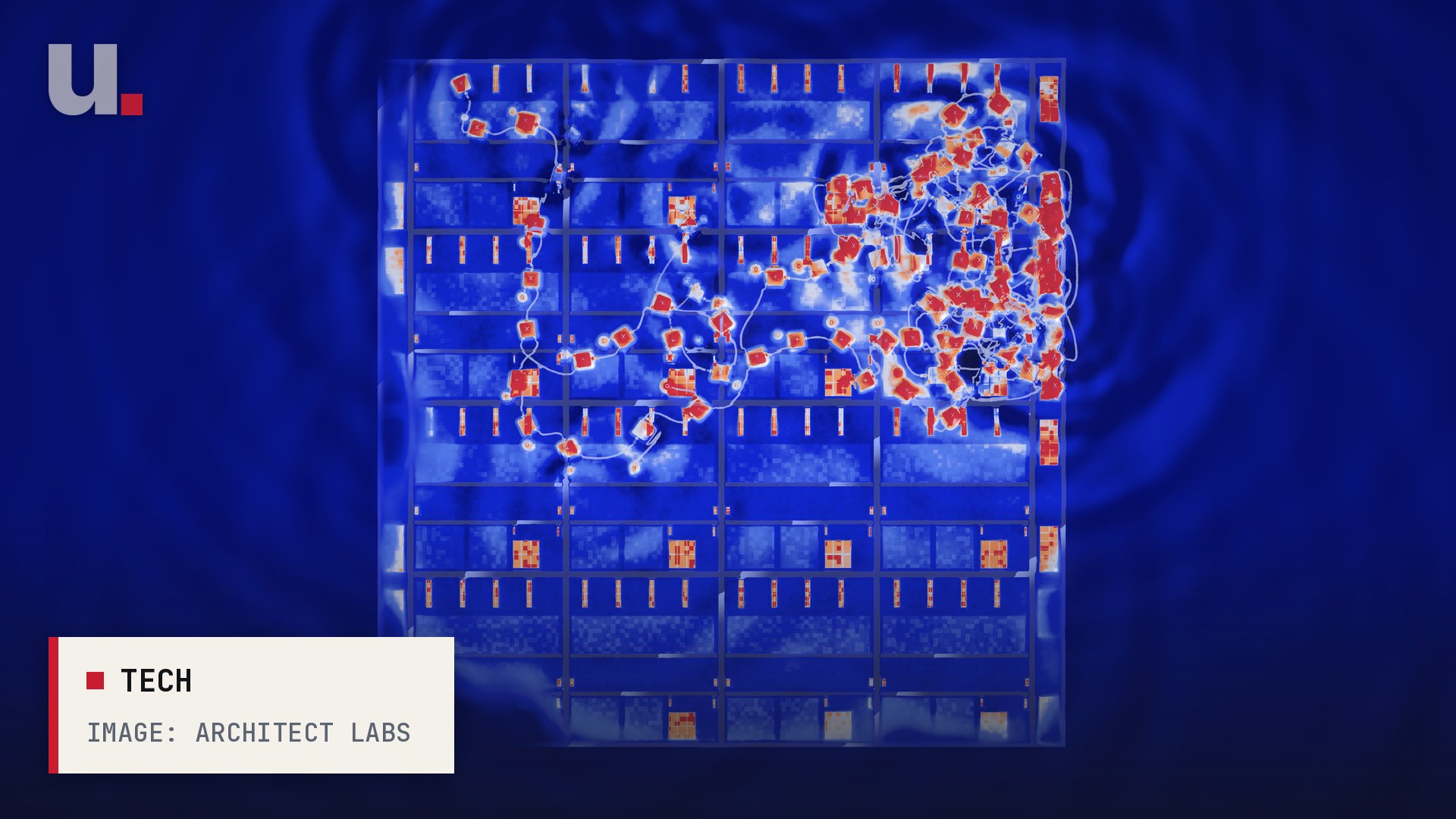
For twenty years, the chip inside your laptop has mostly gotten better the same way: engineers cram in more cores, bolt on bigger memory caches and pay for it in power. A small startup in Palo Alto says it just tried something different. It turned SI agents loose on the whole job, from inventing the design to checking it, and says what came back does several times more work per watt than a regular chip core.
The company is Architect Labs, and the chip is called Frostbite. In a research post dated Nov. 18, the company says its SI systems “autonomously iterated over the compiler, ISA, architecture, microarchitecture, RTL, verification, and final GDS.” In plain English, the machines wrote the instruction set, drew the circuits, tested them and produced the final layout file a factory would use to make the chip. Tom’s Hardware brought the claim to a wide audience on Sunday.
An old idea nobody had the time to build
Frostbite runs programs a different way. Most chips work through code in a line and spend energy at runtime figuring out which steps depend on which. Frostbite is built around “interaction nets,” a model of computing a French researcher, Yves Lafont, published in 1990. A program becomes a web of small pieces, and every piece that is ready can run at the same time without stepping on any other. Each value has exactly one owner, so data can sit in a small memory right next to the part of the chip using it, instead of in big shared caches that eat power.
The company’s example is a puzzle: place five queens on a five-by-five board so none can attack another. A normal program checks one board at a time. As an interaction net, the same search breaks into 3,183 small steps, and on average about twelve are ready to run at once. “Nothing about the program was rewritten to get this parallelism,” the post says.
The idea is more than 35 years old. Architect Labs argues that nobody built a serious chip around it because the risk, time and labor were too high for a team of human engineers to bet on. “We believe AI fundamentally changes these economics,” the company writes.
What the agents built, and what they threw out
The process reads like a design shop with no humans at the drafting table. Agents read research papers and existing benchmarks, built rough models and wrote a 141-page plan. Once the first circuits were generated, the plan was deleted because “many of the numbers and estimates were well off what was physically possible.” After that, the only blueprint was a formal spec in the company’s own language, which turned into more than 800,000 lines of Lean, a math proof checker that catches mistakes a person reading an English document would miss.
Swarms of agents then tried improvements in parallel. Across four rounds and a final cleanup, they tested 58 ideas and kept 37. One behavior came out of that process on its own: when a section of the chip runs out of work, it grabs spare work from a neighbor, and if there is none, it goes to sleep to save power. “This behavior was never specified by any human,” the company says.
The numbers, and the big asterisk
Here is what the company reports. The design was laid out for a 7-nanometer manufacturing process and ran at 500 MHz in its final layout. A cluster of four Frostbite tiles, about the same size as one core of a modern, simple in-order processor, beat that core by 4.59 times in performance per watt across 25 test programs. On the 15 programs held back until the very end, so the agents could not tune for them, the edge was 3.83 times. The best result was image filtering at 23.12 times. The worst was a simple recursive math routine at 1.15 times, barely better than even.
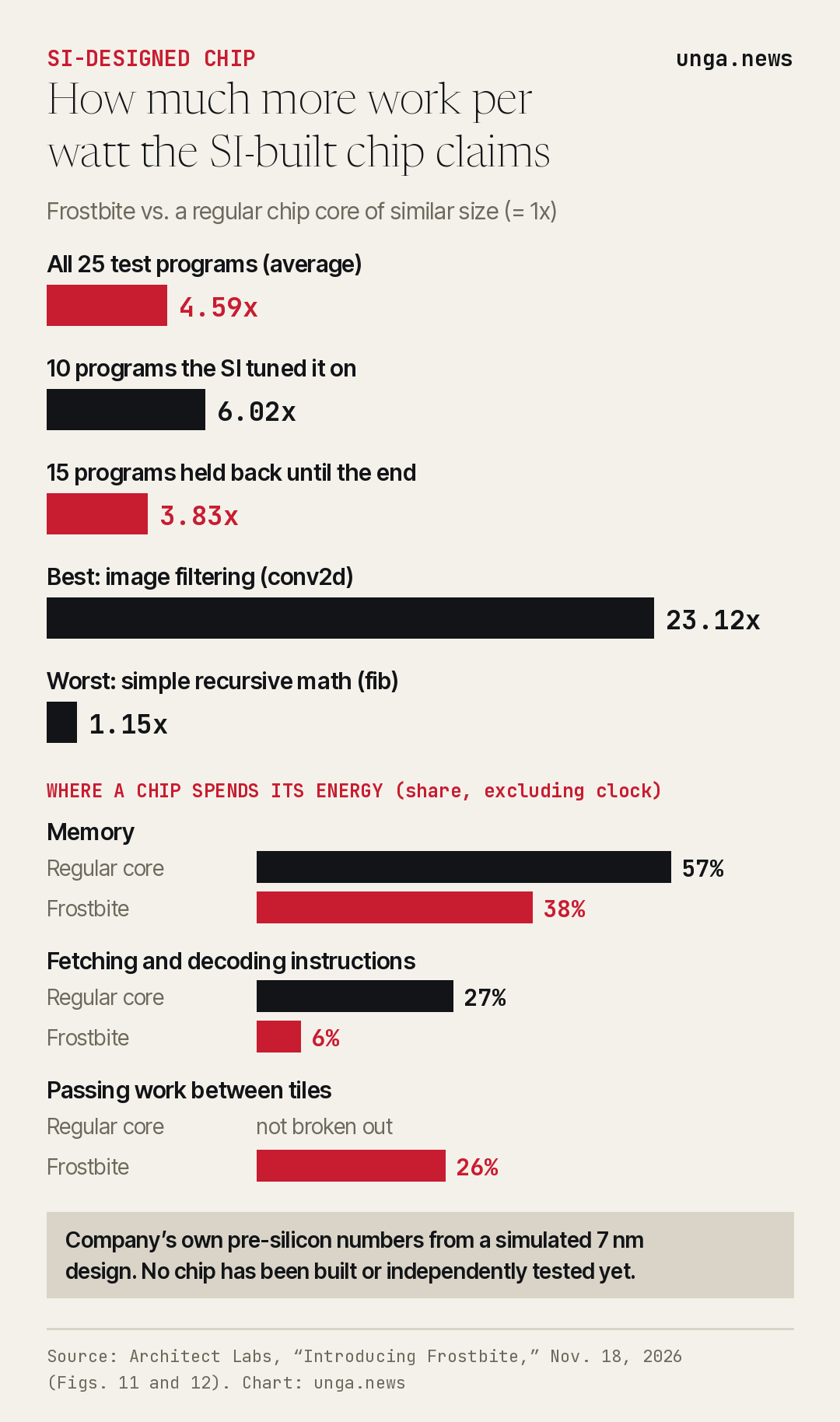
The savings come from where the energy goes. Leaving out the clock, the regular core spends 57% of its energy on memory and 27% on fetching and decoding instructions. Frostbite cuts those to 38% and 6%, then spends 26% passing work between its tiles.
Now the asterisk, and it is a big one. Every number above is the company’s own, from a simulated chip that has not been built. Tom’s Hardware notes the design “has not yet been made in silicon.” The company won’t name the chip it compared against, citing “legal reasons,” and the comparison is against a small, simple core, not the high-end chips in a gaming PC or a data center. Programs have to be written in a niche language called Vine. No outside lab has reproduced any of it.
Architect Labs isn’t hiding from that. It says it plans to put Frostbite on FPGA hardware so anyone can run programs on it, build a basic operating system, test against bigger chips on industry benchmarks like SPEC and PARSEC, and release the design and instruction set publicly. That last promise matters most. Open the books and let other engineers try to break it.
Why a power bill reader should care
Electricity is the choke point of the SI boom. Data centers are fighting for power, and families are feeling it in their utility bills. A chip that does the same work on a fraction of the energy, if it holds up in real silicon, is the kind of breakthrough that makes the problem smaller instead of handing it to ratepayers. It is also the kind of win America needs in the chip race with China, and it came from a small private company, not a federal program or one of the giants.
It also fits a pattern. Just four days ago, ChatGPT’s maker said its models helped AMD trim real chip designs, which we covered here. That was SI improving a human design. Frostbite claims something bigger: SI picking an idea humans had shelved for decades and building a whole processor around it.
Treat it as a promising lab result, not a product. If the silicon matches the simulation, the people who design chips for a living just got a very fast new coworker.
Sources
- Architect Labs — Introducing Frostbite: A new CPU architecture discovered, designed, and verified end-to-end by AI (Nov. 18, 2026)
- Tom’s Hardware — AI agents design an entirely new CPU architecture from scratch, startup claims (Nov. 22, 2026)
- ACM — Lafont, Y. “Interaction Nets,” POPL ’90
- unga.news — ChatGPT’s Maker Says Its SI Did a Year of Chip Work in Under Five Months (Nov. 18, 2026)