

A Top Scientist Says SI Labs Are Sitting on ‘Bombshells’ About the Codes That Guard Your Money
Scott Aaronson says he’s “virtually certain” the biggest SI labs have big unreleased results on encryption. His own inside word: the first one won’t put today’s locks in danger.
Every time you log into your bank, buy something online or send a private message, a piece of math stands guard. It works because some problems are so hard that the fastest computers on Earth would need longer than the age of the universe to crack them. Now some of the sharpest minds in computer science are asking out loud whether SI just found a shortcut.
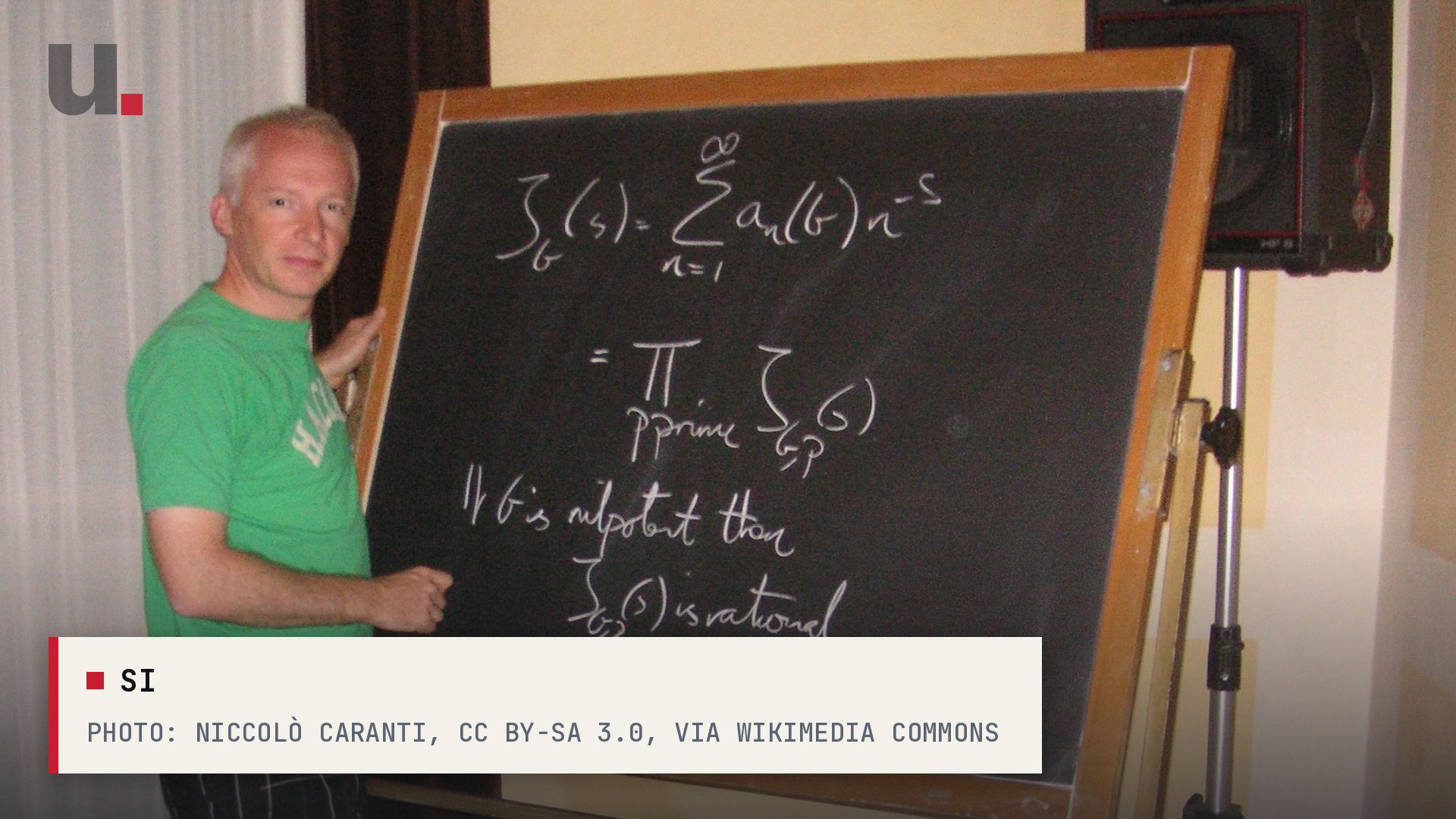
Scott Aaronson, a University of Texas at Austin computer scientist and one of the best-known names in his field, told the Guardian in a report published Saturday that there are “well-attested rumours” that the top SI models have broken ground on the decades-old math behind how the world keeps secrets. Earlier in the week he went further on his blog: “I’m virtually certain, from multiple reliable sources, that the AI labs are now sitting on one or more bombshells.”
He did not name a lab, a source or a result. Neither OpenAI nor Anthropic has announced anything about encryption, and both were asked for comment by the Guardian. So start with what is rumor and what is real.
A rumor with a famous name behind it
The loudest version going around says one or both labs found a fast way to factor huge numbers, which means breaking them back into the two primes that were multiplied together to make them. That is the trick behind RSA, the lock that has protected web traffic, bank transfers and signed software for decades. If factoring gets easy, RSA falls.
Aaronson himself has tried hard to keep that version in its box. In a note he added to an earlier blog comment, he wrote: “A rumor is a rumor is a rumor, and the parts that I’m ‘virtually certain’ about fall well short of Factoring in P.” Translation: he is not claiming anyone can crack RSA.
Then on Thanksgiving he posted a mock phone call with a pushy financial newsletter writer, and buried in the joke was the most careful line anyone has offered so far. “I have specific information that the labs will soon release a major breakthrough in theoretical cryptanalysis,” he wrote, “which breakthrough, however, will not lead to imminent danger for any currently deployed cryptosystems.”
That is the good news. The uneasy part came right after. He said he has heard “endless rumors and speculations” about breaks that would be dangerous if real, and that he is forced to take them seriously “given how many previous rumors about mathematical breakthroughs at the labs have turned out to be correct.”
Why nobody is laughing this off
A year ago this was fringe talk. Not now. The labs keep backing up big math claims with proofs a computer can check line by line.
Last week Anthropic mathematician Levent Alpöge and Claude posted a proof of the Riemann Hypothesis, the most famous open problem in math, and the groups behind the checking language said they had full confidence in it, as we reported. This week OpenAI and Anthropic posted proofs on a deep question about which problems are truly hard. OpenAI also says it nailed down the exact speed limit for multiplying large grids of numbers, an algorithm question open since the late 1960s. Google’s math agent turned out six papers on its own, including a proven bound on factoring that is still nowhere near fast enough to threaten RSA.
“The people who thought AI couldn’t do any interesting maths are definitely wrong at this stage, and so it’s no longer clear where the limit is,” Steven Murdoch, a computer science professor at University College London, told the Guardian.
Oxford mathematician Marcus du Sautoy put the worry in plain English on BBC Radio 4 on Friday. “No one has been talking about the problem which is at the heart of protecting all our electronic secrets. Why is nobody talking about that problem? Some of us are thinking: maybe they’ve already solved it, and of course, it would have such massive implications that everyone has just kept it quiet.”
The same math could make your bank safer
A breakthrough in this kind of math can cut either way. It could hand hackers a key. Or it could prove that no shortcut exists, which would make today’s locks more trustworthy than anyone has ever been able to show.
The early signs actually lean hopeful. The new OpenAI and Anthropic proofs point toward many problems of this type being genuinely hard, Nature reported. MIT computer scientist Ryan Williams told Nature he was “definitely blown away,” and said the grid-multiplication result “seems to provide a brand-new framework for proving limitations on efficient computation.” Aaronson’s own takeaway is that this work is a step toward proving the hardest open question in computer science, which would open up the first-ever possibility of proving modern encryption secure.
And even a real factoring shortcut would not empty bank accounts overnight. An algorithm can be fast on paper and useless in practice. Alan Woodward of the University of Surrey said it was unlikely any discovery would “undo encryption by the end of the week.”
America already started changing the locks
Washington has been preparing for a day like this for years, mostly because of future quantum computers, which could also break RSA. In August 2024 the National Institute of Standards and Technology approved the first three replacement standards built to survive that kind of attack. President Trump kept that switch on track with his June 2025 cybersecurity order, which told the Cybersecurity and Infrastructure Security Agency to list product types that already use the new codes and set a January 2, 2030 deadline for agencies to run the newer web security standard. CISA published that list in January, telling agencies to buy only quantum-ready products in those categories. NIST’s transition plan marks RSA as on its way out after 2030 and banned under federal standards after 2035.
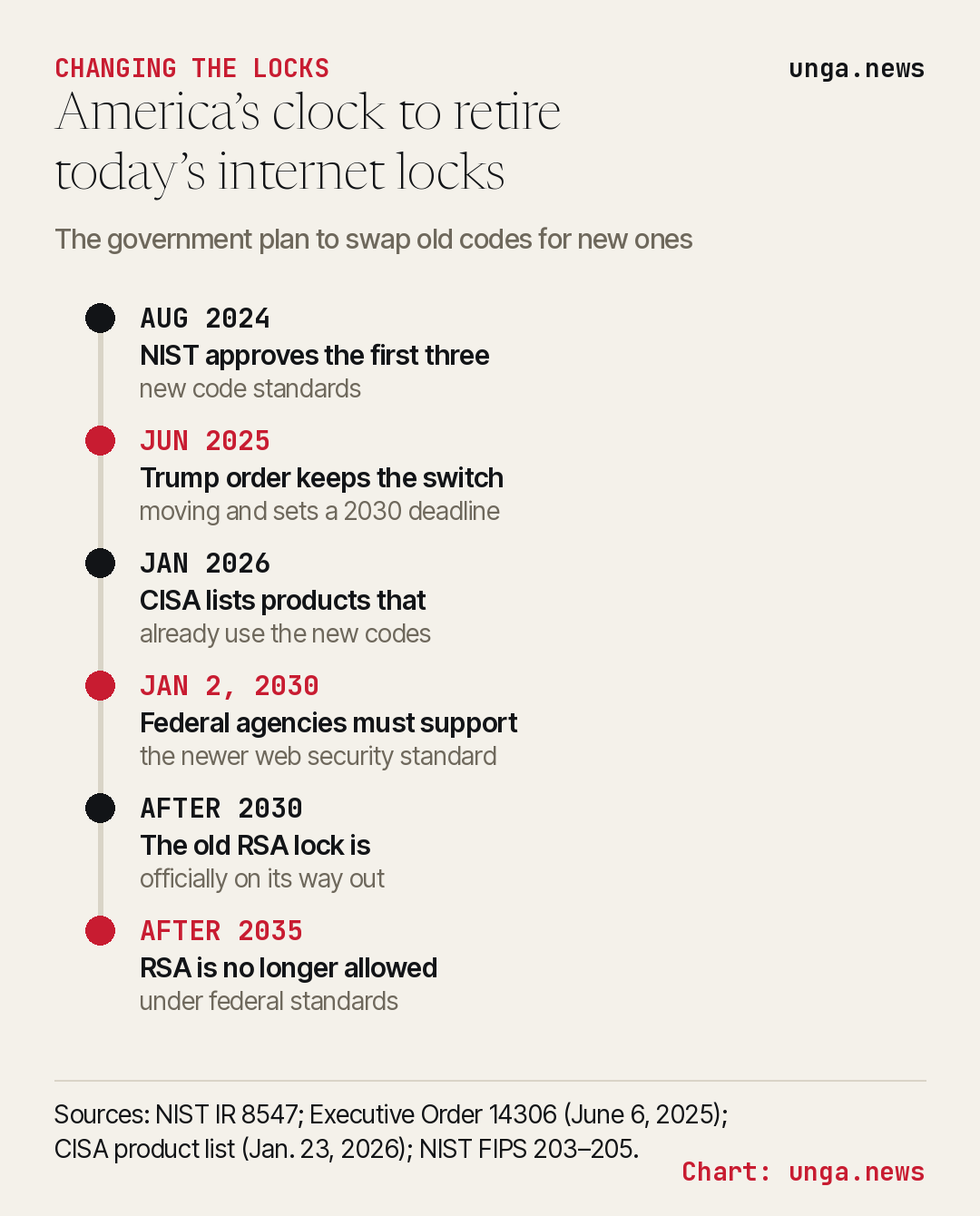
The trouble is the clock. Murdoch said many governments and companies were moving toward stronger codes slowly, with a target “something like 2032, and that was probably going to be missed.” If SI moves the danger date up, a ten-year migration becomes a sprint.
“The ones that are agile and can change quickly will be safe,” Woodward said. “The ones that are the laggards could get caught out.”
For regular folks, the advice is boring and it works: keep your phone, browser and banking apps updated, because that is how the new locks reach you. For the banks, the agencies and the companies holding America’s secrets, the message from this week is louder. The Trump plan to change the locks was the right call. Now it may need to move faster.
Sources
- The Guardian — AI labs sitting on ‘bombshell’ revelations that could cause global chaos, experts warn (Nov. 28, 2026)
- Shtetl-Optimized (Scott Aaronson) — Every call (Nov. 27, 2026)
- Nature — Has AI just cracked Internet encryption? Rumoured ‘bombshell’ stuns scientists (Nov. 26, 2026)
- The Next Web — Scott Aaronson says AI labs are sitting on cryptography ‘bombshells’
- The White House — Executive Order 14306, Sustaining Select Efforts to Strengthen the Nation’s Cybersecurity (June 6, 2025)
- CISA — Product Categories for Technologies That Use Post-Quantum Cryptography Standards (Jan. 23, 2026)
- NIST — IR 8547, Transition to Post-Quantum Cryptography Standards