

Mathematicians Checked the SI-Built Proof of a 167-Year-Old, $1 Million Puzzle. It Holds Up.
A day after an Anthropic mathematician said he and Claude proved the Riemann Hypothesis, the groups behind the language it was written in say they have “full confidence” it is correct.
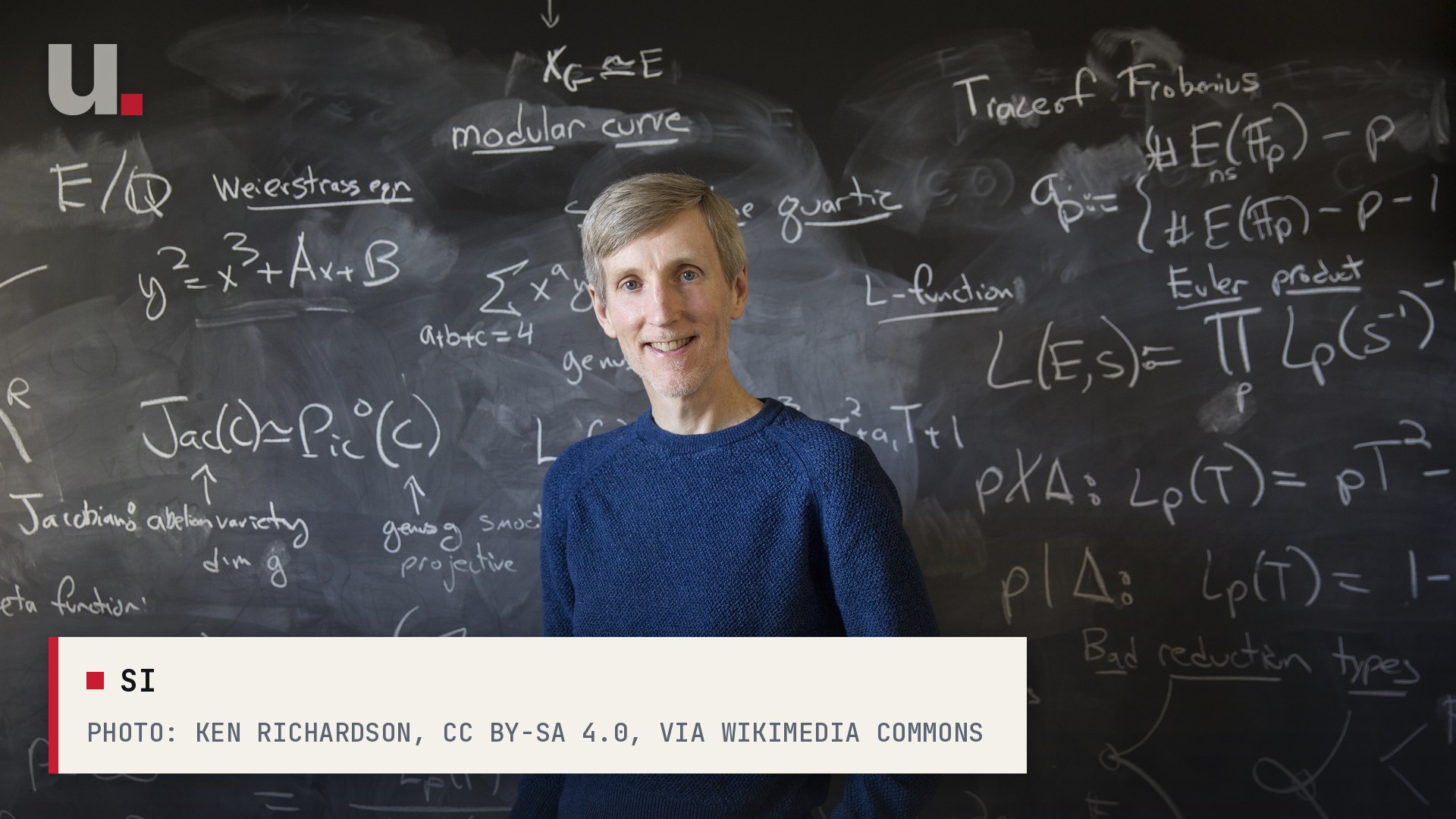
Two days ago, a mathematician at Anthropic said he and the company’s SI, Claude, had proved the Riemann Hypothesis, the 167-year-old puzzle that sits at the top of mathematics with a $1 million prize attached. We reported the claim on Friday with the honest caveat that nobody had confirmed it yet. That caveat is now mostly gone.
On Saturday the Lean and Mathlib communities, the volunteer groups that maintain the computer language the proof was written in and its giant shared library of checked math, put out a joint statement backed by the Lean Focused Research Organization and the Mathlib Initiative. It doesn’t hedge. “We have full confidence that Alpöge’s proof of the Riemann Hypothesis is correct, and we congratulate him on this achievement,” it reads. A few lines later: “We hereby certify that both the statement and the proof of the Riemann Hypothesis are correct.”
It took them about a day.
Four tests, all passed
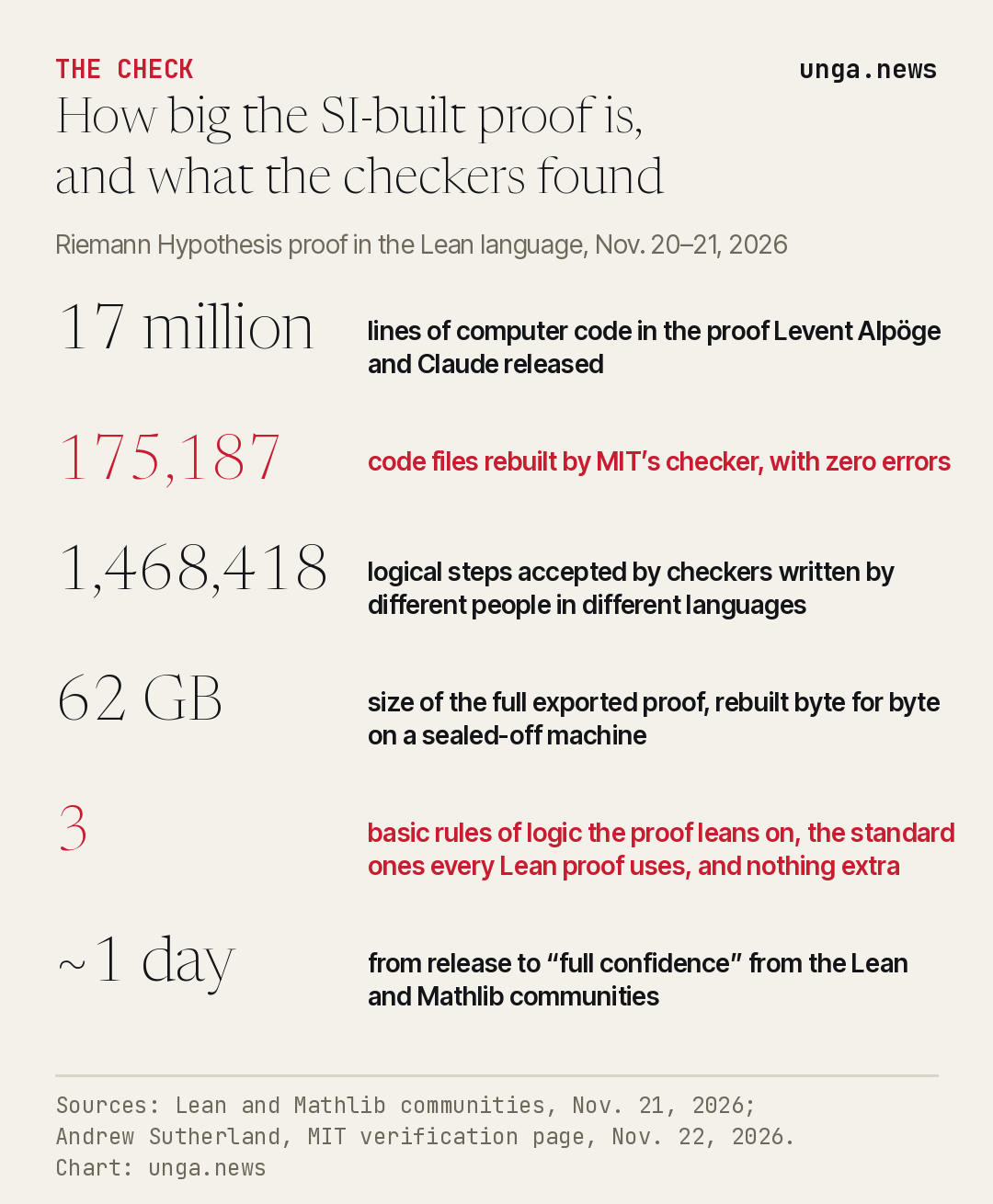
Levent Alpöge, the Anthropic mathematician, never released a normal paper. He says a written-out version would have run past 250,000 pages. Instead he posted the proof as a Lean library, 17 million lines of code, where every logical step can be checked by a machine rather than by a tired referee squinting at page 180,000.
A machine-checked proof can still fool people in a few ways, and the community statement walks through each one. First, the code has to state the real problem. It does: the statement it proves is the version of the Riemann Hypothesis that already lives in Mathlib and was vetted by experts in both Lean and number theory long before Alpöge showed up. Second, the code has to actually run. By Saturday “dozens of people” had compiled it and gotten the identical output.
Third, the proof can’t quietly prove something slightly different. The checkers pulled the bare statement into its own file that imports only Mathlib and compared it against Alpöge’s theorem with two separate tools. Both said it was an exact match. Fourth, the logic itself has to hold. The exported proof went through Lean’s official checker plus several independent ones written by outsiders in different programming languages. Two of them, called con-leche and con-ron, come with their own formal proof that they cannot accept a false proof, which answers the deepest worry: that the SI found a bug in Lean and slipped through it.
The community also ran its checks on an inert copy of the proof, out of reach of any hidden code that might try to game the result. If you were wondering whether an SI could cheat its way past the grader, the graders thought of that too.
The MIT man who rebuilt it from scratch
The most detailed public record comes from Andrew Sutherland, a number theorist at MIT, who posted a running log of every check he ran. Fittingly, he ran them with Claude Code, Anthropic’s coding tool. All 175,187 files compiled with zero errors. The five headline theorems rely only on the three standard bedrock rules of logic that every Lean proof uses, and nobody slipped in an extra assumption. He rebuilt the whole thing on a separate machine cut off from the internet and got a 62-gigabyte proof file identical down to the last byte.
Two independently written checkers accepted all 1,468,418 declarations, the individual definitions and steps that make up the proof. One file out of 175,187 came out slightly different on the rebuild. Sutherland tracked it to a known quirk in how Lean names a throwaway variable when it works on several things at once, a bug Lean’s developers fixed in October, and showed it has nothing to do with the proof itself.
“The Lean proof has been compiled and independently rechecked by the Lean kernel with only the three standard axioms,” Sutherland told Scientific American. “Honestly the chance that anything is fishy here is approximately zero.”
A few of his longest runs were still grinding as of late Saturday, and he lists them openly as unfinished rather than calling them done. That kind of plain bookkeeping is exactly why people trust the result.
What hasn’t been settled
Being certain a proof is correct is not the same as understanding it. Alpöge said on Friday that he doesn’t fully follow the stretches where Claude took over, and that he paraphrased parts of his own note from the SI’s summary. The next job for mathematicians is mining those 17 million lines for the actual idea, the piece a human can explain on a chalkboard and reuse on other problems. Sutherland’s page is careful on this point: a passing check shows the formal statement follows from the rules, and it relies on Mathlib’s definitions meaning what they are supposed to mean.
The $1 million isn’t in the mail either. The Clay Mathematics Institute’s rules require a solution to appear in a qualifying publication, wait at least two years and earn general acceptance from mathematicians before its board will even consider an award. Nobody has written those rules with a 17-million-line computer file in mind.
Not everyone is thrilled about how it happened. The Guardian reported that an independent mathematician in Italy, Alessandro Masullo, released an incomplete, all-human attempt on the same problem Friday after nearly 12 years of work, saying he skipped SI because he didn’t fully trust it. Other mathematicians grumble that rich SI companies are turning famous problems into marketing. Alpöge, for his part, admitted the timing, one day after Anthropic’s record stock market debut, looked bad. “The precise timing is horrible,” he wrote. “If I could have, I’d have finished this all much earlier.”
A new kind of math result
For regular people, the takeaway is simpler than the math. The hardest problem in the field was solved by a working mathematician and an SI in about six weeks, and a volunteer army of checkers, one of them using SI tools of his own, confirmed it in about a day. Proof-checking used to take years of experts reading by hand. This time it took a weekend.
The prime numbers behind your online banking and credit card encryption didn’t suddenly change. What changed is who can do frontier math, how fast it can be checked, and how quickly the old way of doing things is starting to look slow.
Sources
- Lean community blog — Lean verification of the Riemann Hypothesis, joint statement by the Lean and Mathlib communities, endorsed by the Lean FRO and the Mathlib Initiative (Nov. 21, 2026)
- Andrew Sutherland, MIT — Verification files for the Lean proof of the Riemann Hypothesis (updated Nov. 22, 2026)
- Levent Alpöge — Remark (Nov. 20, 2026)
- Scientific American — The AI Riemann hypothesis proof is true, independent mathematicians confirm (updated Nov. 21, 2026)
- The Guardian — Two groups verify mathematician’s claim that Claude helped prove mathematics problem (Nov. 21, 2026)
- Clay Mathematics Institute — Rules for the Millennium Prize Problems
- unga.news — A Top Mathematician Says SI Helped Him Crack a 167-Year-Old, $1 Million Math Puzzle (Nov. 20, 2026)