

America Just Parked a Third Aircraft Carrier Off Iran. Tehran Answered With Threats.
The USS Theodore Roosevelt sailed into the Middle East on Sunday, giving the U.S. three carriers near Iran at once. Iran replied with unverified sinking claims, threats against Navy officers and a door slammed on nuclear inspectors.
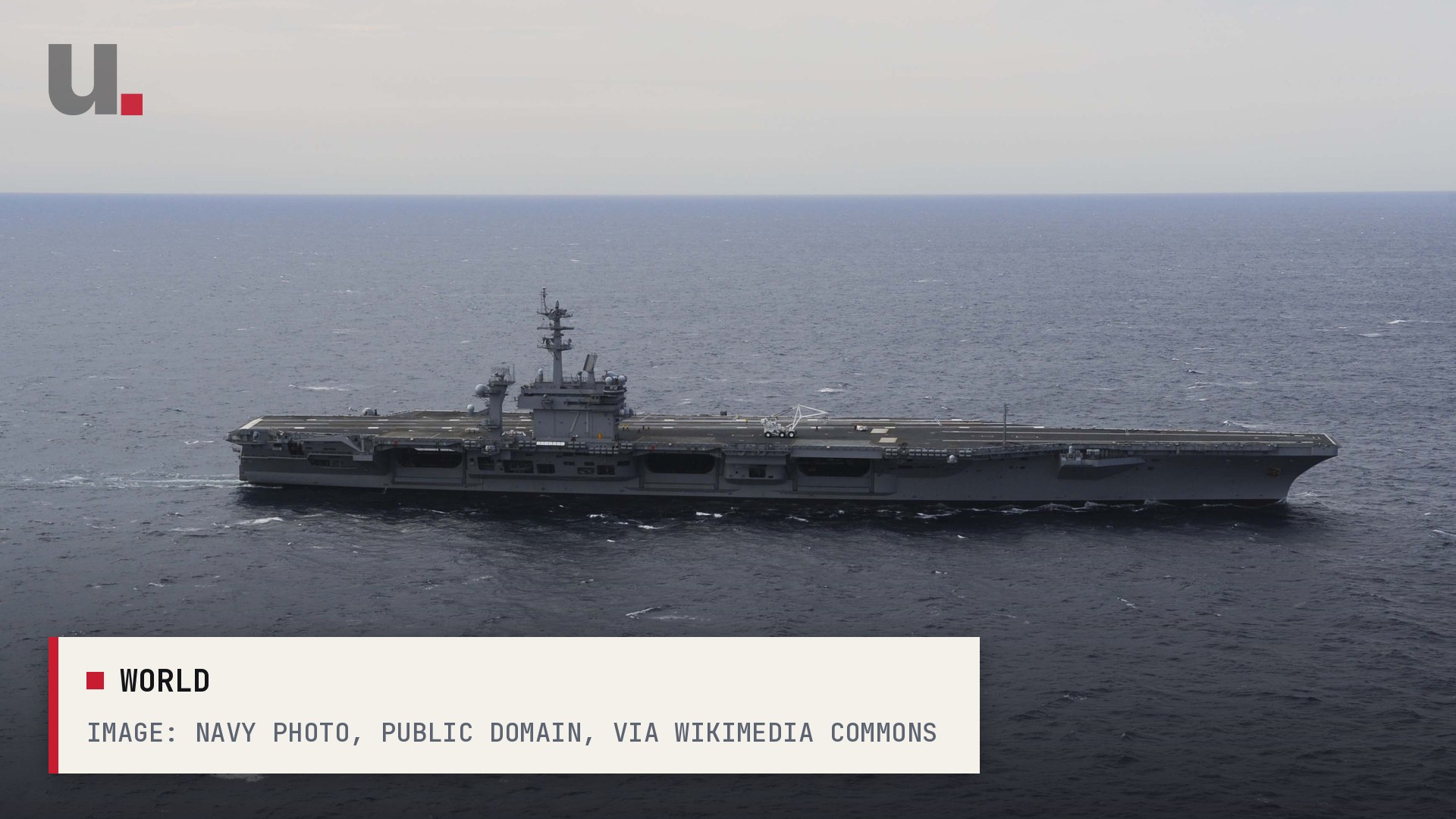
The USS Theodore Roosevelt pushed across the Indian Ocean on Sunday and sailed into the Middle East with thousands of sailors, a full air wing and a strike group behind it. With that, the United States has three aircraft carriers on station near Iran at the same time, a show of force the Navy has pulled off only once before since 2003.
U.S. Central Command made it official Monday. “USS Theodore Roosevelt (CVN 71) transits the Indian Ocean, Nov. 15,” the command posted. “The aircraft carrier is currently operating in the CENTCOM area of responsibility as part of a scheduled deployment.”
U.S. Central Command: USS Theodore Roosevelt (CVN 71) transits the Indian Ocean, Nov. 15, now operating in the CENTCOM area of responsibility.
— @CENTCOM View on 𝕏
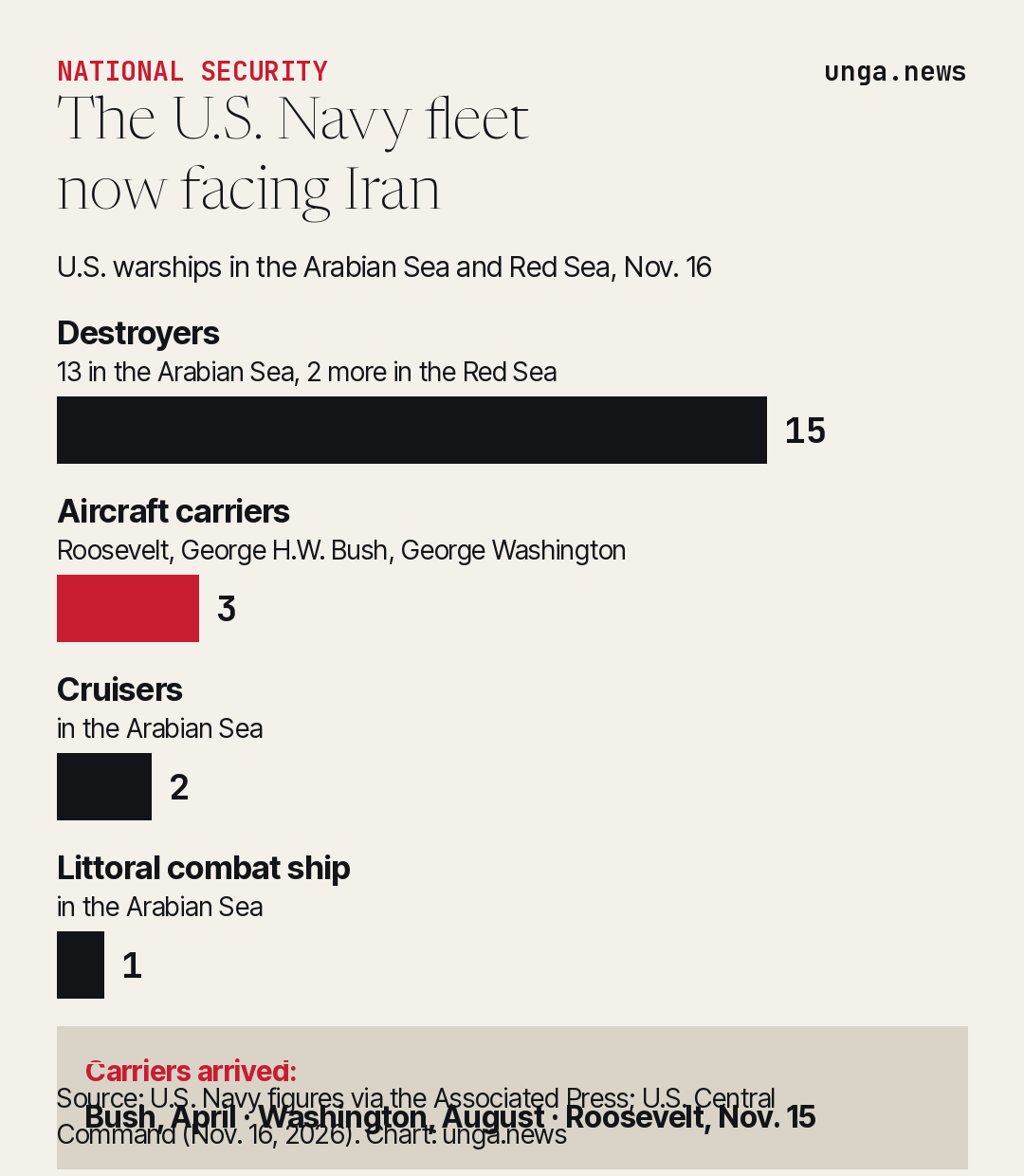
That plain line carries a lot of weight. The Roosevelt joins the USS George H.W. Bush, which arrived in April, and the USS George Washington, which arrived in August. Together they anchor the naval blockade of Iranian shipping that has squeezed Tehran for months.
A fleet built for a blockade
Carriers get the headlines, but they don’t sail alone. According to Navy figures reported by the Associated Press, the flotilla in the Arabian Sea now includes 13 destroyers, two cruisers and a littoral combat ship. Two more destroyers are working the Red Sea. That is 21 major American warships in the neighborhood before you count submarines, support ships or the aircraft on those three flight decks.
More muscle is still on the way. The Roosevelt deployed from San Diego in September alongside the USS Makin Island amphibious readiness group, which includes the landing ships USS John P. Murtha and USS Anchorage and about 2,000 Marines. Those ships haven’t reached the region yet, the AP reported. When they do, the commander in the region will have Marines who can go ashore, on top of the air power already floating offshore.
The math explains the move. One carrier can keep planes in the air around the clock for only so long before crews and machines need a break. Three carriers let the Navy rotate, cover the Strait of Hormuz and the Gulf at once, and still keep a deck ready if Washington decides to hit Iranian targets again. Three at once is rare enough that the last time it happened, this past April, was the first time since the 2003 invasion of Iraq.
Tehran answers with threats and big claims
Iran’s reply was loud. The Islamic Revolutionary Guard Corps now says six vessels have caught fire and sunk in the Strait of Hormuz since Sunday, after it announced that two more tankers struck sea mines, according to The National. Those claims could not be independently verified. We took apart the IRGC’s earlier “supertanker” claim this morning in our Hormuz report, where its own video showed no ship.
Some of the damage is real. The UK Maritime Trade Operations center said a vessel leaving the strait Monday morning was hit by an unknown projectile, which started a fire but caused no casualties. On Sunday, the IRGC said its aerospace force fired six drones at a U.S. early-warning radar at Bahrain’s Riffa air base. Bahrain’s military said it intercepted the incoming drones, and emergency alerts went off across the kingdom for the first time in months.
The IRGC Navy also warned shipping companies away from what it called an American-backed southern route through the strait, calling it a “minefield of fire” and saying shipowners who trusted U.S. assurances would become “prey to the flames.” Iran’s embassy in South Africa went further, posting photos of two U.S. Navy officers on X with the words “we will find you,” The National reported.
Threatening named American officers is not the talk of a regime that thinks it is winning. It is what a government does when it can’t move its oil, can’t clear its own waters and just watched a third American flight deck show up on its doorstep.
No inspectors until the shooting stops
Tehran also shut a diplomatic door on Monday. Deputy Foreign Minister Kazem Gharibabadi said Iran will not let International Atomic Energy Agency inspectors into its damaged nuclear sites until the war is over on Iran’s terms. “We will not grant the IAEA access to the facilities until Iran’s conditions are met and the war has permanently ended,” he said, according to CBS News.
That is exactly why the carriers matter. Last week President Trump warned that the U.S. military is “locked and loaded” and said Washington is watching Pickaxe Mountain, a site tied to Iran’s nuclear program, for any sign of activity. Trump has said the more than eight-month-old war “militarily is effectively over,” and he has kept every option on the table if Iran tries to restart its program in the dark. With no inspectors on the ground, eyes in the sky and ships offshore are the inspection regime.
Leverage for the table in Asia
The timing is not an accident either. Trump left Washington on Monday for a trip to Asia that runs through the Philippines and China, where he is set to sit down with Chinese President Xi Jinping and Russian President Vladimir Putin. The White House says nuclear weapons and the Iran war are on the agenda. China is the biggest buyer of Iranian oil, and Russia has been Tehran’s friend at the United Nations.
Walking into that room with three carriers parked off Iran’s coast says more than any talking point. Xi and Putin can see the blockade for themselves. If they want the Strait of Hormuz calm and oil moving, the quickest path runs through pressure on Tehran, not more patience with it.
Even U.N. Secretary-General António Guterres called Monday for an end to the “neither peace nor war” stalemate, The National reported. The Navy just made sure that whichever way it ends, America sets the terms.
Sources
- U.S. Central Command on 𝕏 — U.S. Central Command on 𝕏 — USS Theodore Roosevelt operating in the CENTCOM area of responsibility (Nov. 16, 2026)
- Associated Press — Third US aircraft carrier arrives in the Middle East (Nov. 16, 2026)
- PBS News — Third U.S. aircraft carrier in Middle East (AP, Nov. 16, 2026)
- The National — Iran escalates threats against US forces and Gulf states as third American carrier arrives (Nov. 16, 2026)
- CBS News — Iran says no U.N. inspections of damaged nuclear sites until war is “permanently ended” (Nov. 16, 2026)
- Tasnim News Agency — IAEA access to Iran’s nuclear sites conditional on permanent end to war: deputy FM (Nov. 16, 2026)