

Iran Says It Sank a Supertanker Full of Oil. Its Own Video Shows No Ship.
The Revolutionary Guards claim a tanker carrying 2 million barrels went down in Hormuz. The attacks anyone can confirm hit two tankers whose crews all walked away, while U.S. escorts keep the oil moving.
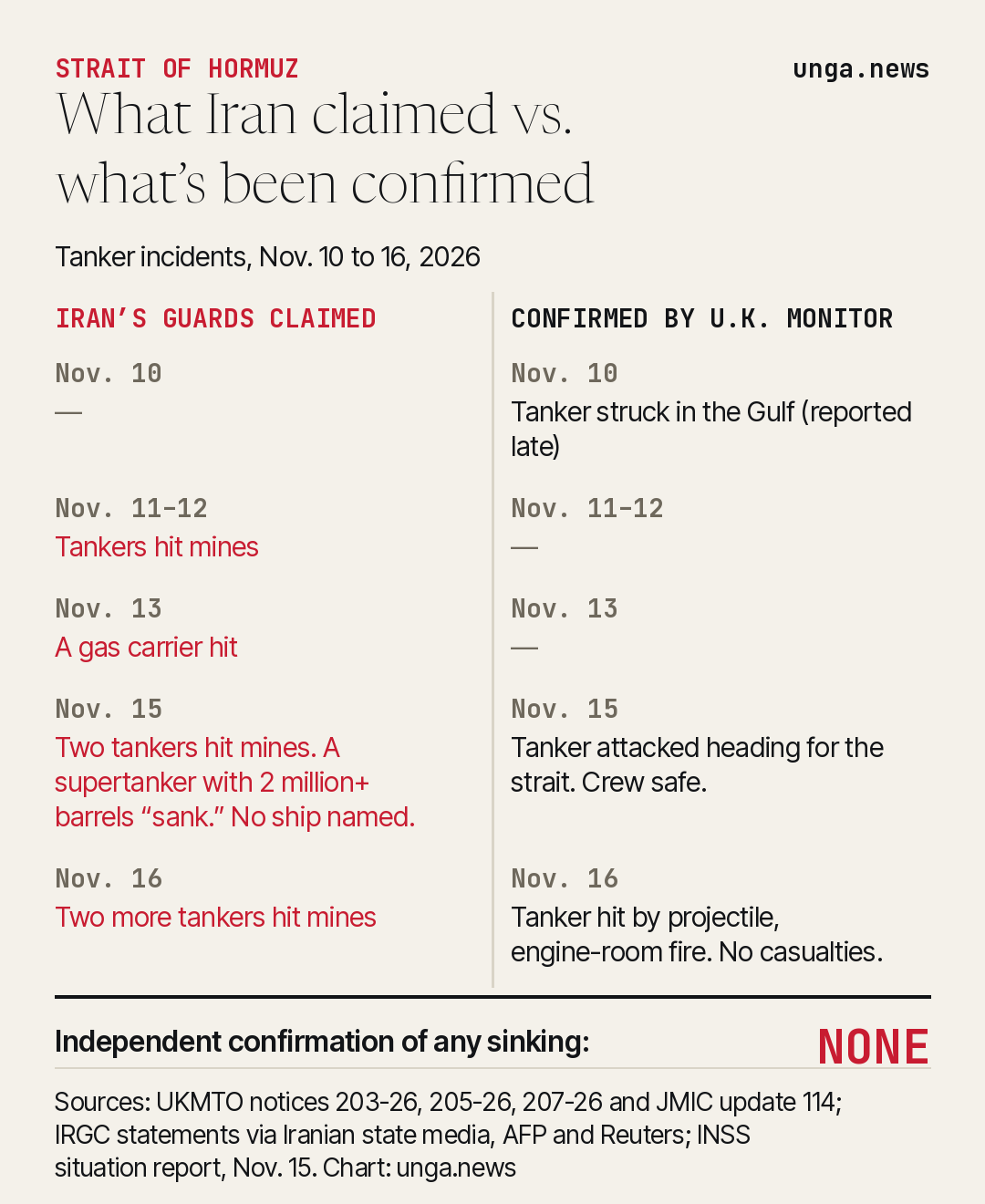
Iran’s Revolutionary Guards announced Sunday that a supertanker hauling more than 2 million barrels of crude had hit a mine in the Strait of Hormuz and sunk. They didn’t name the ship. They didn’t say who owned it, where it was headed or what happened to its crew. They put out a video instead, and the video shows a big fire and black smoke on open water and, in the words of the shipping paper Seatrade Maritime, “no discernible vessel.”
That’s the new turn since the weekend we already covered, when Iran sent drones at Bahrain and none of them reached their target. Out on the water, the story has now split in two. There’s what Tehran announces, and there’s what the people who actually log ship attacks can confirm. The gap between those two lists is the whole point.
Two tankers hit, every sailor accounted for
The confirmed list comes from the U.K. Maritime Trade Operations center, the British military office that tracks attacks on merchant ships across the region. On Sunday it passed along a report from Indian shipping authorities that a tanker had been attacked in the Gulf while heading east toward the strait. “The crew are accounted for and safe,” the notice said. Damage was still being assessed.
The maritime security firm Vanguard Tech identified that ship as the Al Dhannah, a supertanker operated by Thenamaris. It was hit in the steering gear room at the stern and turned back toward Dubai.
Monday morning brought a second one. A tanker’s company security officer reported the ship had been “struck by an unknown projectile whilst transiting outbound,” setting off a fire in the engine room. “No casualties have been reported and all crew have been accounted for,” the monitor said. Vanguard named that ship as the Panama-flagged On Phoenix, hit about 3 nautical miles off the coast of Oman.
One detail ties the two ships together. Both are on the blacklist kept by Iran’s new Persian Gulf Strait Authority, the office Tehran created to decide who gets to pass. Seatrade reports the Al Dhannah is on its “non-compliant” list and the On Phoenix has been blacklisted since Sept. 14. Tehran insists the only legal route is a northern lane through Iranian waters, with its permission. Seatrade says Iran is targeting ships in the southern lane that get guided transits from American forces.
The sinking nobody can find
Now the other list. “Over the past few hours, two oil tankers travelling along an unauthorised route in the southern part of the Strait of Hormuz struck naval mines, resulting in massive explosions and fire,” the Guards said in a statement carried by Iranian state TV, according to AFP. “One of these vessels — a super tanker carrying over two million barrels of crude oil — sank in the southern waters of the Persian Gulf.” On Monday the Guards said two more tankers had struck mines. Reuters said it could not verify that one either.
This has become a near-daily habit. Israel’s Institute for National Security Studies counted Guards claims of tankers hitting mines on Nov. 11 and 12 and a gas carrier on Nov. 13, before this weekend’s round. Not one of those ships has been named.
Think about what a real sinking of a loaded supertanker would leave behind. A crew to pull out of the water. An owner and a flag country making calls. An insurer with one of the biggest claims of the year. Very likely an oil slick you could see from a plane. No shipping authority, owner or navy has reported any of it.
Central Command has been calling this play for weeks. In late October it answered the mine stories in its blunt claim-and-fact format.
U.S. Central Command on 𝕏, Oct. 28, 2026: “CLAIM: … commercial vessels are hitting sea mines while transiting the Strait of Hormuz. These claims are FALSE.”
— @CENTCOM View on 𝕏
“All internationally recognized primary transit routes through the Strait of Hormuz have been cleared of sea mines by U.S. forces and remain so,” CENTCOM wrote. “Thousands of commercial vessels have safely used the transit lanes and continue today.”
So why keep inventing wrecks? The Israeli institute’s analysts say the goal is to “erode operators’ confidence in US escort operations and force transits through Iranian territorial waters.” If shipowners and their insurers come to believe the American lane is mined, the tankers go where Tehran wants them, on Tehran’s terms. A press release costs less than a mine.
The oil keeps moving anyway
Here’s what the scare campaign is up against. On Saturday CENTCOM said more than 1.7 billion barrels of crude have now moved through the strait by Gulf partners under U.S. protection. The joint maritime information center that works with the British monitor counted an average of about 28 American-assisted transits a day over the 72 hours before its Sunday update.
The muscle behind those escorts just got bigger. A U.S. official told ABC News that the USS Theodore Roosevelt carrier strike group entered Central Command’s waters on Sunday, joining the USS George H.W. Bush and USS George Washington. More than 20 Navy ships are enforcing the blockade of Iran’s ports, which CENTCOM estimates has already cost Tehran more than $30 billion in crude sales.
The markets shrugged. Brent crude was up 5 cents, to $95.89 a barrel, Monday morning, Reuters reported, after dipping as much as 1% in early Asian trading. On Friday the International Energy Agency said the world oil market will swing back to a surplus this quarter, with supply running 1.7 million barrels a day ahead of demand, because Middle East exports are recovering faster than expected despite the attacks. Traders with real money on the line aren’t pricing in a sunken supertanker.
None of this makes the strait safe. Two real ships took real hits in two days, and those crews were lucky to walk away. Iran can still put a projectile into an engine room. What it can’t do is stop the tankers from coming, so it has settled for sinking them on television.
Sources
- UK Maritime Trade Operations — Warning 205-26: Attack (Nov. 15, 2026)
- UK Maritime Trade Operations — Warning 207-26: Attack (Nov. 16, 2026)
- Joint Maritime Information Center — Update 114 to JMIC Advisory Note (Nov. 15, 2026)
- Seatrade Maritime — Two tankers confirmed struck, Iran claims VLCC sinking in Hormuz (Nov. 16, 2026)
- AFP via Arab News — Iran says supertanker with 2 million barrels of oil sank in Gulf (Nov. 15, 2026)
- U.S. Central Command on 𝕏 — “These claims are FALSE.” (Oct. 28, 2026)
- U.S. Central Command on 𝕏 — “More than 1.7 billion barrels of crude oil have been shipped through the Strait of Hormuz by Gulf partners with U.S. protection.” (Nov. 14, 2026)
- INSS — US Force Posture in the Middle East vis-à-vis Iran: Situation Report, November 8–15, 2026
- ABC News — Iran live updates: Tanker attacked in Strait of Hormuz, UKMTO says (Nov. 16, 2026)
- Reuters via CNBC — Oil edges up as Hormuz tanker incidents highlight shipping risks (Nov. 16, 2026)