

Iran Fired Drones at a U.S. Base in Bahrain Twice in Three Days. None Got Through.
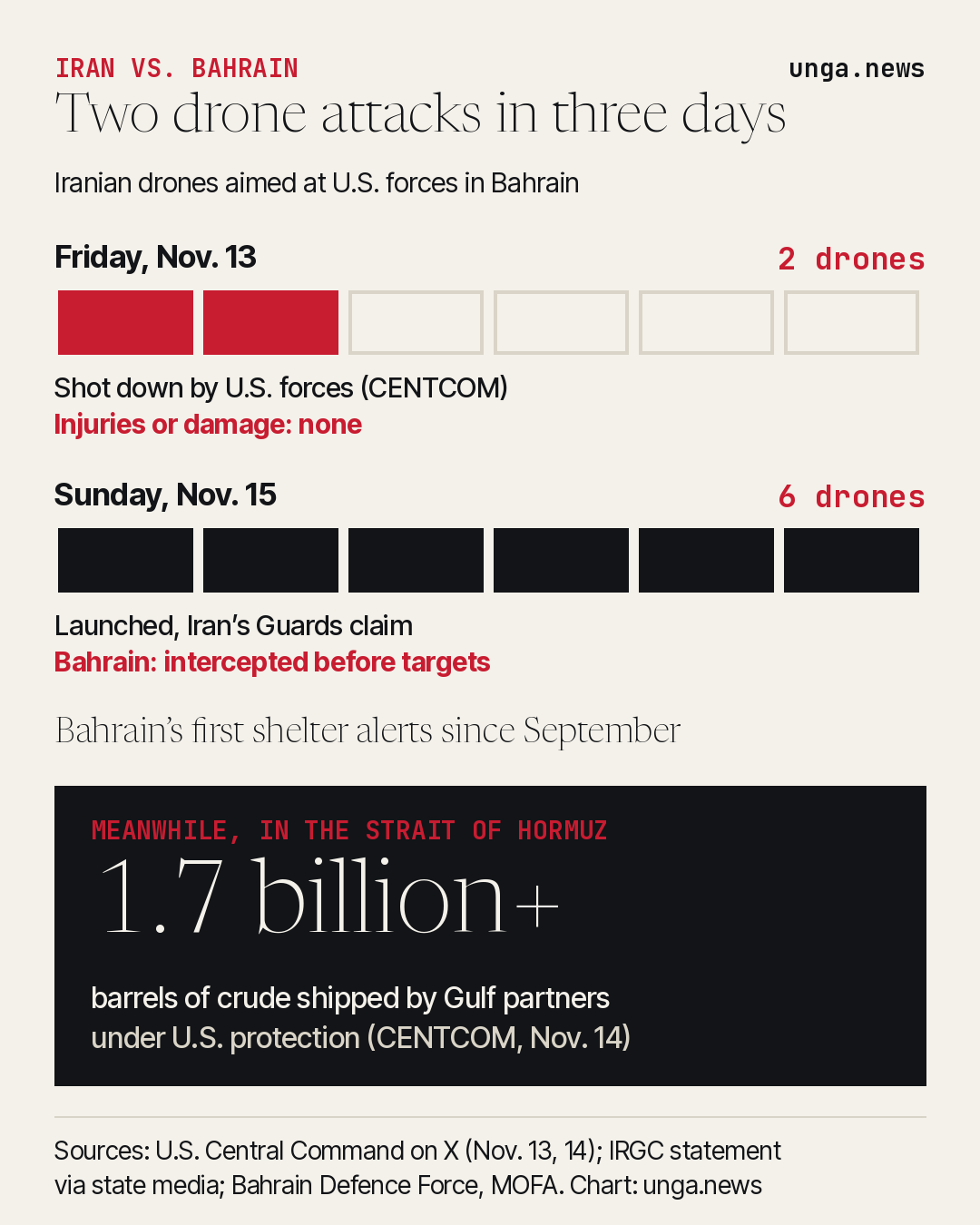
U.S. forces shot down Friday’s pair with no injuries or damage, and Bahrain says Sunday’s wave never reached its target. The kingdom now holds Tehran “fully responsible” while American-guarded tankers keep moving through Hormuz.
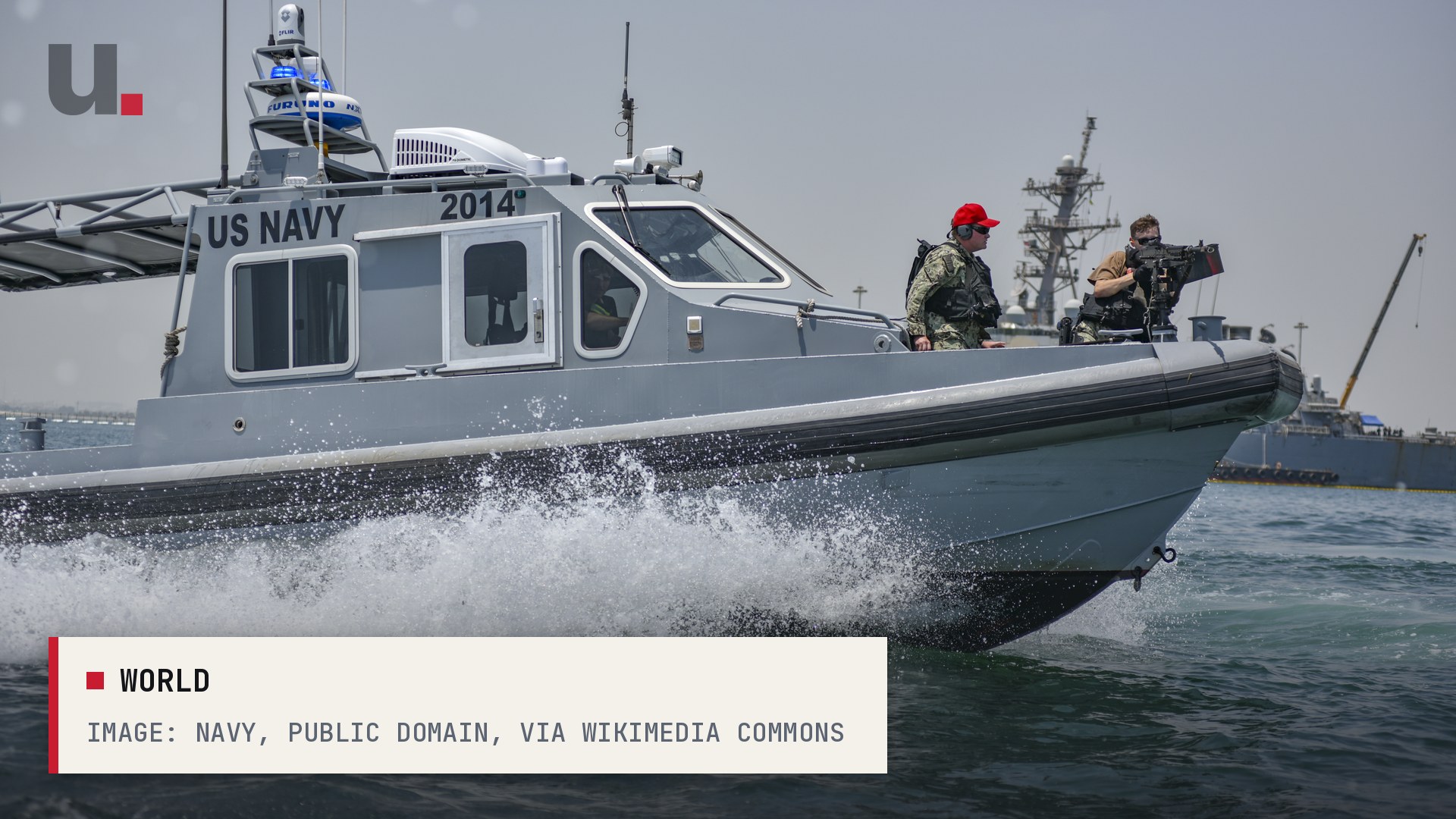
Sirens went off across Bahrain a little after 4 a.m. Sunday, and again before 7. For the second time in three days, Iran had sent drones at American forces in the small island kingdom that hosts the U.S. Navy’s Fifth Fleet. For the second time in three days, nothing Iran fired reached its target.
Bahrain’s Interior Ministry pushed out its first shelter alerts since September, telling citizens and residents to “remain calm, proceed to the nearest safe location, and follow news through official channels.” Residents heard explosions around 4 a.m. and a second round about 6:30. A few hours later the Bahrain Defence Force said its air defenses had “intercepted and destroyed” the incoming Iranian attacks before they reached their targets.
Iran’s Revolutionary Guards told a different story, as they usually do. In a statement carried by state television, the Guards said “the US air defence radar system at the Al-Riffa helicopter base in Bahrain was targeted by six drones belonging to the IRGC Aerospace Force,” according to France 24. Then came the threat: “The Strait of Hormuz is closed, and any aggression by the American enemy will be met with an even harsher and more forceful response.”
Friday’s claim didn’t hold up
Sunday’s raid followed one on Friday that went just as badly for Tehran. That morning the Guards announced they had “targeted and destroyed” a U.S. early-warning radar in Bahrain. They called it payback for a strike on a telecommunications tower in Sirik, a port town on Iran’s southern coast, which Iranian state media blamed on “enemy fire.” It was the first time since early September that Iran had claimed a hit on American military assets in a Gulf country.
Central Command answered within hours, in the blunt format it now uses for Iranian claims.
U.S. Central Command on 𝕏, Nov. 13, 2026: “The IRGC launched two one-way attack drones toward Bahrain and both were shot down by U.S. forces.”
— @CENTCOM View on 𝕏
“FACT: The IRGC launched two one-way attack drones toward Bahrain and both were shot down by U.S. forces. There were no injuries or damage,” CENTCOM wrote. No radar destroyed. No Americans hurt.
So that’s the scorecard so far: two drones Friday, by the American count, and six Sunday, by Iran’s own count. Bahrain says Sunday’s wave never made it to the base. Neither Washington nor Manama has reported a single hit.
Bahrain is done being polite
The kingdom didn’t spend Sunday wringing its hands. Its Foreign Ministry called the two raids “a resumption of Iran’s aggression against Bahrain and other countries in the region,” said “no pretext can legitimise violations of state sovereignty,” and drew a line Tehran will not like. Bahrain “rejects the use of its territory to settle accounts and holds Iran fully responsible for the attacks and their consequences,” the ministry said, as reported by Al Jazeera. The defense force was shorter about it: “Iran continues its systematic hostile approach through its criminal attacks.”
The neighbors lined up behind Manama. Jordan’s Foreign Ministry condemned “Iran’s brutal attacks on the sister kingdom of Bahrain as a flagrant violation of its sovereignty.” Egypt said it “reiterates its categorical rejection” of attacks on the region and called Bahrain’s security a pillar of Arab national security.
Tehran’s reply came from Foreign Ministry spokesman Esmaeil Baghaei, who called the strikes “purely defensive in nature” and claimed cover under Article 51 of the U.N. Charter, the self-defense clause. He accused Gulf states of letting their bases and logistics be used against Iran and said “no action has been taken by Iran against the sovereignty of these countries.” Tell that to the Bahrainis who were sent looking for shelter before sunrise.
Mines that nobody else can find
The drones weren’t Iran’s only weekend headline. Over the weekend, Iran’s navy and the Guards’ navy put out a string of claims that oil tankers slipping through the Strait of Hormuz with their tracking systems switched off had hit naval mines and caught fire, one of them a supertanker. Iran didn’t name a single ship. Reuters said it could not verify the reports.
Washington has heard this one before. When the Guards claimed in late August that a supertanker had hit two mines in the strait, CENTCOM called it “FALSE” and “yet another IRGC attempt to intimidate regional commercial shipping through disinformation.” The U.S. military says it has cleared the main routes through the waterway of mines.
And the oil keeps moving. On Saturday, CENTCOM posted that more than 1.7 billion barrels of crude have now been shipped through the Strait of Hormuz by Gulf partners under American protection.
That’s the part of this war Iran can’t spin. Since the fighting began with U.S. and Israeli strikes on Feb. 28, a ceasefire in April and a memorandum of understanding in June have not produced a final deal. In the meantime, the U.S. Navy has blockaded Iran’s ports and the Treasury has kept squeezing the regime’s oil money.
Secretary of State Marco Rubio laid out the strategy in Paris just days ago, and he told allies the squeeze is working so well that the President “really doesn’t have any need to conduct major combat operations.” He also said the Guards were still firing “a couple drones a night trying to sink commercial vessels,” that American forces would keep knocking them down, and that if the regime lashed out at civilian infrastructure in the Gulf, “they’ll pay a terrible price.”
Read the weekend through that lens. A regime that can no longer sell its oil freely is trying to look dangerous on the cheap: a handful of drones at a radar dish, press releases about burning tankers nobody can name. American and Bahraini crews shot down what showed up. The Gulf’s Arab governments, which Tehran hoped to scare off, are instead calling Iran the aggressor in public.
There is a real risk here, and nobody should wave it off. Al Jazeera’s correspondent in Tehran said Iran had held its fire for weeks during low-level American strikes in the south, and that firing at Bahrain twice in three days looks like “the new rule of engagement.” Every one of these raids is a bet that the next drone won’t be the one that gets through.
But the leverage hasn’t moved. Iran’s drones are getting shot down, its oil money is drying up, and its neighbors are done making excuses for it. The leaders of America, China and Russia are set to meet in Shenzhen on Thursday, and the Iran war is among the flashpoints on the table. Tehran just spent its weekend reminding all three of them who keeps lighting the fuse.
Sources
- U.S. Central Command on 𝕏 — “The IRGC launched two one-way attack drones toward Bahrain and both were shot down by U.S. forces.” (Nov. 13, 2026)
- U.S. Central Command on 𝕏 — “More than 1.7 billion barrels of crude oil have been shipped through the Strait of Hormuz by Gulf partners with U.S. protection.” (Nov. 14, 2026)
- Bahrain Ministry of Interior on 𝕏 — “An alert of potential threat.” (Nov. 15, 2026)
- France 24 / AFP — Iran claims attack on US military airbase in Bahrain (Nov. 15, 2026)
- Al Jazeera — Bahrain accuses Iran of attacking its territory to ‘settle’ score with US (Nov. 15, 2026)
- ABC News — Iran live updates: Bahrain reports Iranian attack, IRGC says air base targeted (Nov. 15, 2026)
- Anadolu Agency — CENTCOM denies Iranian claim of attack on US radar in Bahrain, says 2 drones shot down (Nov. 13, 2026)
- CNA / Reuters — Iran reports three incidents of oil tankers hit by mines in Hormuz (Nov. 14, 2026)
- Arab News / Reuters — Two tankers on fire after hitting naval mines in the Strait of Hormuz, Iran’s IRGC says (Nov. 15, 2026)
- unga.news — Rubio Says the Squeeze on Iran Is Working So Well That America Doesn’t Need to Bomb Again