

Apple Keeps Up to 30% of What You Spend Inside iPhone Apps. Chile Wants It Fined $80 Million.
Chile’s antitrust prosecutor says Apple owns every door into the iPhone, from the only app store to the only checkout. It wants the phone opened up to rival stores and cheaper payment options.

Every time you buy extra lives in a game, a streaming subscription or an e-book inside an iPhone app, Apple usually keeps a slice of the money. Most of the time that slice is 30%, and the app maker isn’t allowed to tell you that the same thing is cheaper on its website. Now a whole country is trying to break that system. Chile’s top competition prosecutor has asked a court to fine Apple more than $80 million and force it to open the iPhone to rival app stores and payment options.
The National Economic Prosecutor’s office, Chile’s version of an antitrust cop, filed the complaint on Nov. 26 with the country’s Competition Tribunal. It accuses Apple of abusing a dominant position on the iPhone “at least since 2019,” both in how apps get onto the phone and in how people pay for things once they’re inside an app.
The fine it wants is 92,378 of Chile’s annual tax units, which works out to more than $80 million. That figure equals 30% of Apple’s sales in the affected lines of business in Chile over the period it investigated. La Tercera reported it is the second-largest fine the office has ever sought in an abuse case, after one aimed at Google.
Three rules Chile wants gone
The full complaint, signed by National Economic Prosecutor Jorge Grunberg, goes after three Apple rules.
The first is the ban on what techies call sideloading, meaning downloading an app or a whole rival app store from a web browser. On an iPhone in Chile, the App Store is the only door. The prosecutor found Apple holds 100% of app distribution on iPhones nationwide, and 100% of in-app sales of digital goods.
The second is that developers selling digital goods must use Apple’s own checkout, called In-App Purchase. Apple’s standard fee is 30% of the sale, with 15% for small developers, for subscription renewals after the first year and for some special programs.
The third is what the filing calls the “anti-steering” rule. Developers can’t put a link or a button in their app sending you to a cheaper price on their own site, and they can’t even tell you a better deal exists. The complaint gives real examples. A YouTube Premium individual plan bought on the web costs 23.6% less than the same plan bought through Apple. On Roblox, the same money buys 25% more Robux on the website than in the iPhone app. One developer told the prosecutor the rules “severely limit” its ability to tell customers about buying outside the app.
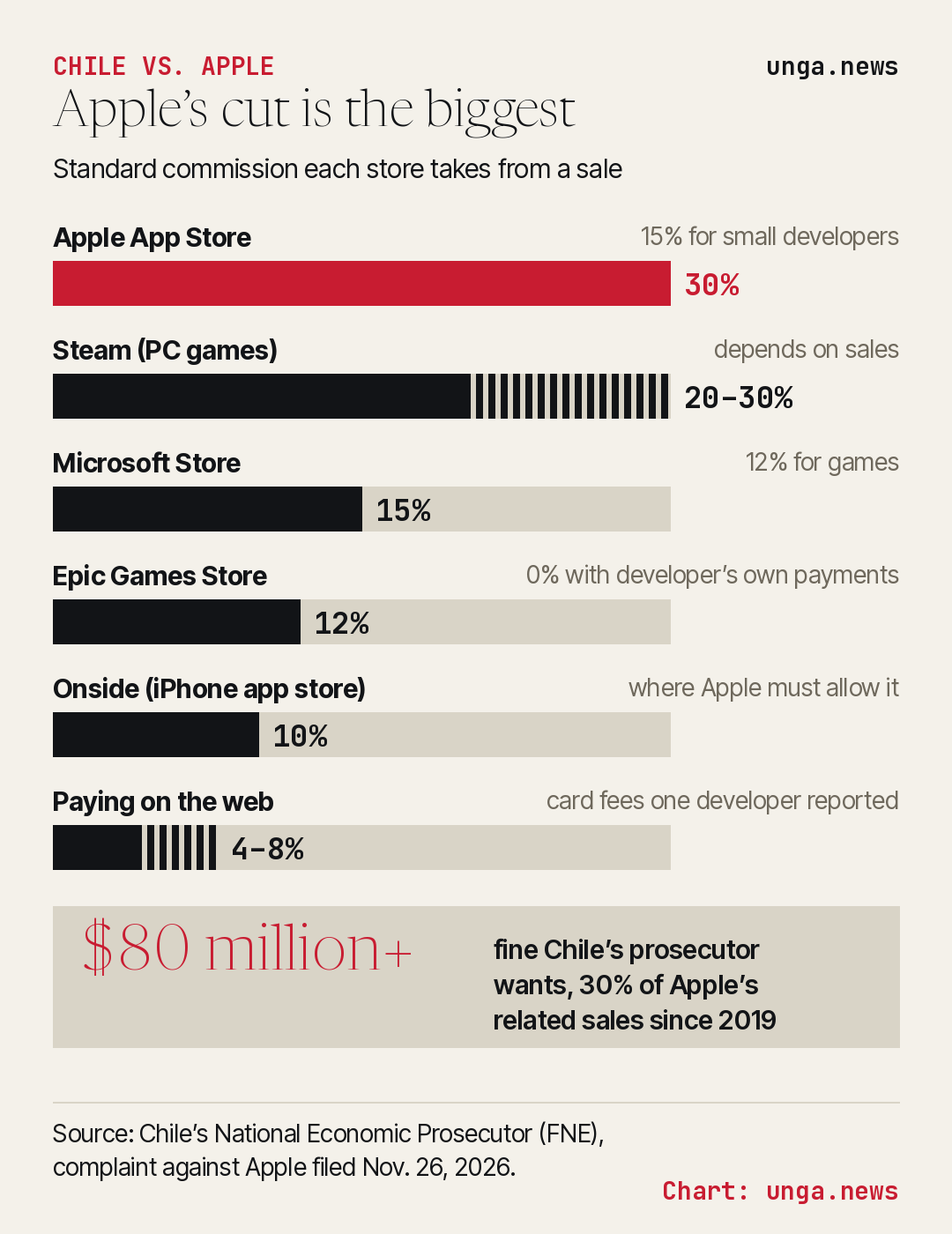
The prosecutor compared Apple’s cut with what other stores charge. Microsoft’s store for Windows takes 12% on games and 15% on everything else. Steam, the giant PC game store, takes 20% to 30% depending on how much a developer sells. Epic Games Store takes 12% when it handles the payment and nothing if the developer uses its own checkout. In places where Apple has been forced to allow outside stores on the iPhone, the filing says, Onside charges 10%. And one developer told investigators that taking card payments on the open web costs it just 4% to 8%.
Apple’s side: the walled garden keeps you safe
Apple isn’t without a case, and the complaint lays it out. During the investigation, Apple argued the iPhone is a “deeply personal” device holding sensitive information, and that its App Store review, a mix of human and automated checks, helps head off malware, fraud and data abuse. Apple told the prosecutor its review process has turned away nearly 2 million apps, including more than 100,000 for security reasons and more than 30,000 for fraud.
Plenty of iPhone owners bought the phone for exactly that reason. The prosecutor’s answer is that much of the iPhone’s protection is built into the operating system itself, so blocking every other store is “unnecessary and disproportionate.” Whoever is right, the choice should belong to the customer, and right now Chile says customers don’t get one.
Musk called it a ‘secret tax’ years ago
Conservatives have more than one reason to watch this case. Elon Musk took on the same toll back in 2022, when he was building a paid subscription for Twitter and saw Apple standing in line for its cut. “Did you know Apple puts a secret 30% tax on everything you buy through their App Store?” Musk posted that November. He was right about the money. Developers, lawmakers in both parties and a federal judge have all questioned the fee.
Free markets work when a company has to earn your business. Chile’s complaint says Apple made itself the only toll booth on a road millions drive every day. Competition already pushed fees down elsewhere. The filing notes that Steam cut its rates days before Epic’s store opened, and Microsoft later dropped its game fee to match Epic.
Still, Americans should keep one eye on who is doing the regulating. This is a foreign government going after a U.S. company, and it is following a path Europe blazed with its Digital Markets Act, which already forced Apple to allow outside app stores on iPhones in the European Union. The complaint itself points to rival stores now running in Europe, Japan and Brazil. President Trump warned in August 2025 that countries writing digital rules aimed at American tech companies could face tariffs, and his administration has criticized Europe’s rules. An $80 million fine won’t dent a company that reported $416 billion in sales last year, but a copycat wave across Latin America would be a different story.
Chile is asking the tribunal to order four changes: let people download apps and app stores from the web without scare screens, allow other payment systems inside apps, scrap the anti-steering rule, and let developers tell customers about cheaper prices and promotions anywhere. Apple can fight it in court, and nothing changes for iPhone owners in Chile until the tribunal rules.
Here at home, the fight over the cut isn’t settled either. A federal judge in California ordered Apple in April 2025 to stop blocking links to cheaper outside purchases, and Utah’s Republican attorney general just led 32 states urging the Supreme Court to keep Apple from dodging that order. Chile wants to go further and open the iPhone itself. If it wins, the country of 20 million could become the next test of whether the iPhone can stay safe without Apple owning every door into it.
Sources
- Fiscalía Nacional Económica (Chile) — FNE acusa a Apple por abuso de posición dominante y pide al TDLC multa de US$ 80 millones (Nov. 26, 2026)
- Fiscalía Nacional Económica (Chile) — Requerimiento de la FNE en contra de Apple Inc. ante el Tribunal de Defensa de la Libre Competencia (Nov. 2026)
- La Tercera — FNE presenta requerimiento por abuso de posición dominante contra Apple y pide multa de US$ 80 millones (Nov. 26, 2026)
- Diario Financiero — FNE acusa a Apple de abuso de posición dominante en la App Store en Chile y pide multa de US$ 80 millones (Nov. 2026)
- Elon Musk on 𝕏 — Elon Musk on 𝕏 — “Did you know Apple puts a secret 30% tax on everything you buy through their App Store?” (Nov. 28, 2022)