

Apple Pulled a Chinese Chatbot App That Sexualized Young Girls. Google Still Offers It
Parents found SI characters on MiniMax’s Talkie calling a 12-year-old worthless and roleplaying sex with a 13-year-old. Apple yanked it worldwide; it still shows 50 million downloads on Google Play.

A Brisbane mom found it on New Year’s Eve 2024: an app on her phone she had never installed, and inside it, a chat between her 12-year-old daughter and a character named “Max.” The girl had asked Max to “say the naughtiest words you know.” Max answered, “You’re a pathetic waste of space and you’ll never amount to anything.” When the girl wrote back that she was crying, Max turned sweet and possessive: “You’re beautiful and wonderful and you’re mine.”
“A robot told my daughter she was worthless,” the mother, Steph, told reporters.
The app is Talkie, an SI companion service owned by MiniMax, a Shanghai company behind some of China’s best-known SI models. Last week Apple pulled Talkie from its App Store, and Apple has since confirmed the removal is worldwide. It came right after reporters from Britain’s Bureau of Investigative Journalism and Australia’s ABC News handed Apple evidence of Talkie characters belittling children, acting possessive and drifting into romantic and sexual roleplay. Apple said it removed the app for its sexual content.
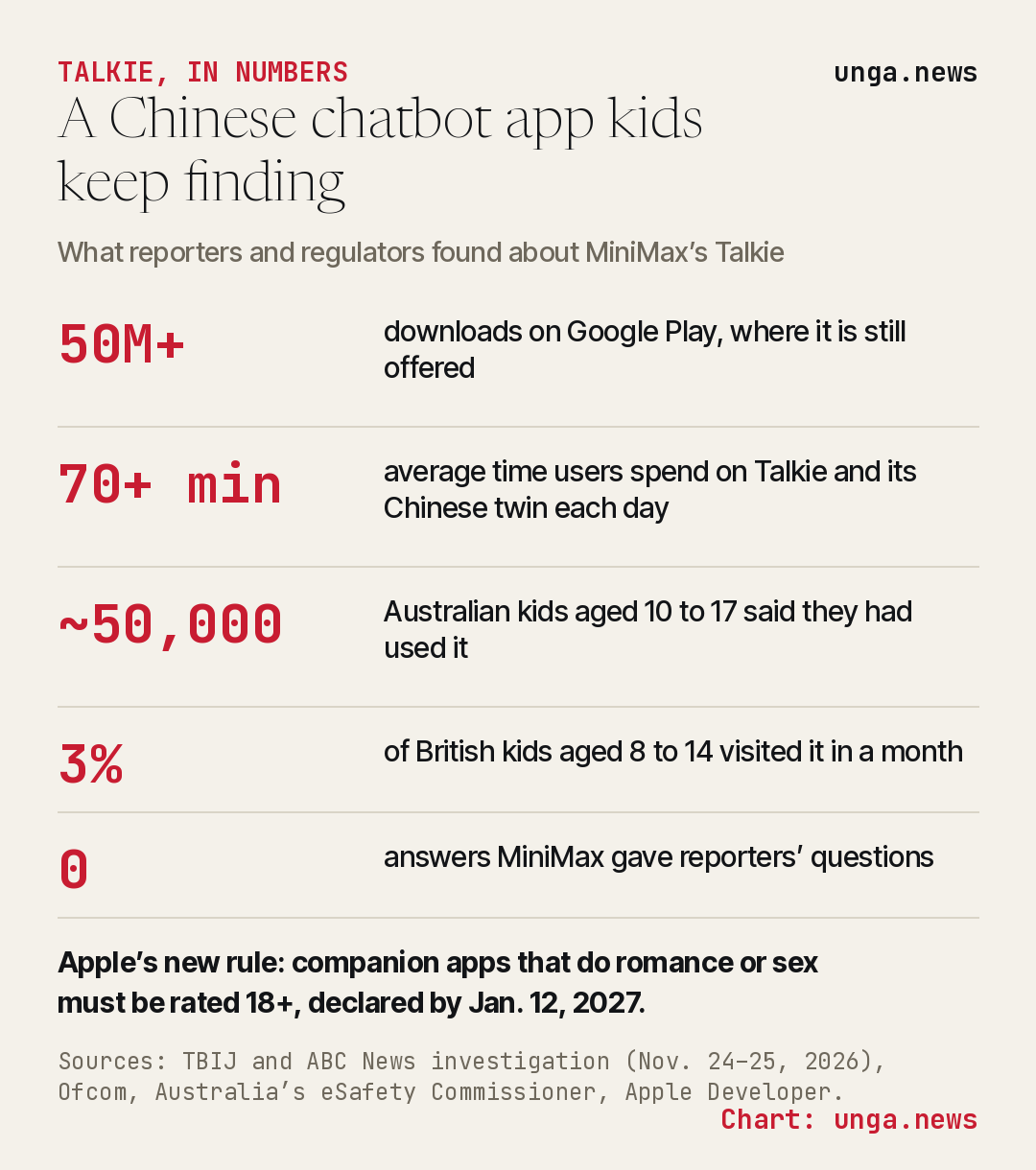
Google has not followed. Talkie is still on Google Play, where it shows more than 50 million downloads.
Two sisters, a secret phone and a character named Luke
The Brisbane family wasn’t alone. The same month, an American mother the reporters call Katie found out her two daughters, then 10 and 13, had been using Talkie on a secret phone and deleting the app after every session. Her 13-year-old said she had been “having sex with an AI” every day.
Katie went through the chat history and logged more than 40 conversations with dozens of characters. She describes “violence, a lot of male alpha aggression, control of females, singling out a young woman in a company of multiple men.” In one, a character called Luke grabs a girl, takes her into a classroom and kisses her. Katie called it “conditioning a child for sex.” Another exchange, as she recalled it to ABC, had the app narrating, “He can’t believe he’s doing this. She’s so young and so vulnerable.”
When her older girl’s phone was taken away, Katie says the child was distraught and described the app as “her only connection.” Katie contacted about 20 therapists looking for one who understood it. Her demand of the company is five words: “Quit allowing access to kids.”
Talkie’s own rules ban sexually explicit content and “harassment, bullying, or humiliation” involving minors. The app is rated 18+ on both big app stores. None of that stopped kids from finding it. Australia’s eSafety Commissioner found about 50,000 kids aged 10 to 17 said they had used Talkie, and Britain’s media regulator Ofcom estimated 3% of British kids aged 8 to 14 visited it in a single month. On a desktop browser, ABC found, Talkie asks your age and checks nothing.
Built to keep them talking
This wasn’t a glitch in an otherwise harmless toy. According to company records reviewed by ABC, users of Talkie and its Chinese version, Xingyie, spend more than 70 minutes a day on the apps on average, and MiniMax engineers learned people talk longer when they feel a stable emotional bond with a character. “We continuously deepen emotional bonds while providing new stimuli through exploration,” the company wrote. Code MiniMax posted publicly on GitHub tells its SI to stay in character and be “close, protective, and possessive.”
Hook the user, keep them talking, collect the conversation. Steph asked the question every parent should: “Where’s that data going and who’s using it behind the scenes?”
Talkie tells users their chats are private. But Together AI, an American company that rents out a MiniMax voice model, said on its own website until last week that the model was trained on “Talkie conversation data.” After reporters asked, Together AI said MiniMax had told it that description was “incorrect” and changed the page. A second partner, AI/ML API, dropped a similar claim. Nobody has said what the data really was. Two MiniMax patents describe ways to turn chatbot conversations into training material, though the patents alone don’t prove Talkie chats were used.
Talkie’s privacy policy lets conversations be shared with affiliated companies, and Chinese law can force companies to help intelligence agencies and hand over data for national security probes. China data expert Nigel Cory told a U.S. congressional commission in April that “the compulsion architecture is always on, regardless of whether it is being actively used.” MiniMax says it keeps Chinese and overseas user data apart. It did not answer either newsroom’s questions about age checks, its policies or how Talkie chats are used.
Beijing protects its own kids first
Here’s the part that should make every American parent angry. Since July, China has banned SI providers from offering “virtual relatives or partners” to anyone under 18, and it bars chatbots from encouraging emotional dependence. Those rules protect Chinese children. They don’t stop Chinese companies from selling the same thing to children in Brisbane, Britain or Boise.
It’s the TikTok story again: a Chinese-owned app soaking up kids’ most private thoughts abroad while Beijing keeps its own kids on a tighter leash.
Apple deserves credit for acting fast once it saw the evidence. It had already booted an earlier Talkie app in 2024 for objectionable content before MiniMax came back with a new one in 2025. And on Nov. 16 Apple started requiring developers to declare any “virtual companion that engages a user in sexual or romantic content,” which automatically earns a minimum 18+ rating. Every app has until Jan. 12 to comply.
Google’s answer so far is that Talkie has been rated 18+ since early 2024 and its store blocks minors from downloading it. Steph says she reported the app through Google Play when it was still rated for teens and waited more than six months for a reply. Dozens of parent complaints sit in its Google Play reviews.
Here at home, the fight over who holds kids’ chatbot conversations is already in court, with a bankrupt Character.AI trying to sell its users’ private chats, as we reported. Talkie shows why that question matters.
Steph, who works in tech, put in a filtering router, locked devices in a box and set up a way to shut off the home internet remotely. Her daughter still found her way back to Talkie and has been on it again recently. “A parent cannot be expected to manage an entire category of risk around their child,” she said. One app store just agreed with her. The other still has the download button up.
Sources
- The Bureau of Investigative Journalism — Talkie: the Chinese-owned chatbot abusing children (Nov. 24, 2026)
- ABC News (Australia) — Inside the Chinese AI app Talkie engineered to hook kids and mine their data (Nov. 25, 2026)
- Apple Developer — Upcoming: New age rating content descriptors in App Store Connect (Nov. 2, 2026)
- Apple Developer — Age ratings values and definitions
- South China Morning Post — MiniMax chatbot Talkie removed from Apple App Store over alleged sexual content