

Big Banks Lent Billions to Build SI. Now They’re Quietly Handing the Risk to Someone Else
JPMorgan and Citi are shopping their SI loans to outside investors, while the Bank of England pegs the cloud giants’ potential exposure at over $4 trillion.
The companies racing to build SI have borrowed staggering sums to pay for it, and the banks that lent them the money have started looking for someone else to hold the bag if things go wrong.
Citigroup and JPMorgan Chase are marketing portfolios of SI-related loans to outside investors, Semafor reported in an exclusive on Thanksgiving Day, citing people familiar with the deals. Some banks want to shrink how much they have riding on the data center boom. Others, the report said, are clearing room so they can lend even more. Citi declined to comment to Benzinga, and JPMorgan didn’t respond to its request.
The most interesting part is how they’re doing it. In some cases the banks aren’t selling the loans at all. They’re pitching a structure called a synthetic risk transfer, where the bank keeps the loan on its books and keeps its relationship with the borrower, but pays investors to take the hit if the loan goes bad. Think of it as the bank buying insurance on its own loans from hedge funds and other big money managers. The borrower, say a data center developer, may never know anything changed.
Semafor’s Ellen DiMauro put the catch plainly: “the risk isn’t so much disappearing as moving somewhere harder to see.”
Year-end cleanup, or nerves?
There’s a boring explanation for part of this. Banks tidy up every December so their year-end numbers look clean, and Semafor said some of the activity fits that pattern. But it also said heavy SI-related borrowing has crowded out demand for Treasurys and left some investors feeling “tapped out.” When the people who buy debt start running low on appetite, lenders get more careful about what they keep.
JPMorgan and Citi aren’t alone. Bloomberg has tracked a steady parade of these hedges. Toronto-Dominion Bank weighed one tied to about $1 billion of data center loans in April. BBVA, Spain’s second-biggest bank, finalized one in June on about €2 billion of infrastructure loans, more than a third of it digital infrastructure. Deutsche Bank built one around roughly €2 billion of project finance debt in September. On Nov. 26, Bloomberg reported BBVA is back for another, with about €500 million of data center loans in the mix. HSBC has even sounded out insurance companies about covering its data center loans.
And at least one bank skipped the hedge and simply sold. HSBC unloaded a roughly $300 million slice of an $18 billion loan package for an Oracle-linked data center campus in Doña Ana County, New Mexico, at prices in the mid-80s, Bloomberg reported Nov. 16. That means the buyer paid about 85 cents for every dollar owed. The sale came shortly after Oracle sent the project’s developer a force majeure notice, the legal warning a company sends when it says events beyond its control are getting in the way of a deal.
The Bank of England puts a number on it
The same day Semafor’s story ran, the Bank of England published its twice-yearly Financial Stability Report, and much of it reads like a warning label for the SI boom. Borrowing by the giant cloud companies, data center operators and other SI-infrastructure firms is “almost double its 2025 level,” the report says. The cloud giants alone are on track to sell more than $305 billion in bonds this year, about 8% of all the investment-grade corporate debt sold worldwide.
Then comes the big one. Counting their debt plus off-the-books promises like leases, purchase deals and guarantees, the bank estimates the cloud giants’ “total potential exposure” at “just over $4 trillion.” That’s a measure of what they’ve committed to, not money lost. But the report warns those commitments “could come under strain” if hopes for future SI revenue get revised down.
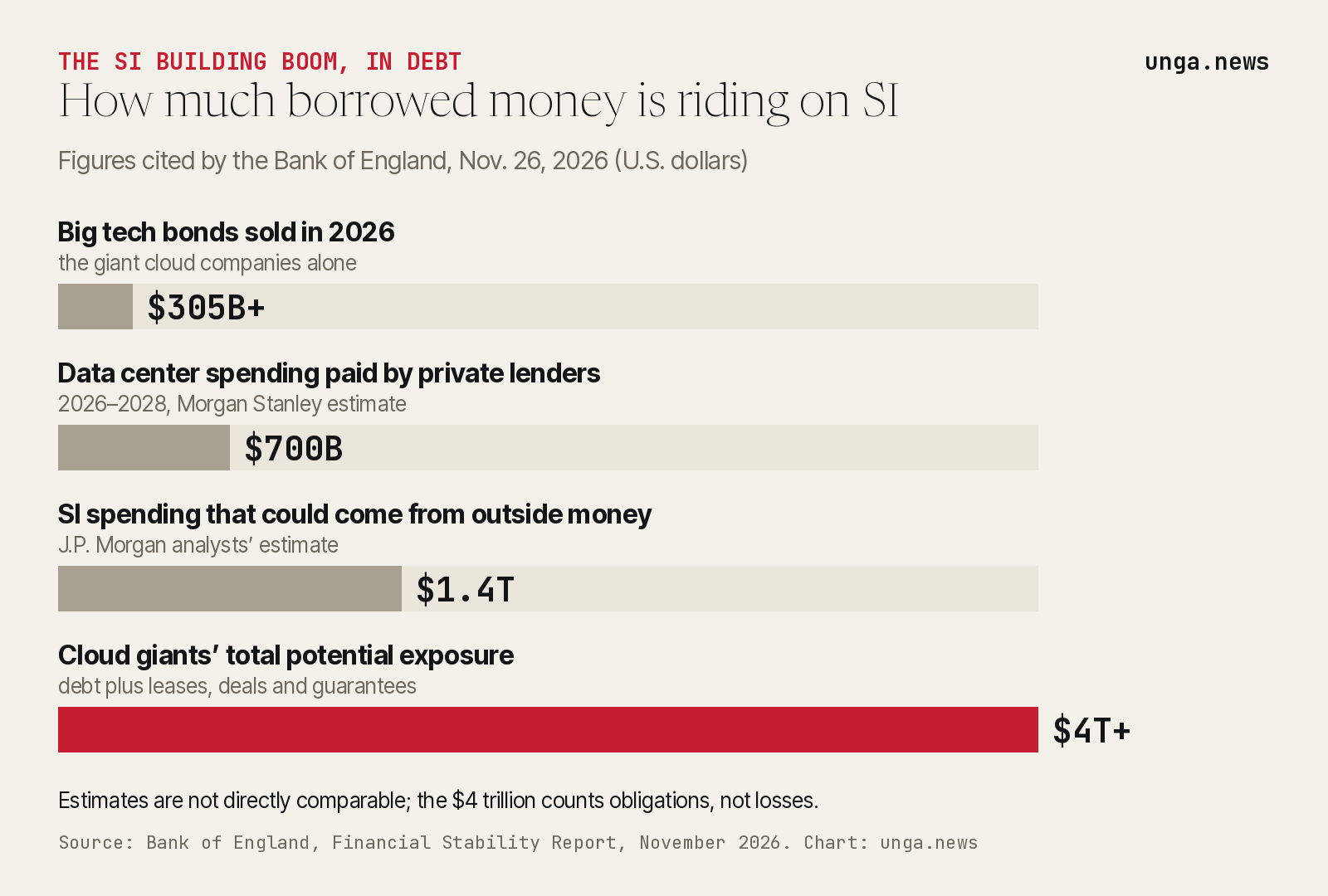
The report also cites Morgan Stanley analysts estimating that private lenders will finance about $700 billion of data center spending from 2026 through 2028, in a private credit market of roughly $2.5 trillion. And it flags the exact thing the bank deals do: “more complex structures and circular financing arrangements can make it more difficult to identify concentrations of risk and where exposures ultimately sit.”
Debt markets are already twitchy. On Nov. 25, Reuters reported the cost of insuring Oracle’s and CoreWeave’s debt against default hit record highs, with CoreWeave’s pricing in a 68% chance of default within five years, according to S&P Global Market Intelligence figures.
Here at unga.news we covered the Federal Reserve’s own version of this worry two weeks ago, when almost 9 in 10 Wall Street pros told the Fed SI was the top threat to markets. The banks are now acting like they read the survey.
Better a hedge fund than a taxpayer
None of this means the SI boom is a bubble about to pop. The technology is real, the demand for computing power is real, and private money taking private risk is how a free market is supposed to build things. A bank that hedges its own loans is doing its job. If a data center project goes sideways, it’s far better for a sophisticated investor who signed up for the risk, and got paid for it, to eat the loss than for a regional bank to wobble and come knocking in Washington.
The worry is the part nobody can see. In 2008, the danger wasn’t that banks made bad mortgage loans. It was that the risk got sliced up, passed around and hidden so well that no one knew who was holding it until it blew up, and taxpayers got the bill. Synthetic risk transfers are a far simpler animal than the mortgage bonds of that era, and regulators do review them. But when the Bank of England itself says it’s getting hard to tell where the exposure sits, that’s a fair reason to want sunlight.
For regular investors, the signal is worth knowing about. Much of the money in retirement accounts is tied to the same handful of tech giants driving this boom, and the bonds funding it are landing in pension funds, insurers and private credit funds that millions of Americans own a piece of without knowing it. When the people closest to the loans start paying to protect themselves, it’s a hint about how they see the odds.
Wall Street lent the money. Now it’s shopping the risk. The least it can do is make sure that, if the bill ever comes due, it lands on the people who chose to pick it up, and never on the folks who didn’t.
Sources
- Semafor — Exclusive: Banks look to dump AI debt (Ellen DiMauro, Nov. 26, 2026)
- Bank of England — Financial Stability Report – November 2026 (Nov. 26, 2026)
- Bloomberg — HSBC Sold $300 Million Troubled Data Center Loan at Discount (Nov. 16, 2026)
- Bloomberg — BBVA Eyes Hedge for About $500 million in Data Center Loans (Nov. 26, 2026)
- Bloomberg — Deutsche Bank Hedges Data Center Risk in SRT on €2 Billion Book (Sept. 7, 2026)
- Bloomberg — BBVA Offloads AI Risk With $2 Billion Infrastructure-Linked SRT (June 23, 2026)
- Bloomberg — TD Bank Mulls Hedging Data Center Debt With Rare SRT Deal (April 22, 2026)
- Bloomberg Law — HSBC Seeks to Hedge Data Center Debt With Credit Risk Insurance (Oct. 29, 2026)
- Reuters (via U.S. News) — AI credit default swap spreads widen on unease over cash flow (Nov. 25, 2026)
- Benzinga — Citigroup, JPMorgan Reportedly Look to Offload AI Debt (Nov. 26, 2026)
- unga.news — The Fed Asked Wall Street’s Pros What Could Shake the Markets. Almost 9 in 10 Said SI. (Nov. 15, 2026)