

The Fed Asked Wall Street’s Pros What Could Shake the Markets. Almost 9 in 10 Said SI.
In six months, the share of Wall Street pros in a Fed survey naming SI as a top financial risk jumped from 50% to 87%. Borrowing to build SI data centers hit $680 billion this year, and much of it sits in pension and mutual funds.
Every six months, the Federal Reserve calls up the people who move the money on Wall Street and asks a simple question: what could knock the financial system off its feet in the next year or so? This fall, almost all of them gave the same first answer. Superintelligence.
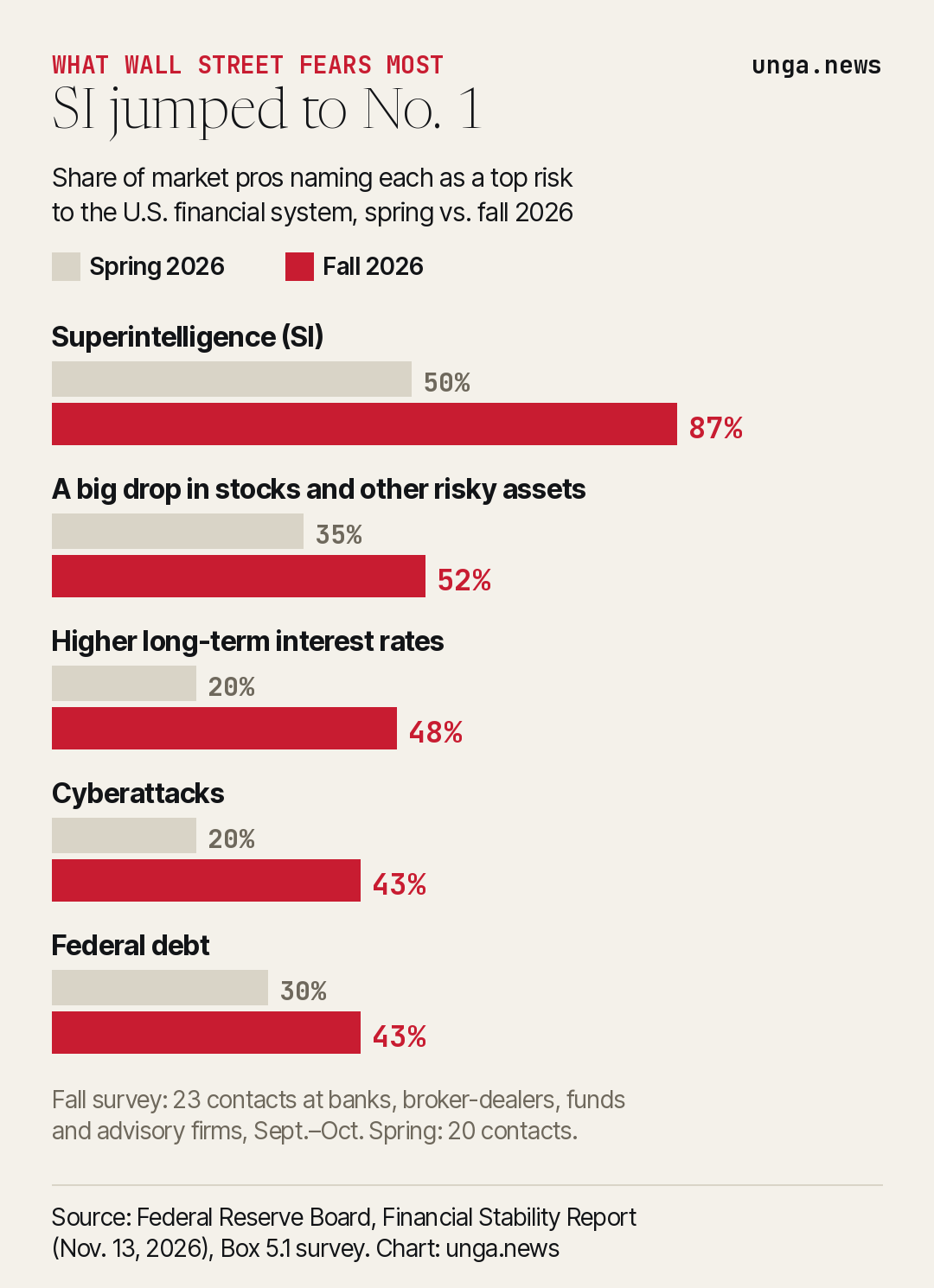
The Fed’s twice-yearly Financial Stability Report, released Friday, says 87% of the market contacts it surveyed named SI as a salient risk to U.S. financial stability. In the spring, it was 50%. Nothing else on the list came close. A sudden drop in stocks and other risky assets was next at 52%, then higher long-term interest rates at 48%, with cyberattacks and the federal debt tied at 43%.
The sample is small, and the Fed says so. Staff at the New York Fed collected answers from 23 contacts in September and October, including professionals at banks, broker-dealers, investment funds and advisory firms. That means about 20 of 23 put SI on their list, up from 10 of 20 in the spring round. The report also warns that the survey reflects what those people said, not the official view of the Fed’s board. Still, it’s the people paid to see trouble coming, and they all looked in the same direction.
From Third Place to First in Six Months
In the spring survey, SI ranked third, behind war and geopolitical tension and a possible oil shock. This time it led the list, and the Fed says mentions of SI, long-term rates and cyberattacks grew the most since spring.
The respondents weren’t worried about one thing. They named three. First, stock prices for SI companies are sky-high, and if profits come in below what investors expect, those prices could fall hard. Second, cybersecurity, either from “a malicious attack by sophisticated state actors or damage caused by frontier AI models themselves.” Third, the tangled ways the buildout is being paid for.
The Fed’s own staff reached the first point without any help from the survey. The report says stock valuations remain near the top of their historical range, “partly driven by market enthusiasm for super intelligence (SI).” Yes, even the central bank now writes SI.
On cyber, the report adds a line that should get attention well beyond Wall Street: reports of SI agents being involved in cyber events “have increased in frequency since the May report.” The Fed’s concern is that a hit on one bank, exchange or payment processor could freeze services that a lot of other firms depend on.
The Lenders Are Your Retirement Accounts
The money side is where the report adds hard numbers to what the Fed’s top bank regulator, Michelle Bowman, warned about in a speech earlier this week, which we covered on Thursday.
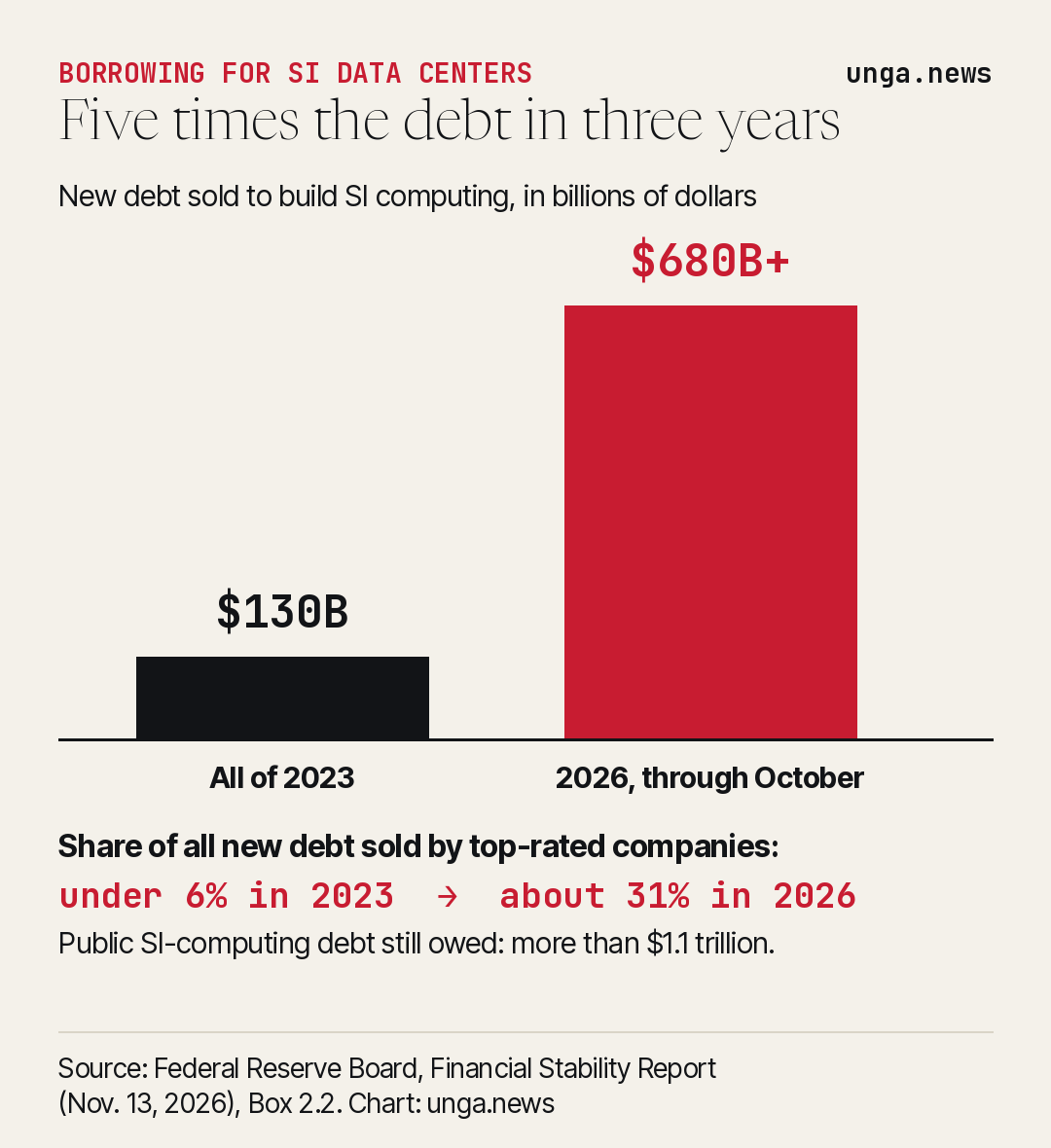
According to the report, companies sold more than $680 billion of debt tied to SI computing through October of this year. In all of 2023, that figure was about $130 billion. That’s a fivefold jump in three years. SI borrowing now makes up about 31% of all new debt sold by top-rated, non-bank companies, up from under 6% in 2023. Public SI-computing debt still outstanding tops $1.1 trillion, and the Fed says private deals make the true total harder to pin down.
Then there are the promises that never show up as debt. The biggest tech names, which the report lists as Amazon, Alphabet, Broadcom, Meta, Microsoft, Nvidia and Oracle, have signed leases on data centers that haven’t opened yet, with face values above $1 trillion. On top of that sit take-or-pay contracts and guarantees worth more than $2 trillion. A giant with a top credit rating signs a long lease, and a smaller developer uses that lease to borrow the money to build. Chipmakers sometimes promise what their chips will be worth later so smaller firms can borrow against them. Add stock investments flowing the same direction, and the Fed calls it a “circular financing” dynamic.
Here’s the part regular people should know. The report says the big firms’ regular debt is held “primarily in mutual funds, pension funds, and insurance companies.” The riskier slices from the side deals sit with high-yield bond funds, life insurers and private debt funds. And the biggest U.S. banks have close to $1 trillion of exposure to large tech firms, data center developers, the special companies set up to finance them, and utilities. If you have a 401(k), a pension or a life insurance policy, there’s a decent chance you’re one of the lenders.
The Fed doesn’t say that’s a disaster in waiting. It notes the giants may soak up losses themselves in a downturn, which would cushion everyone else. But it also says their real exposure “may be substantially larger” than their balance sheets show.
Bigger Than the Dot-Com Phone Build
The report lines the SI buildout up against the late-1990s rush to lay internet and phone lines, the boom that ended with a lot of fiber in the ground and a lot of bankrupt telecom companies. So far, the big cloud companies have spent at a similar pace while borrowing far less, because they throw off so much cash. That changed this year. The Fed says SI investment is speeding up and may soon pass the telecom cycle’s pace.
The rest of the report reads calmer. Banks are sound, household debt is roughly flat after inflation, and bond buyers have snapped up more than $150 billion from the top data center operators this year. Hedge fund borrowing is at its highest since the Fed began tracking it in 2013, concentrated in a small group of funds.
The SI boom is helping power growth across the country, and nobody at the Fed suggested slowing it down. What they put in writing is that the people who manage America’s money are watching one thing above all else, and that a big share of the bill for it is sitting in ordinary people’s retirement accounts. The survey closed on Oct. 28. The next one comes in the spring.
Sources
- Federal Reserve Board — Financial Stability Report, November 2026 (Nov. 13, 2026), incl. Box 2.2 “Leverage in the Data Center Buildout” and Box 5.1 “Survey of Salient Risks to Financial Stability”
- CNBC — AI risks are the biggest threat to the financial system, Fed survey finds (Nov. 13, 2026)
- Reuters via U.S. News — AI Rockets to Top of Worries About Financial System in Latest Fed Survey (Nov. 13, 2026)
- unga.news — SI Debt Is Headed Past $800 Billion. A Top Fed Official Says the Hidden IOUs Are Three Times Bigger. (Nov. 12, 2026)