

Bought Samsonite Luggage on Your Phone Before Black Friday? Hackers Hid a Card Thief at Checkout
Researchers caught a card-stealing program on the phone checkouts of Samsonite, American Tourister, Revolve, FWRD and Lascana in the week before Black Friday. It grabbed card numbers and security codes before the payment even went through.
If you bought a suitcase from Samsonite on your phone in the days before Black Friday, there’s a chance someone besides the store saw your card number. Researchers say a card-stealing program was hiding on the mobile checkout pages of five well-known online stores, grabbing payment details the moment shoppers typed them in.
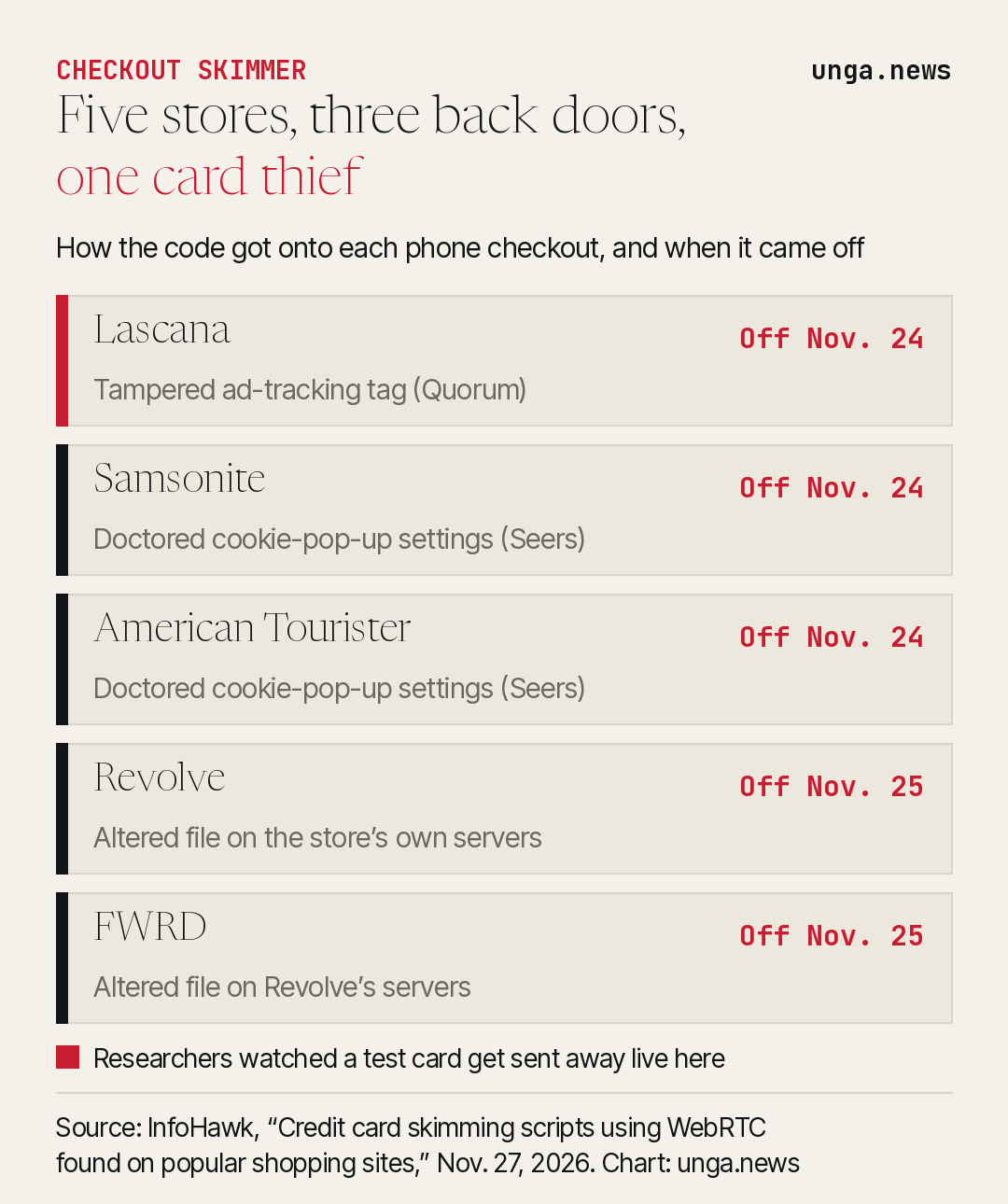
The find comes from InfoHawk, a web security research firm, which published its report on Thanksgiving Day. The five sites were Samsonite, its sister brand American Tourister, the fashion retailers Revolve and FWRD, and the lingerie and swimwear store Lascana. All five had the code pulled on November 24 or 25, after InfoHawk warned them. That was just in time for the biggest shopping weekend of the year, but not before it had been sitting there for some stretch of the week.
Nobody knows yet how many shoppers got hit. InfoHawk says so plainly: “Across all of these sites, we do not know how many, if any, shopper details or payment credentials may have been captured.” What it does know is that the thing worked. On Lascana’s site, the researchers ran a test card through checkout and watched its details get shipped off to a third party.
It took more than the card number
This wasn’t a smash-and-grab for one piece of data. InfoHawk believes the program was built to take the card number, expiration date and the three-digit security code on the back, plus the shopper’s name, address, phone number and email. That’s a full kit for running up charges or opening the door to identity fraud.
It also struck before the store ever checked the payment. That detail matters. A shopper whose order was declined, or who changed their mind and backed out, could still have had their card taken, and nothing on the screen would have looked wrong. You’d get no error message and see no strange pop-up.
The thief also picked its targets with care. The code only switched on for small or touch screens, meaning phones and tablets, and InfoHawk saw it turn on only at the checkout step. On Samsonite’s site it ran on the checkout page and nowhere else. That’s a clever way to stay hidden, because a security team scanning the homepage from a desktop computer would see a perfectly clean site.
Three ways in, one crook
Here’s the part that should worry every online store in the country. The hackers didn’t break in the same way twice. At Lascana, they rode in on an altered marketing tag from Quorum, an ad company that tracks which ads lead to sales. At Samsonite and American Tourister, they slipped it into the settings for the cookie consent pop-up, the little “accept cookies” box made by a company called Seers. A hidden image sat inside the privacy-policy link field, and when it failed to load, it triggered the bad code. At Revolve and FWRD, which Revolve owns, the hackers changed a file on Revolve’s own content servers.
Three different doors, but InfoHawk says all of them led back to the same attacker’s equipment. To the researchers, that means this almost certainly isn’t limited to five stores. Their warning to retailers was blunt: other sites are likely affected too, so go check your own.
The way the stolen data left the building is the sneakiest part. The program used WebRTC, the same technology that lets you hop on a video call right in your web browser. Most store security rules are written to police ordinary web traffic, and they often don’t watch that video-call channel closely. The skimmer pulled down its own code in chunks over that channel, ran it, and sent the card data back out the same way, routed through Cloudflare’s relay servers so the traffic blended in with normal video-call data and hid where it was really going.
Who answered and who didn’t
InfoHawk says it notified the stores, the ad and cookie vendors, Amazon Web Services, which hosted the storage buckets serving the script, and Cloudflare on November 24. Lascana and Quorum both replied and cleaned up that same day. Revolve also responded quickly, saying in a statement for both of its stores: “On November 25, InfoHawk notified our team of a potential security issue impacting mobile and tablet versions of our websites which we resolved the same day. We appreciate the outreach, and are actively investigating the issue to determine any potential impact.”
Samsonite, American Tourister and Seers never answered the researchers, according to the report. The bad code still disappeared from their sites on November 24.
There’s a bigger lesson here, and it isn’t new. Online stores load code from a long list of outside vendors, from ad trackers to chat widgets to cookie banners, and that code runs with the same power as the store’s own. If a hacker gets into any one of those vendors, they get into every checkout that vendor touches. InfoHawk pointed to the November 16 attack on Optimizely, a website testing tool, in which malicious code was reportedly pushed out to visitors of 178 organizations’ sites, including Zoom, the BBC and CNN, without those sites changing a line of their own code. Earlier this week we covered another card breach at a company that runs checkout for software sellers.
The researchers’ fix for retailers is simple enough that it’s a little maddening it isn’t standard: keep marketing tags off payment and login pages, and lock down checkout pages so they can only talk to the handful of servers the store actually uses. That one rule would have stopped this skimmer before it ever loaded.
What to do if you shopped there
If you bought anything from these five sites on a phone or tablet in the week before Black Friday, go through your recent statements now, especially on a debit card. If you spot a charge you don’t recognize, call your bank and ask for a new card number.
Federal law is on your side, but it’s stronger for credit cards. The Federal Trade Commission says that if only your credit card number was stolen and not the card itself, you’re not liable for charges you didn’t make. Debit cards are a different story. If someone uses a stolen debit card number, you’re covered only if you report the fraud within 60 days of the statement that shows it. Wait longer, and the money that drained out of your checking account could be gone for good.
So use a credit card when you shop online. Check your statements. And don’t assume a big-name store means a safe checkout. These shoppers trusted brands they knew, and the thief was hiding in the plumbing the whole time.
Sources
- InfoHawk — Credit card skimming scripts using WebRTC found on popular shopping sites (Nov. 27, 2026)
- Federal Trade Commission (IdentityTheft.gov) — Know Your Rights: credit and debit card fraud liability
- Consumer Financial Protection Bureau — Regulation E, § 1005.6: Liability of consumer for unauthorized transfers
- unga.news — Bought Software Online? Hackers May Have Your Card Number and the Code on the Back