

Canada’s Biggest Phone Company Says an SI-Driven Hacker Took Customers’ Names, Addresses and Account Numbers
Bell says an “agentic” attacker got inside on Nov. 17 and took personal details from Bell, Virgin Plus and Lucky Mobile customers. It still hasn’t said how many people were hit.
Canada’s biggest phone company just told its customers something every phone and internet customer should hear: a hacker got inside, took personal information, and Bell itself describes the intruder as “agentic.” In tech-speak, that means an attacker built around SI agents, software that can poke around a network and take steps on its own instead of waiting for a human at a keyboard.
Bell confirmed on Monday that the break-in happened on Nov. 17 and that it reached everyday households, not just business accounts. Customers of Bell, Bell Aliant, Bell MTS, Virgin Plus and Lucky Mobile with internet, TV or wireless service were affected, spokesperson Ellen Murphy said in a statement shared with BNN Bloomberg and other outlets.
“On November 17, an agentic threat actor accessed some Bell internal systems and obtained some personal information about our residential and business customers,” the statement says.
What the hacker walked away with
According to Bell’s own customer notice, the stolen records may include your name, mailing address, phone numbers, email address, account number, the products you pay for, a business name if you have one, and the date and amount of your last payment.
Bell says no credit card numbers or bank account details were taken. That’s good news, but don’t let it lull you. A crook who knows your name, your address, your account number and exactly what you paid Bell last month has everything needed to send a very convincing fake bill, text or phone call. That’s how most of the real damage from breaches like this gets done. Nobody needs your card number if they can talk you into reading it to them.
Bell’s notice says as much. It warns customers to watch for “unsolicited requests by actors posing as Bell” and says the company “will never contact you to ask for bank account information, passwords or PINs.”
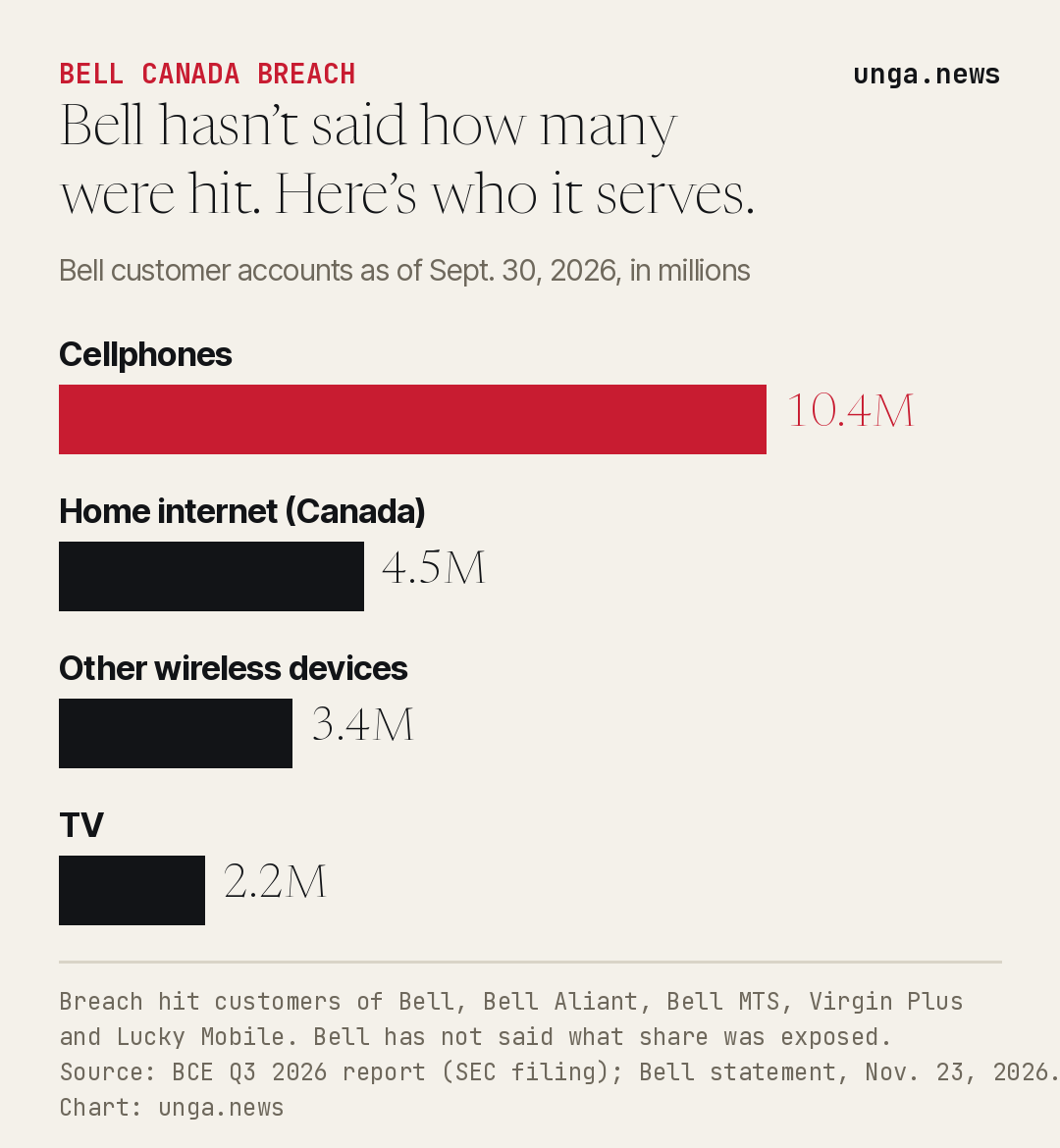
Bell has not said how many people were hit, and that’s the number customers most want. The scale of what’s at stake is no secret. At the end of September, the company reported 10.4 million cellphone customers, about 4.5 million home internet accounts in Canada and 2.2 million TV accounts, according to its latest quarterly report filed with the SEC. Not every one of those was touched, and Bell hasn’t claimed otherwise. Until it gives a count, though, customers have no way to judge how wide this went.
It started with business accounts
This didn’t come out all at once. Last week, Bell began warning its business customers first. BleepingComputer obtained a notice saying the intruder got into a test version of Maximo, the system Bell uses to order and set up network connections for companies. That data included business contact names, job titles, work emails and phone numbers, ticket titles and some IP addresses tied to network equipment.
“Bell is investigating a cybersecurity incident that occurred on November 17 in which an agentic threat actor accessed some of our systems, including a system used for ordering and provisioning circuits, and exfiltrated some enterprise customer data,” the company told BleepingComputer.
Then over the weekend and on Monday, the emails started landing in regular customers’ inboxes. Virgin Plus sent its warning late Sunday. Bell says it told people “as soon as we confirmed that some customer data may have been impacted.” Five or six days from break-in to household warnings is faster than many companies manage, but that’s still most of a week in which customers didn’t know their account details were floating around.
There’s a second, unrelated mess on top of it. Bell says the outside company that runs email for Bell MTS customers in Manitoba was hit by its own cyberattack last week. That one locked people out of their email and forced password resets, and the attacker may have gotten into some accounts. Bell says that provider “does not have ties into the rest of Bell’s systems.”
Who did it is still a mystery
Bell says it doesn’t know who was behind the main breach. “At this stage no one has contacted us claiming responsibility and to our knowledge, no one has publicly claimed responsibility,” Murphy told the Globe and Mail. The company says it kicked the intruder out right away, called in the RCMP’s cybercrime unit and shared clues from the attack with the Canadian Centre for Cyber Security so other organizations can check their own networks.
Credit where it’s due: passing those clues along is exactly what a company should do. It would be better still if Bell published them so smaller firms on both sides of the border could look for the same intruder.
What Bell hasn’t done is explain what made this attacker “agentic.” That’s the word that should get attention well beyond Canada. Just last week, the FBI warned that a free SI hacking kit was helping criminals get privileged access inside companies in under three hours. A big phone company now says it was hit by the kind of attacker that warning describes. Phone companies hold the keys to everything else: the texts that carry your login codes, your home address and your payment history.
Americans have seen how bad this can get. Chinese state hackers spent months inside major U.S. phone networks in the Salt Typhoon campaign uncovered in 2024. There’s no sign China had anything to do with Bell, and nobody should pretend otherwise. But the lesson is the same either way. Telecom networks are prime targets, and the tools for breaking into them just got cheaper and faster.
Bell also owns Ziply Fiber, an internet provider in the Pacific Northwest with about 453,000 American subscribers. Nothing Bell has said suggests those customers were part of this breach, and the affected brands it named are all Canadian.
If you’re a Bell, Virgin Plus or Lucky Mobile customer, assume any call or text about your bill could be fake until you check it yourself through the company’s app or website. Don’t click links in surprise messages, and keep an eye on your accounts. And Bell owes its customers one more thing it hasn’t given yet: a straight answer on how many of them were hit.
Sources
- Bell Canada — Important Cyber Security Update (customer notice)
- BNN Bloomberg — Bell investigates cyberattack that exposed customer information (Nov. 23, 2026), with Bell’s full statement
- The Globe and Mail — Bell Canada residential internet, mobile customers affected by cybersecurity incident (Nov. 23, 2026)
- BleepingComputer — Bell Canada says ‘agentic’ hacker stole enterprise customer data
- CBC News — Bell says cybersecurity incident affected customers at Virgin Plus, Lucky Mobile (Nov. 23, 2026)
- CBC News — Bell says it’s investigating cyberattack that led to potential theft of business customer data
- BCE Inc. (SEC filing) — Third quarter 2026 management’s discussion and analysis
- unga.news — The FBI Says a Free SI Hacking Kit Can Break Into a Company in Under Three Hours