

ChatGPT Can Now Shop and Pay for You. It Never Sees Your Card Number.
OpenAI’s new ChatGPT Wallet lets its SI helpers finish a purchase after you approve it with your face or fingerprint, using a one-time stand-in card number instead of your real one. For now it’s only for $200-a-month subscribers.

For about two years, every SI company has promised the same thing: tell the computer what you want, and it goes and gets it. The catch has always been the last step. Somebody still had to type in a card number, and nobody sane wanted to hand a chatbot their Visa.
On Friday, OpenAI said it has solved that last step. ChatGPT Wallet lets the company’s SI helpers, which it calls dots, finish a purchase for you. You add a card once. The dot finds the sweater, books the Chicago hotel or orders the dinner, and when it reaches checkout it stops and shows you the store, the items, the total and the card it plans to use. You approve with Face ID or a fingerprint. Then it pays.
The part that should make regular people feel better is what the SI never touches. It doesn’t see your real card number, and neither does the store.
A fake card number for every purchase
The trick is in the card number. After you approve, the card network (American Express, Mastercard or Visa, all of which built this with OpenAI) hands the dot a payment token. That’s a stand-in card number with its own security code and expiration date, tied to that one transaction, CNBC reported. The charge lands on your real card, but the real number stays locked away.
So if a shady website or a hacked SI ever got hold of what the dot typed in, it would be holding a number built for a single sale. That’s a real upgrade over pasting your card into a chat window and hoping for the best.
You also keep what you already get from your card. OpenAI says rewards points still pile up, and the usual protections for eligible disputes still apply, such as when something shows up broken. The store keeps control of pricing, shipping, returns and customer service, so you’re still buying from the store, not from OpenAI.
OpenAI’s help page adds some fine print worth knowing. Wallet works with eligible U.S. cards from American Express, Chase, Mastercard and Visa. If you want to add a Chase card, you have to be the main cardholder, not an authorized user. And if you agree to something that renews, like a subscription, the store can keep the payment credential and charge it again under the terms you accepted, so canceling means going to the store.
There’s one more detail people will trip over. When the dot says it’s “ready to check out,” that only means your approval went through. It doesn’t mean the store actually placed the order. OpenAI tells users to look for the store’s confirmation before trying again, which is a polite way of saying don’t accidentally buy two couches.
Only the $200 crowd gets it first
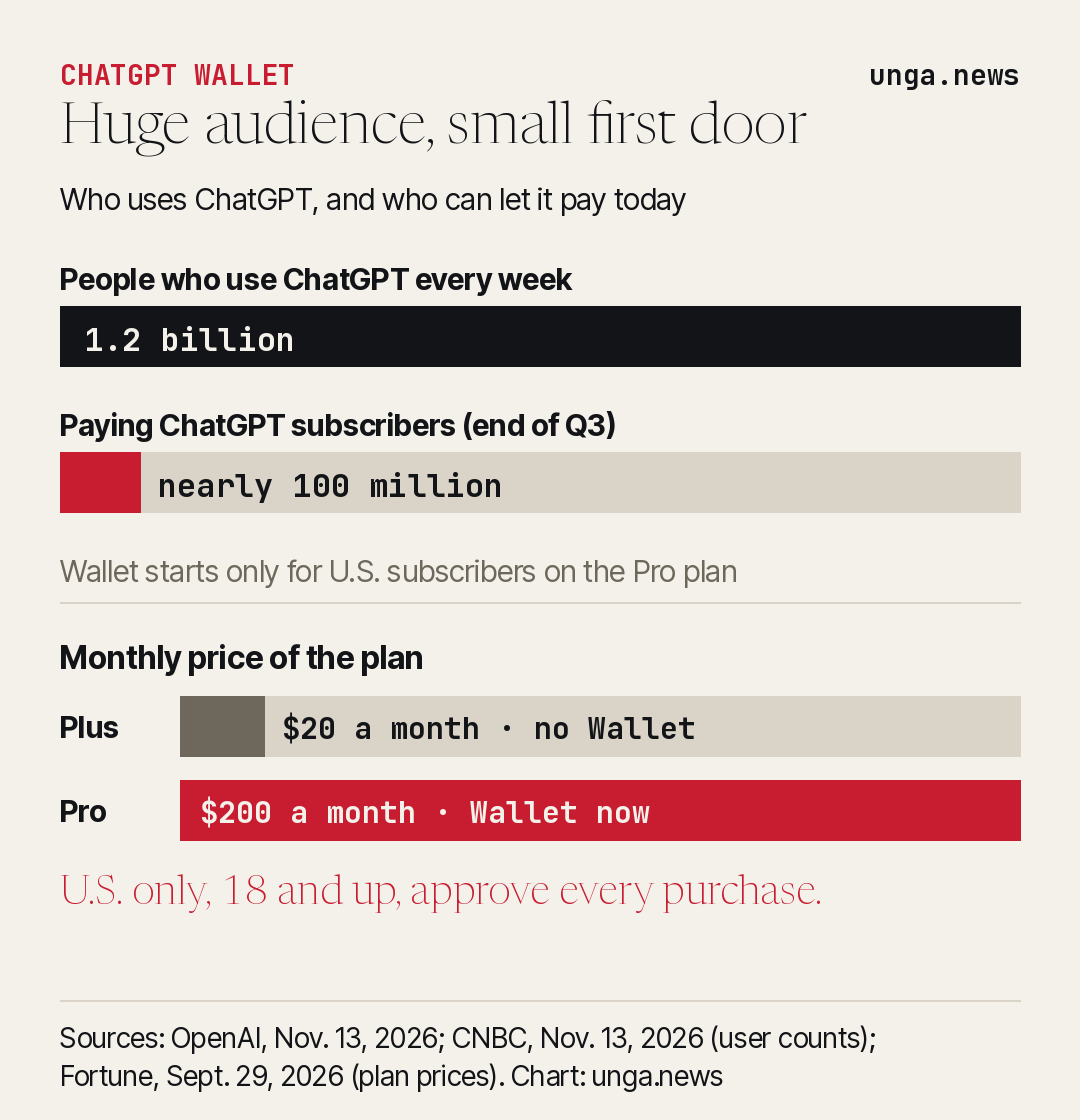
Don’t go looking for this in the free app. Wallet is rolling out only to ChatGPT Pro subscribers who are 18 or older, live in the United States and have a U.S. billing address. Pro runs $200 a month, Fortune reported when OpenAI unveiled the dots in late September, against $20 for the Plus plan most paying users have.
That’s a tiny slice of a giant audience. More than 1.2 billion people use ChatGPT every week, and it had nearly 100 million paying users at the end of the third quarter, according to CNBC. Wallet only works inside a dot, too, not in a regular ChatGPT chat.
Amex’s head of innovation, Luke Gebb, told CNBC the small start is on purpose. “It just makes sense to watch it, start it in a contained environment, and then keep rolling from there,” he said. With that many users waiting, OpenAI can “turn up the volume” whenever it likes.
The dots themselves are only about six weeks old. OpenAI introduced them at its developer conference in late September as always-on helpers, each with its own cloud computer and web browser, able to connect to more than 4,000 apps and keep working after you close the chat. Paying for things was the awkward part, and that’s what Wallet is built to fix.
Some stores aren’t letting the robots in
The hard part now isn’t the SI. It’s the stores. CNBC noted that United Airlines said this week it will block SI agents from booking tickets in its systems, and Amazon already stops them from buying on its site. Plenty of other websites will turn agents away by accident, because their fraud filters were built to catch bots, and a dot is a bot.
OpenAI admits as much. Alongside Wallet it published a playbook for businesses on letting agents shop without getting flagged, and it says it’s working with fraud-fighting firms like Forter, Riskified, Sardine and Signifyd, plus payment companies including Adyen, Checkout.com and Stripe, so legitimate agent purchases don’t get declined.
OpenAI has been burned here before. It launched an Instant Checkout feature last fall and quickly moved away from it, CNBC reported, then rebuilt its shopping search this spring. Chaya Nayak, who runs payments at OpenAI, described Wallet as the next step after helping people find what to buy: “If someone found something they’re really excited to buy, then we want to be able to get them through to that endpoint.”
For now, OpenAI isn’t taking a cut of any sale. That will be tempting to change once millions of people are shopping this way.
Your approval still matters most
The thumbprint before every purchase is the real safety net, and it’s worth using like one. Just this week, a test by brand-protection firm Podqi found that popular chatbots pointed shoppers to risky, fake or dead websites in about 9% of where-to-buy answers. A secure payment token doesn’t help much if the store on the other end isn’t real. Read the store name on the approval screen before you press your thumb down.
OpenAI already has a bigger plan. Down the road, it says, you’ll be able to set rules, such as a spending cap, certain kinds of purchases or a time window, and let your dot buy within them without asking every time. That’s when this stops being a neat trick for $200-a-month subscribers and starts being the way a lot of people shop.
For anyone who has ever spent a lunch break typing the same card number into five different websites, that future sounds pretty good. Just keep your thumb on the button until the robots earn it.
Sources
- OpenAI — Introducing ChatGPT Wallet (Nov. 13, 2026)
- OpenAI Help Center — Making purchases with ChatGPT Wallet
- CNBC — OpenAI launches ChatGPT Wallet, allowing its 'dots' AI agents to make purchases for users (Nov. 13, 2026)
- Fortune — OpenAI unveils Dots as rival to Meta's Muse, plus a $500 monthly plan (Sept. 29, 2026)
- The Next Web — OpenAI's ChatGPT Wallet lets its AI agents shop without seeing your card
- unga.news — Ask a Chatbot Where to Buy Something and It Might Send You to a Fake Store