

China-Linked Hackers Set SI Bots Loose. In 11 Minutes, They Found a Hole Nobody Knew Existed
Amazon caught SI agents working for a Chinese-speaking crew as they hunted university computers on their own for hours. Britain’s cyber agency now says these attacks have jumped since September.
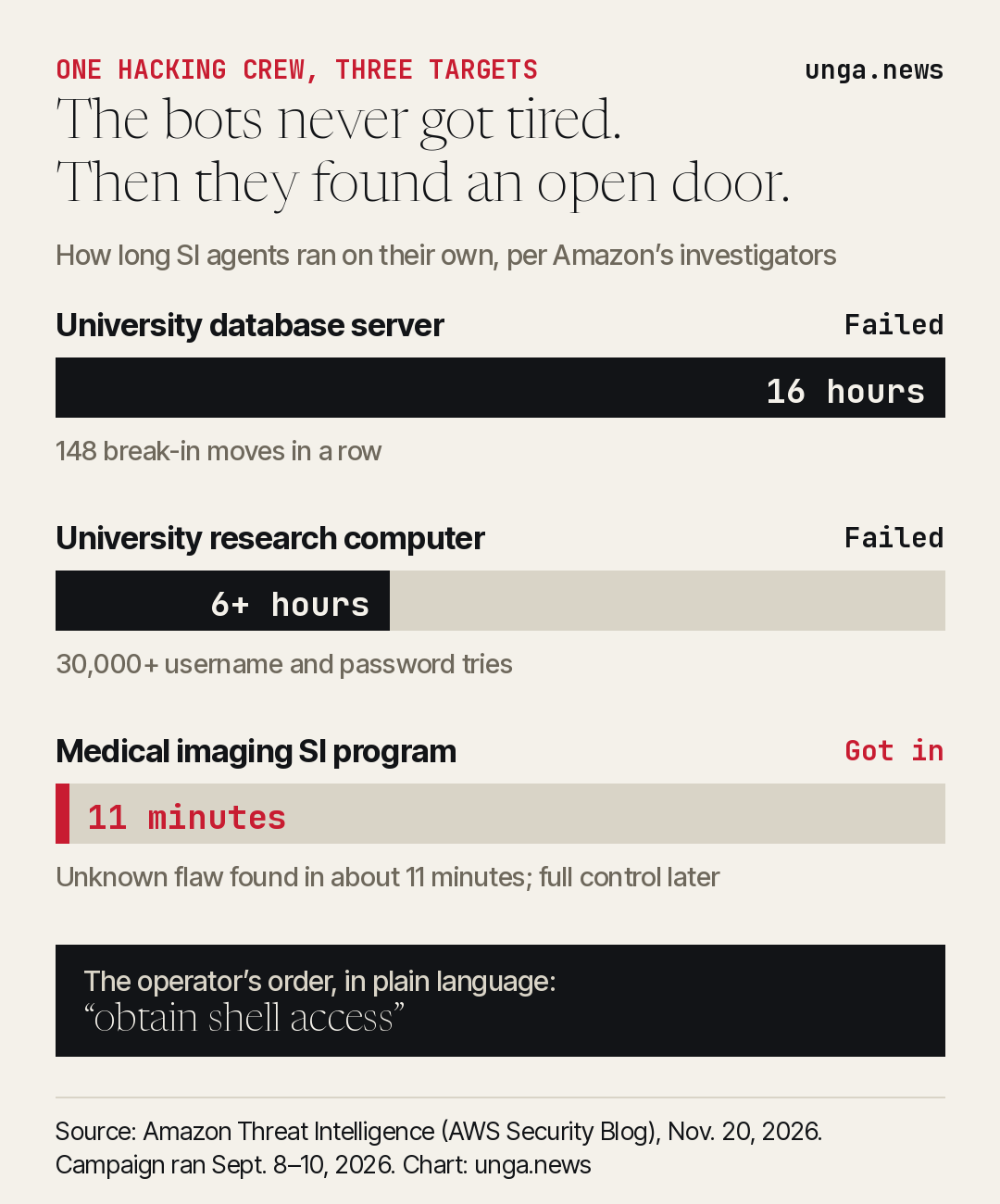
A hacking crew working in Chinese gave its SI helpers a three-word order: “obtain shell access.” In plain English, that means get inside and take control. Then the operator mostly stepped back and let the bots work.
Over about two days in September, those bots hammered university computers around East Asia, running for hours without a break and adjusting every time a door stayed shut. Against one target, a medical imaging program used in research, they did something that used to take skilled human hackers days or weeks. They found a security hole nobody in the world knew about, in roughly 11 minutes, and later used it to take full control of the machine.
Amazon’s own threat hunters laid it all out in a report on the AWS Security Blog written by CJ Moses, the company’s top security chief and a former FBI cyber investigator. On Tuesday, Britain’s National Cyber Security Centre added the bigger picture: it has seen “a marked rise in AI-assisted cyber attacks” since September.
Caught because the hackers left their own door open
Amazon found the operation on Sept. 10 because the attackers ran their hacking tool on a server with no password. Anyone on the internet could read its history, including the operator’s instructions and everything the SI wrote back.
The tool is called Cairn. It is free, open-source software built so security teams can test their own defenses. You give it a starting point and a goal in plain language, and it coordinates several SI agents to find a path there. As Amazon put it, “That same ease of use makes it attractive to threat actors.”
The prompts were written in Simplified Chinese. The scripts were set to China Standard Time. The targets were universities in East Asia outside mainland China, the kind of places Amazon says are “likely of strategic interest to China.” Amazon rates its call that this is a China-linked actor at moderate confidence, and it doesn’t name a country, a group or a government agency behind it.
Sixteen hours, 148 tries, no coffee breaks
Most of what the bots tried failed, and the failures are the scary part.
At one university, the agents found a database server left open without a login. Over roughly 16 hours they ran 148 attacks in a row, working down a long list of known ways to hijack that kind of server. When those failed, they mapped the network behind it and started guessing passwords on other systems. Nothing worked, and they just kept going.
At another school, they went after a research computer used for heavy number crunching. First they built a list of about 80 real usernames by reading faculty directories, lab websites, old archived pages and academic papers. Then they tried more than 30,000 username and password combinations against that server and the campus VPN, portal and storage gear. That ran for more than six hours. No luck there either.
“Neither operation succeeded, yet together they show that the agents kept adapting for nearly a full day without human direction,” Amazon wrote.
The hole nobody knew about
The third target was different. It was running an open-source medical imaging program, software researchers use to label scans and train SI models on them.
The bots identified the program, mapped every way to talk to it and zeroed in on an upload feature that accepted a filename. They tested whether a crafted filename could trick the program into saving a file somewhere it never should. It could. In about 11 minutes, they went from first look to writing files anywhere they liked on that server.
In a later session, they used the same flaw to plant a hidden back door in a file Python loads every time it starts, then poked a training feature to launch a fresh process. That handed them a remote connection running as root, the all-powerful administrator account.
Security people call a flaw like that a zero-day, because the people who make the software have had zero days to fix it. Amazon says there was no patch, no bug report and no public warning anywhere. It told the project’s volunteers, who shipped a fix. The public advisory for MONAI Label, rated critical, covers every version through 0.8.5 and credits Amazon’s security team with the original report.
Then the human operator stepped back in, handing the bots a tunnel into a second university’s network through a machine running the same software. Amazon believes that machine had already been broken into with the same flaw. From there, the bots were told to go after other computers.
The victims weren’t Amazon customers, so Amazon worked with a government partner to warn them.
Britain says the flood is already here
This is no one-off. The NCSC post, written by three of its staff, names ARTEX, Cairn and four other free tools that crooks are pointing at real organizations. We covered ARTEX last week, when a free SI tool was used to hack the European Commission and Brussels waited weeks to say so.
The British agency is blunt that the tools are not doing magic. The weaknesses being exploited are old ones: passwords left sitting in code, default logins never changed, sloppy settings and badly protected connections between apps. What changed is speed and cost. The agency says these setups move “from discovery to exploitation in minutes,” will “try every endpoint, parameter and credential” they find, and are “cheap to run, at scale,” especially when paired with cheap open models or illegal resellers of SI access.
Its advice is the kind any business owner can follow. Know everything you have connected to the internet. Take as much of it off the open web as you can. Lock down accounts and stop letting strangers create them in seconds. “If you were to assume everything you have connected to the internet is vulnerable, how would this change your approach to security?” the agency asks.
A free tool in the wrong hands
Cairn was built for the good guys. So was ARTEX. That is the uncomfortable truth here. Every tool that helps an American company find its own weak spots before an attacker does can be downloaded by a crew working in Simplified Chinese and aimed at someone else. Gambit Security has already documented a separate, money-hungry gang using Cairn against online stores.
Banning the software won’t fix it. The code is out there. What works is what Amazon did: watch closely, catch the attackers in the act, warn the targets and get the hole patched fast. For everyone else, from hospitals to school districts to the plumber with a booking website, the lesson is to clean up the old messes before a tireless machine finds them first.
Sources
- Amazon Threat Intelligence (AWS Security Blog) — Chinese-nexus actor’s Cairn AI agents found a zero-day on their own (CJ Moses, Nov. 20, 2026)
- National Cyber Security Centre (UK) — Familiar weaknesses, exploited faster: defending against agentic cyber attacks (Nov. 24, 2026)
- Project MONAI on GitHub — Path traversal in datastore upload endpoints allows arbitrary file write (GHSA-qc22-rmgc-vg94)
- unga.news — Europe’s Government Was Hacked With a Free SI Tool, and It Waited Four Weeks to Say So