

Congress Can’t Cut the Justices’ Pay. Justice Alito Warns It Can Still Turn Off the Court’s Lights.
At a Federalist Society dinner, Alito said the Supreme Court depends on Congress for every dollar beyond the justices’ salaries, and that some lower-court judges have gone “far astray” freezing presidents’ plans for years.
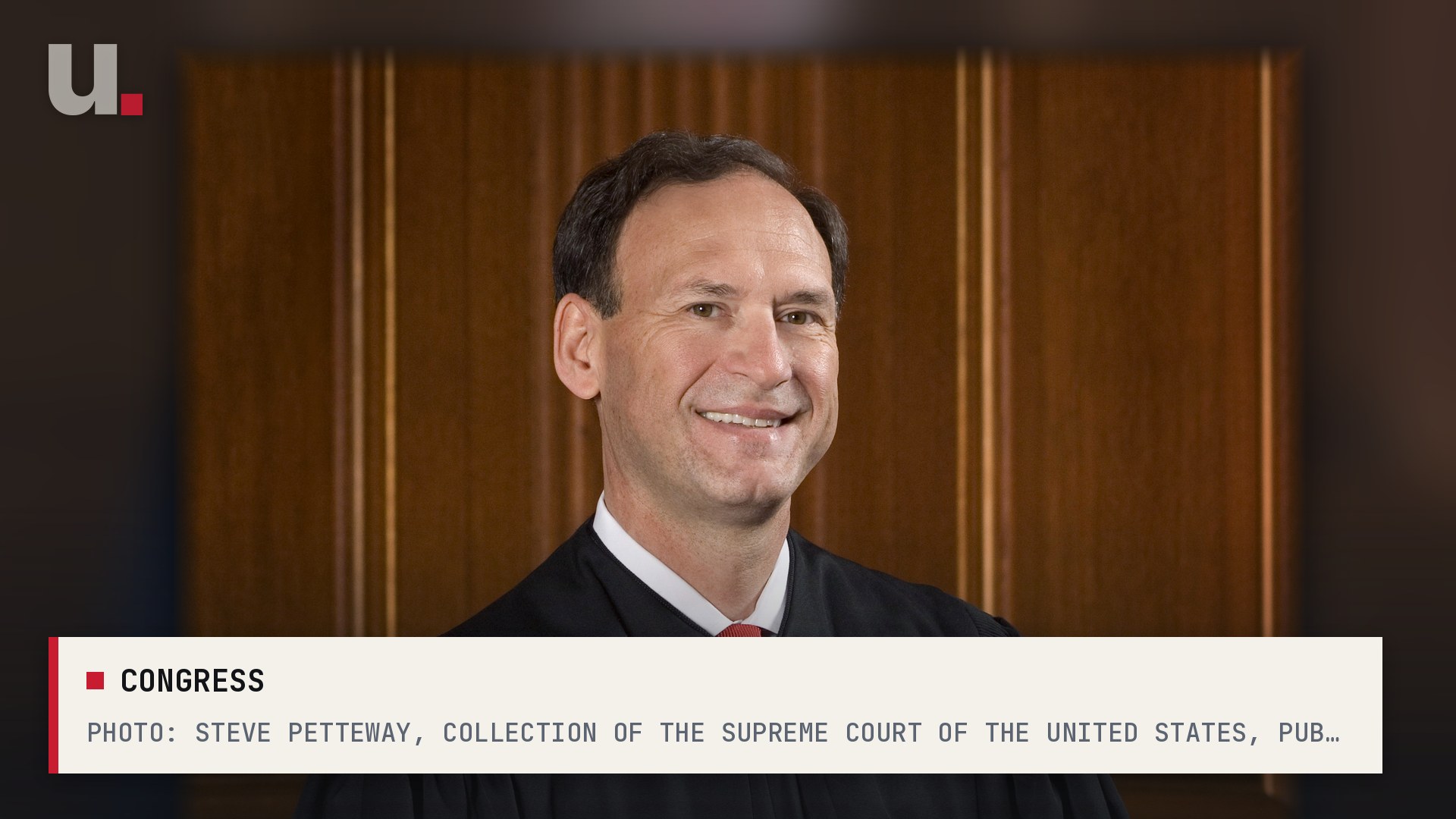
Justice Samuel Alito doesn’t give many speeches, and he chose his words for this one carefully. Standing before a black-tie crowd at the Federalist Society’s annual convention dinner in Washington on Thursday night, he reminded the country of a fact most people never think about: the Supreme Court can’t pay its own light bill.
“Congress can turn off the lights of the Supreme Court and stop everything from happening if they will not fund their activities,” Alito said, according to NBC News, which reported the remarks from the room. “And there are many, many, many other things that they can do, or at least try to do. So it is important to preserve the independence of the judiciary.”
He was talking with Mollie Hemingway, the editor of The Federalist, at the group’s Antonin Scalia Memorial Dinner. NBC put the audience at more than 2,500 conservative officials, lawyers, judges and advocates. Alito, who has served on the Court since early 2006, did not mention last week’s elections. He didn’t have to. When the new Congress is sworn in this January, both chambers will be run by Democrats, and ideas like term limits, new ethics rules and extra seats have been floating around their side for years.
The weakest branch, and the one with no wallet
Alito leaned on an old idea from Alexander Hamilton: the judiciary is the “least dangerous” branch. It has no army and no budget. It can only rule. He said the courts are “vulnerable to the executive and to Congress because they are more powerful.”
He then gave the comparison that got the most attention. The judiciary isn’t a nuclear weapon or a 500-pound bomb, he said. It’s a hand grenade. “The hand grenade is the least dangerous, but that is not to say that is not dangerous.”
The money part of his warning is real, and it’s narrower than it sounds. The Constitution protects the justices themselves. Article III says judges “shall, at stated Times, receive for their Services, a Compensation, which shall not be diminished during their Continuance in Office.” Congress cannot cut a sitting justice’s paycheck.
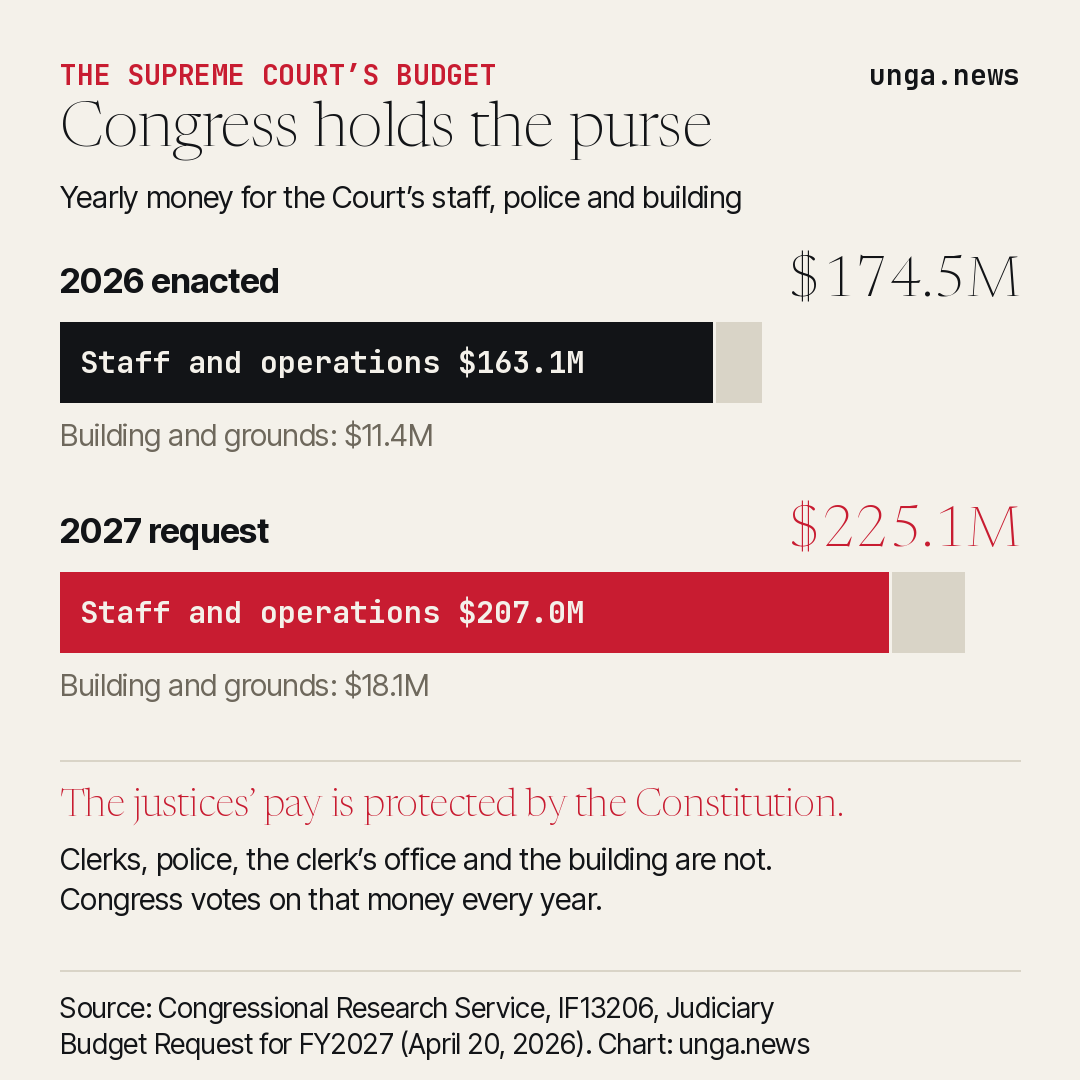
Everything around that paycheck is another story. The law clerks, the Supreme Court Police, the clerk’s office that processes thousands of petitions, and the marble building itself are all paid for in the yearly spending bills Congress passes. According to the Congressional Research Service, the Court got $174.5 million for fiscal 2026. Its request for fiscal 2027 is $225.1 million, a 29% jump that the CRS report splits between $207 million for salaries and expenses and $18.1 million for the building and grounds.
Any spending bill that cut that money would still need the president’s signature, and President Trump holds the veto pen for two more years. But Alito’s point stands. The Court depends on the same Congress whose laws it sometimes strikes down.
Size is the other lever. The Constitution never says how many justices there are. A federal statute, 28 U.S.C. 1, sets the number at a chief justice and eight associates. An ordinary bill could change that, which is why court packing comes back every time one party is unhappy with the bench.
Judges who freeze a president for years
The second half of Alito’s remarks went after a problem conservatives have complained about for a long time: a single district judge stopping a national policy for everyone.
“Presidents have become very frustrated with their inability to get Congress to enact their legislative agenda, and so they have looked for ways to do as much as they can unilaterally with their own powers,” he said. Opponents then race to court, and they pick their courtroom. “The litigators, understandably, choose the districts where they think they are most likely to get the result they want. Their expectations are very often met.”
In some cases, Alito said, judges have handed down “very sweeping and unjustified orders, stopping what the president wants during the pendency of appeal,” a process that can drag on for years. “So, if at the end of that period it turns out that the district judge was wrong, the president, whoever it is, will have been prevented for most of a four-year term from implementing this, this, this initiative.”
Notice the words “whoever it is.” Alito framed this as a rule for every president, not a favor for one. A voter elects a president to carry out an agenda. If one judge in a hand-picked district can bench that agenda for most of a term, and the higher courts later say the judge got it wrong, the voters lost something they can’t get back.
That is the backdrop for the Court’s busy emergency docket, which Alito said grew out of these sweeping orders over the past 10 or 15 years. In the current term, the Trump administration has won a long string of those emergency rulings, letting it move ahead on immigration enforcement and the restructuring of the federal government while the lawsuits play out. Just this week, the justices agreed to hear Trump’s case on shutting off asylum at the southern border.
Alito was careful not to trash his colleagues on the lower courts. “They are dedicated and they are skillful, but they’re not perfect, and they make mistakes,” he said. “And in some instances, I think they have gone far astray.”
One speech, two warnings
Put the two halves together and the message is consistent. Alito wants courts that are independent enough to say no to Congress and humble enough not to run the executive branch from a single courtroom. Both warnings come from the same place: each branch has a job, and the system breaks when one grabs another’s.
Critics on the left will hear the first half as a shot at the incoming majority and the second as a defense of Trump. But the funding threat is not hypothetical, and the forum-shopping problem has frustrated presidents of both parties. The real test arrives with the fiscal 2027 spending bill that covers the judiciary. If the Court’s line comes in well under its request, Alito’s dinner remark will look less like a warning and more like a forecast.
Sources
- NBC News — Alito says Supreme Court is caught between the president and a Congress that can ‘turn off the lights’ (Nov. 13, 2026)
- The Hill — Justice Samuel Alito warns Congress could ‘turn off the lights’ on Supreme Court (Nov. 13, 2026)
- Congressional Research Service — Judiciary Budget Request for FY2027 (IF13206, April 20, 2026)
- U.S. Constitution — Article III, Section 1
- U.S. Code — 28 U.S.C. 1, Number of justices; quorum