

Trump Took His Border Asylum Shutoff to the Supreme Court. The Justices Just Said Yes.
The Supreme Court agreed Friday to decide whether a president can shut asylum for people who cross the border illegally. The order stays in force while they do, with a ruling due by summer.
Two days ago I wrote here that President Trump’s Day One order shutting asylum at the southern border had lost twice in the lower courts and was waiting on the Supreme Court. On Friday the waiting ended. The justices agreed to take the case.
The entry on the Supreme Court’s docket is one line long: “Petition GRANTED limited to Questions 1 and 2 presented by the petition.” That one line does two things at once. It keeps the asylum shutoff running at the border while the case is argued and decided, and it guarantees the country a final answer from the highest court instead of leaving the last word to a panel in Washington. A ruling is due before the end of June, NBC News reported.
For the administration, that is the outcome it asked for. Turning the case away would have let the lower-court ruling take effect and switched the asylum shutoff off. Instead, the justices looked at the case at two straight private conferences, Nov. 6 and Nov. 13, and decided it deserves their full attention. It takes only four of the nine to say yes.
What the justices agreed to answer
The case is Mullin v. Refugee and Immigrant Center for Education and Legal Services, named for Homeland Security Secretary Markwayne Mullin and the Texas nonprofit that sued. Solicitor General D. John Sauer’s petition asked three questions. The court took the first two.
The first is the big one: whether Proclamation 10888, which Trump signed on Jan. 20, 2025, and the guidance that carries it out are lawful. The order suspended entry for people crossing illegally at the southern border and cut them off from the parts of immigration law that let a person stay in the country while a case drags on, asylum included.
The second is a quieter question with real teeth. A federal law, 8 U.S.C. 1252(f)(1), limits the power of lower courts to block the government’s immigration procedures for a whole class of people at once. The district judge certified a class covering everyone subject to the order, including people who haven’t even arrived yet. Sauer says that law forbids exactly that kind of sweeping order. If the justices agree, it would rein in single judges far beyond this one case.
The third question, whether the class itself was drawn properly, didn’t make the cut. That doesn’t hurt the government much. If it wins on the first two, the class fight barely matters.
A border that stayed quiet
The strongest argument the administration brings into the courtroom isn’t a legal citation. It’s the border itself.
Since the proclamation took effect, the petition says, border encounters “have fallen by 93 percent, dropping to the lowest levels since the 1960s.” Customs and Border Protection’s full-year numbers back that up. The Border Patrol made 98,708 apprehensions at the southwest border in all of fiscal 2026, the agency [announced Oct. 16]({CBP}). That entire year came in 60% below the Biden administration’s single worst month, 249,740. CBP also reported zero Border Patrol releases into the country for 17 straight months through September.
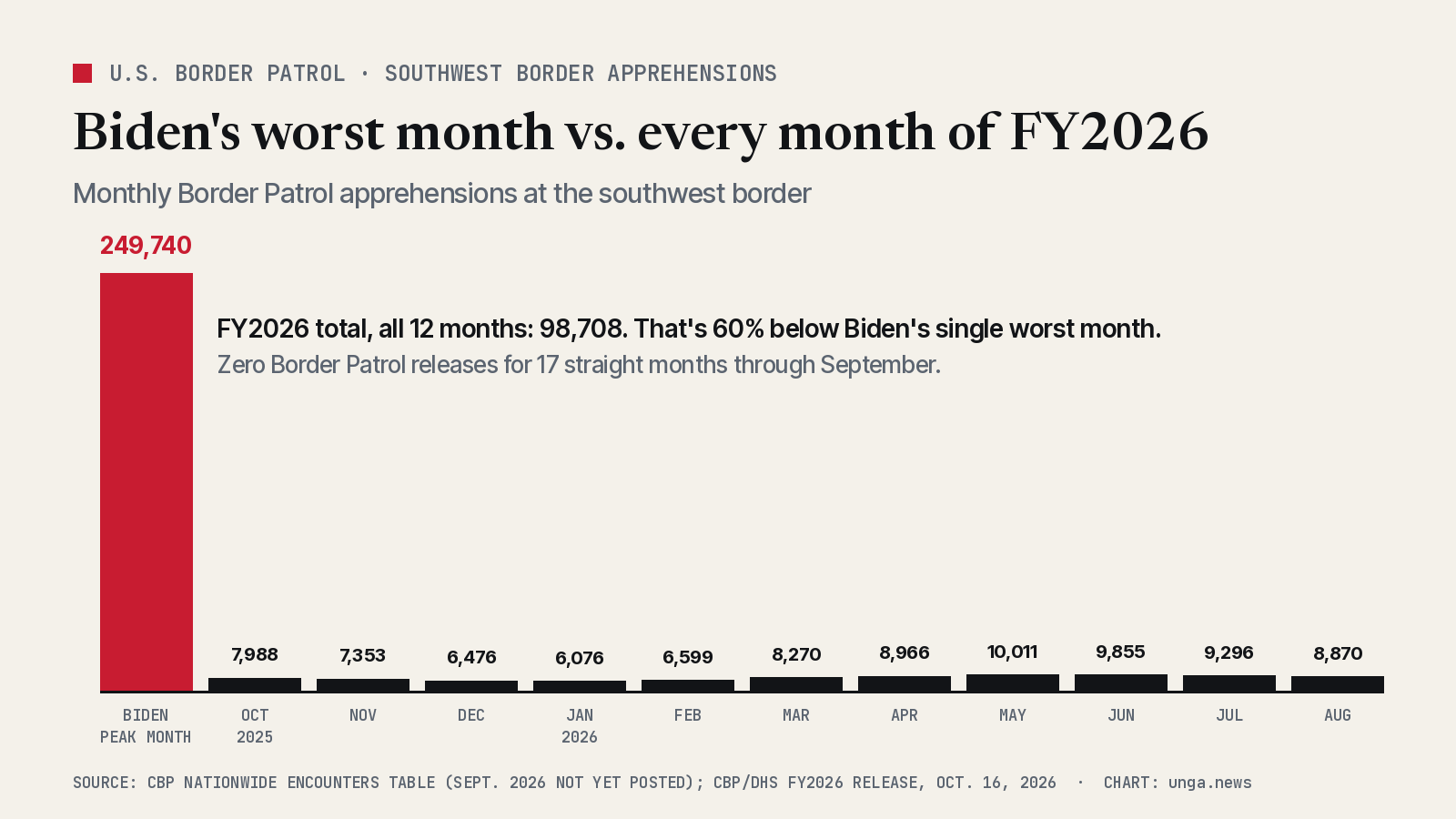
Look at that chart and ask what the justices are really being asked to decide. Not whether the policy works. Whether a president is allowed to use it.
Sauer’s answer is that the policy “rests on a commonsense understanding of the President’s inherent and delegated powers to exclude aliens.” He points to a provision of immigration law that lets a president suspend the entry of anyone whose arrival he finds would be “detrimental to the interests of the United States.” Asylum, he argues, has always been something the government may grant, not something any individual is owed. If the president has already decided illegal crossers won’t get it, forcing officers to sit through every claim anyway is process for its own sake.
Why the lower courts saw it differently
The challengers, three legal-aid groups and 13 migrants represented by the ACLU, say Congress already settled this. Federal law says anyone “physically present” in the country may apply for asylum, however they got here. In their brief, the president “may not invent by fiat a new removal system that eviscerates the protections Congress mandated by statute.”
U.S. District Judge Randolph Moss agreed with them in July 2025. In April of this year, a three-judge appeals panel in Washington mostly did too, and the full appeals court refused to rehear it. But that same court froze its own ruling so the government could come to the Supreme Court first. Under that freeze, people who cross illegally still can’t get asylum, though their claims that they’d face persecution or torture back home still have to be heard, according to the Center for Gender and Refugee Studies, which is on the challengers’ side.
The government’s best friend from below is Judge Justin Walker, who dissented in part on the appeals panel. “The Executive has already exercised his lawful discretion to deny all asylum applications,” he wrote. “So he may foreclose the application process as futile.” Walker also said the district court had no business handing relief to potentially millions of people at once. Those two points line up almost exactly with the two questions the justices just agreed to decide.
Twenty-two states, led by Iowa, filed briefs backing the administration, along with America First Legal and the Federation for American Immigration Reform.
One of three border cases on the docket
This isn’t the only immigration fight the court is taking on this term. NBC counts it as the third major one. The justices are already set to weigh the administration’s push to deport people to third countries when their home nations won’t take them back, and its effort to keep people in detention while their deportation cases play out instead of releasing them to wait.
Put those together and the Supreme Court is about to decide, in one term, most of the big questions about how far a president can go to control who gets in and who stays. Sauer has reminded the justices that they have been here before. In 2018 they upheld Trump’s travel ban under the same entry-suspension power.
Until June, the asylum shutoff stays on. Border towns that went from overrun to quiet will be watching the calendar more closely than anyone.
Sources
- Supreme Court of the United States — Docket No. 26-239, Mullin v. Refugee and Immigrant Center for Education and Legal Services (cert. granted Nov. 13, 2026)
- U.S. Solicitor General — Petition for a writ of certiorari, Mullin v. RAICES, No. 26-239
- RAICES et al. — Brief in opposition, Sept. 23, 2026
- The White House — Proclamation 10888, Guaranteeing the States Protection Against Invasion
- U.S. Customs and Border Protection — Under President Trump and Secretary Mullin, DHS announces lowest fiscal year border crossings in American history (Oct. 16, 2026)
- U.S. Customs and Border Protection — Nationwide Encounters (monthly Border Patrol apprehensions, FY2026)
- NBC News — Supreme Court to rule on Trump’s asylum ban (Nov. 13, 2026)
- SCOTUSblog — Mullin v. Refugee and Immigrant Center for Education and Legal Services (26-239)
- Center for Gender and Refugee Studies — RAICES v. Mullin case page
- unga.news — Trump’s Border Asylum Ban Is Still Standing. The Supreme Court Takes a Second Look Friday. (Nov. 11, 2026)