

Connecticut Can’t Jail ICE Agents for Wearing Masks, a Biden-Appointed Judge Rules
Judge Vernon Oliver blocked the state’s mask ban, badge rule and plan to prosecute federal officers, writing that the Constitution gives Connecticut “no power” to control them.

Connecticut wrote a law that could put a federal immigration officer in jail for doing his job with his face covered. On Friday a federal judge in Hartford said the state can’t do that. U.S. District Judge Vernon D. Oliver blocked four sections of Connecticut’s new ICE law, the mask ban, the badge-and-name-tag rule and a state system for investigating and prosecuting federal officers over their use of force, finding all four likely violate the Supremacy Clause of the U.S. Constitution.
The 39-page ruling comes three days after California gave up the same fight and agreed to a permanent order barring its own mask and badge laws from being used against federal agents. Two blue states, one week, the same answer from the courts: a state doesn’t get to set the rules for federal officers.
Thirty days in jail for a face covering
The law is Senate Bill 397, enacted as Public Act 26-14 and signed by Gov. Ned Lamont in May. Section 6 says a peace officer enforcing the laws of Connecticut, another state “or the United States” shall not wear “any facial covering or personal disguise while interacting with the public.” The definition of peace officer explicitly includes federal agents. There are narrow exceptions for health, safety and an “active undercover operation or assignment,” and even that undercover exception only works if a supervisor or a court signs off.
The same section requires a federal officer to be “clearly identified” by a “badge and name tag on the officer’s uniform” during a planned arrest or while dealing with the public. Break either rule and the officer “shall be guilty of a class D misdemeanor,” which carries up to 30 days in jail. Section 6(d) goes further and strips a masked officer of “any privilege or immunity” in a civil lawsuit if the violation was knowing and willful.
Sections 3, 4 and 5 were the bigger reach. They hand Connecticut’s Inspector General, the office that reviews police shootings, the power to decide whether a federal officer’s use of force was “justifiable” under a Connecticut standard, and then to investigate and prosecute that officer if the answer is no. Section 4 says force is justified “only” when the officer’s “actions are objectively reasonable” and, for deadly force, only after the officer “reasonably determine[s] that there are no available reasonable alternatives.” Hartford wanted to grade ICE agents against its own rulebook and charge the ones who failed.
“No power” to do it
Judge Oliver, a former state Superior Court judge whom President Joe Biden put on the federal bench in 2023, did not buy it. The state, he wrote, “plainly imposes conditions on how federal officers must conduct and present themselves during the course of their federal duties, and it subjects them to criminal and civil penalties if they do not abide by those state-imposed conditions. But the Supremacy Clause ensures that federal operations are not chilled by state prosecution and that federal officers are immune from state prosecution when acting within the scope of their federal authority.”
On the mask and badge rule he left no daylight at all.
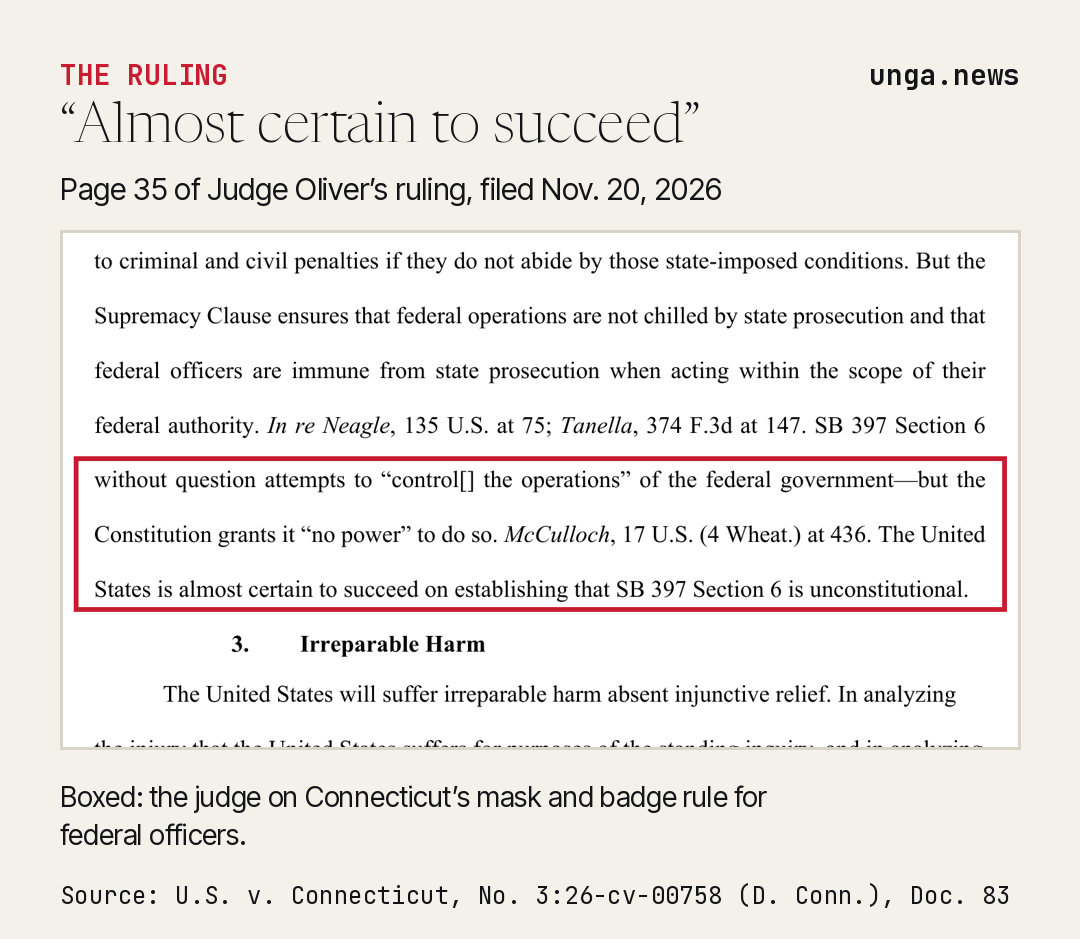
Oliver also took the safety argument seriously. The mask and ID rule, he wrote, “places federal officers and their families at a heightened risk of retributive attacks, especially given the contentious nature of federal law enforcement activity.” On the use-of-force sections, he found that officers facing a state prosecution under a different standard “will hesitate before acting in dangerous, high-stress situations” and “may also second-guess or choose to disregard their extensive federal use of force training.”
Connecticut tried to get the case thrown out before it started, arguing the federal government had no standing and that nothing was ripe until an actual officer was charged. Oliver rejected both. The question, he wrote, is “purely legal in nature and thus ripe for review.”
Who is blocked, and who isn’t
The order is a preliminary injunction, so it holds while the lawsuit continues. It bars the State of Connecticut, Gov. Lamont and Chief State’s Attorney Patrick Griffin, plus everyone working with them, from enforcing all four sections against federal officers, agents and employees. Inspector General Eliot Prescott is blocked from enforcing the use-of-force sections. He escaped the mask and badge part only because his office has no power to enforce it.
Attorney General William Tong was dismissed as an improper defendant, a ruling on who can be sued rather than on the law itself. His office said only, “We are reviewing the decision and evaluating next steps.”
The Justice Department filed this suit on May 15, during Police Week. “Law enforcement officers risk their lives every day to keep Americans safe, and they do not deserve to be doxed or harassed simply for carrying out their duties,” Todd Blanche said in the department’s announcement. “Connecticut’s anti-law enforcement policies regulate the federal government and are designed to create risk for our agents. These laws cannot stand.” Six months later, a Biden appointee wrote that the government is “almost certain to succeed.”
Hartford digs in
Lamont’s office did not take the hint. His communications director, Cathryn Vaulman, said the governor was “disappointed by today’s ruling,” accused ICE of having “terrorized and traumatized our communities” and urged “the new Democratic majorities in Congress to strengthen oversight of DHS.” State Sen. Matt Lesser, a backer of the bill, called it “un-American to allow masked, secret police to detain our residents,” said he hopes the ruling is overturned on appeal and said Connecticut “should move swiftly to tweak and strengthen our law in 2027.”
Lesser is right about one thing: most of SB 397 was never challenged and stays on the books, including Section 1, which lets residents sue in state court over constitutional violations, and limits on warrantless ICE activity at schools, hospitals and churches. Washington challenged only the parts that put state handcuffs on federal officers, and those just fell.
Connecticut Republicans said they saw this coming. “We warned that the law violates the Constitution’s Supremacy Clause by attempting to regulate federal officers while they carry out their official duties,” said Sens. Rob Sampson and Eric Berthel and outgoing Senate Minority Leader Stephen Harding. “Lo and behold, a federal judge right here in CT agrees with what we had warned about.”
The pattern is now hard to miss. Lawmakers pass a law aimed at the agents enforcing federal immigration law, the Justice Department sues, and a federal judge, whoever appointed him, reaches for the same 1890 Supreme Court precedent, In re Neagle, that has protected federal officers from state prosecution for more than a century. Connecticut’s leaders now say they want another round in 2027. The Constitution they keep running into hasn’t changed.
Sources
- U.S. District Court, D. Conn. — Memorandum of Decision and Order on Motion to Dismiss and Motion for Preliminary Injunction, United States v. Connecticut, No. 3:26-cv-00758-VDO, Doc. 83 (Nov. 20, 2026)
- U.S. Department of Justice — Justice Department Files Complaint to Protect Law Enforcement, Challenging Connecticut Mask Ban, Identification Requirements, and Use-of-Force Policies for Federal Officers (May 15, 2026)
- Connecticut Senate Democrats — Sen. Lesser Statement on Federal Ruling on ICE Bill (Nov. 20, 2026)
- CT Mirror — Federal judge blocks CT law that sought to regulate ICE agents (Nov. 20, 2026)
- unga.news — California Surrendered Its Fight to Unmask ICE Agents, and a Judge Made It Permanent