

Drones Killed Two Italian Repairmen in Kuwait on Thanksgiving. Kuwait Says Iran Sent Them.
Antonio Saccoccio, 65, and Emanuele Lo Russo, 36, were keeping the radars running that shoot Iran’s drones down. Tehran says it wasn’t them. Italy says the drone was made in Iran.

Antonio Saccoccio was 65 and close to retirement. Emanuele Lo Russo was 36, a diehard AS Roma soccer fan who loved the gym and had just come back from a trip to Thailand with his friends. On Thursday, while Americans sat down to Thanksgiving dinner, the two Italian technicians were at a military site in Kuwait keeping the country’s air defense radars running. Around 2 in the afternoon local time, the drones came in.
Both men were killed. A Kuwaiti army officer and a Pakistani worker were wounded.
Kuwait didn’t hedge about who sent them. “The Iranian aggression targeted a vital site,” Defense Ministry spokesman Col. Saud Abdulaziz Al-Atwan said in the ministry’s first statement, adding that Kuwaiti forces had spotted several hostile drones in the country’s airspace and “dealt with” them. Shrapnel came down and hit four people, and the site took material damage. About an hour later the ministry put out a second statement: the two Italians had died of their wounds.
Two men who kept the radars running
Saccoccio, from Formia, south of Rome, was one of the veterans at Rheinmetall Italia, the Italian arm of Germany’s biggest arms maker, according to ANSA, Italy’s national news agency. He had spent a lifetime on the factory floor and knew the company’s defense systems inside and out. Lo Russo, from Rome, had been with the firm since July 2023.
They were in Kuwait under a contract to maintain the detection antennas on Skyguard, a Rheinmetall system of radars, guns and missiles built to knock down exactly the kind of cheap drone swarms Iran has been throwing at the Gulf. Systems like that need constant care, so Kuwait brings in the company’s own technicians. In other words, these two civilians were killed doing the job that keeps Kuwaiti families safe from Iranian drones.
Italy’s Foreign Minister Antonio Tajani broke the news to the Senate in Rome. “There was a powerful explosion and, unfortunately, according to the information reaching us from Kuwait, both of our fellow citizens have died,” he said, and promised to lodge a complaint with Iran’s embassy.
Prime Minister Giorgia Meloni learned of the deaths in Brussels, in the middle of a European Council summit.
Giorgia Meloni on 𝕏 — “On behalf of myself and the Government, I express deep sorrow and offer my most heartfelt condolences to the families of the victims.” (Translated from Italian.)
— @GiorgiaMeloni View on 𝕏
Tehran’s answer: it wasn’t us
Iran’s regime denied all of it. Its top armed forces spokesman, Abolfazl Shekarchi, said no Iranian military operation of any kind had taken place in the region. Then he went further, claiming the accusation was cover for “false flag” tactics by Israel and the United States. Iran’s embassy in Rome “categorically” rejected what it called the “purported drone attack,” and Foreign Minister Abbas Araghchi called Tajani Thursday evening to offer condolences and a joint investigation with Kuwait.
Tajani wasn’t buying the full story. Kuwaiti authorities told him the drone was built in Iran, he said. Araghchi insisted it wasn’t launched by Iran’s forces or from Iranian soil. “But we know there are also many Iranian proxy militias that use these drones,” Tajani said, a pointed reference to the Tehran-backed armed groups in neighboring Iraq.
The denial would carry more weight if Kuwait were a first-time target. It isn’t. On Nov. 17 Kuwait’s army fought off a drone attack that Iran’s own military openly claimed, saying it had gone after Ali Al Salem Air Base, where U.S. Air Force units operate. That strike came right after American jets hit back at an Iranian missile site on Qeshm Island. Italy had already moved its contingent of about 200 troops out of that base for their safety. Thursday’s drones were the second wave to hit Kuwait this month.
Europe’s leaders, often slow to call out Tehran, didn’t mince words this time. “We must step up pressure on Iran to put an end to these unacceptable attacks against its neighbours and our partners in the Gulf,” European Commission President Ursula von der Leyen wrote, calling it “yet another Iranian drone attack.” Israel’s foreign minister, Gideon Sa’ar, sent Italy his solidarity and said Iran’s unchecked aggression threatens the Middle East and beyond, and has to end.
The squeeze on Iran keeps tightening
The deaths in Kuwait landed in the middle of a long fight over the Strait of Hormuz, the narrow gap where a big share of the world’s oil leaves the Gulf. Iran’s Revolutionary Guards claimed on Thursday that two more “non-compliant” tankers struck naval mines and caught fire near Khasab, Oman, including a supertanker carrying more than 2 million barrels. No independent maritime agency confirmed it. The British military’s shipping office did confirm that unknown projectiles struck or exploded near two tankers on Wednesday, with the crews safe.
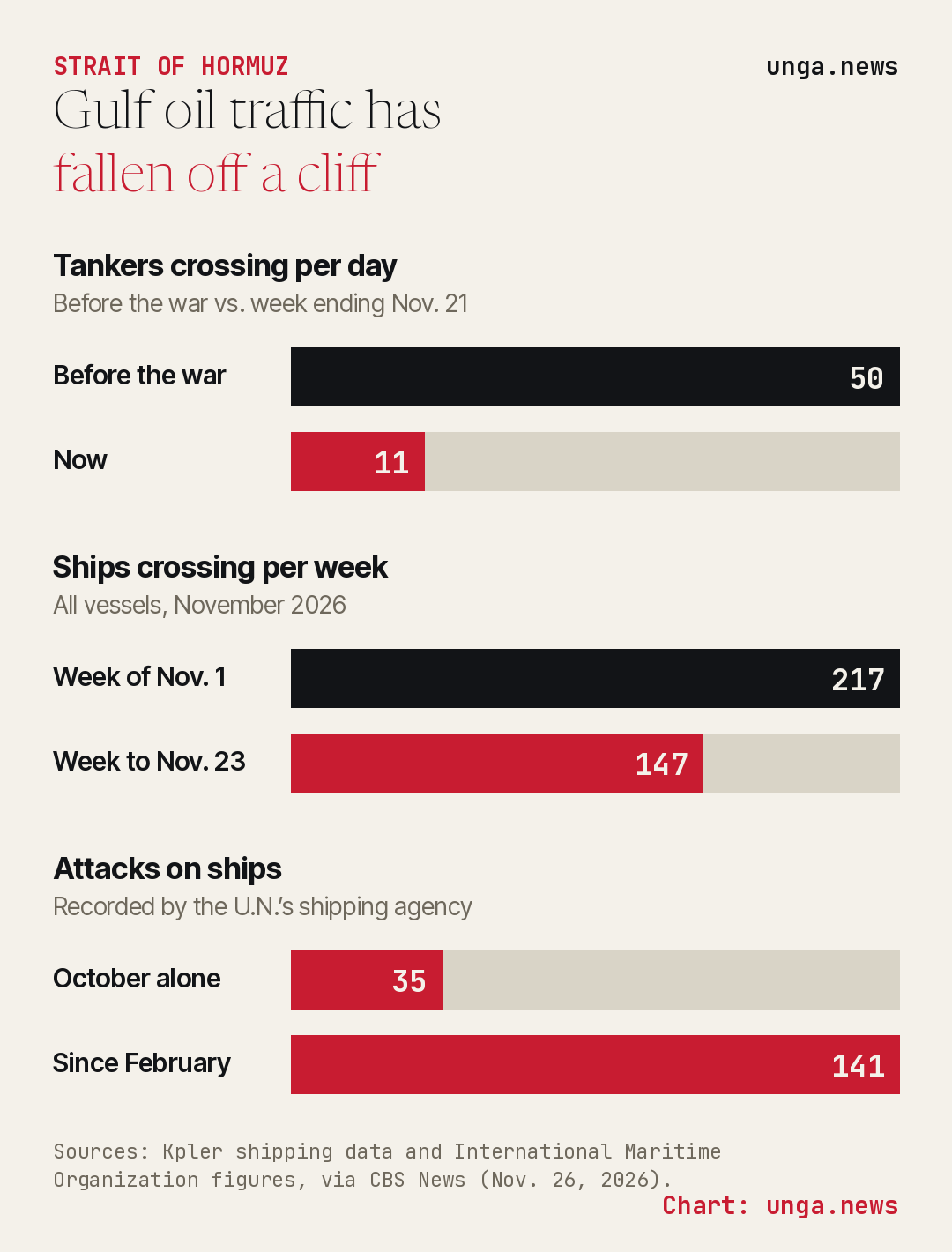
The numbers show what that pressure costs everyone. Before the war, about 50 tankers a day moved through the strait. In the week ending Nov. 21, it was 11, according to the shipping data firm Kpler. The U.N.’s International Maritime Organization has counted 141 attacks on commercial ships in and around the strait since February, with 35 in October alone.
President Trump spent part of Thanksgiving on the phone with troops deployed across the region, and he sounded like a man who thinks Iran is running low on options. “We have victory at hand,” he told the Army’s 1st Battalion, 7th Air Defense Artillery Regiment. “We’re giving them every chance to make a deal and save a lot of lives. But I’m not sure if they are going to take advantage of that.”
He told sailors aboard the USS Portland that the U.S. blockade of Iran’s ports is “the most successful blockade in naval history.” He asked an Air Force F-16 commander flying out of Saudi Arabia whether he was seeing a “much tamer enemy.” “Absolutely, I think my assessment is they’re starting to run out of things,” the officer answered. Later, at Mar-a-Lago, Trump told reporters, “If we do something, we will definitely hit Pickaxe Mountain,” the site where Iran is suspected of hiding underground uranium enrichment.
None of that brings Antonio Saccoccio or Emanuele Lo Russo home. Saccoccio was supposed to retire soon. Lo Russo had barely started. They went to Kuwait to keep a radar spinning so a small Gulf ally could see the next drone coming, and the regime that builds those drones is now offering to help investigate who killed them.
Sources
- Kuwait Ministry of Defense (Kuwait Army) on 𝕏 — Statement No. 83: hostile drones in Kuwaiti airspace, “Iranian aggression” targeted a vital site (Nov. 26, 2026)
- Kuwait Ministry of Defense (Kuwait Army) on 𝕏 — Statement No. 84: the two Italian nationals died of their injuries (Nov. 26, 2026)
- Giorgia Meloni on 𝕏 — Condolences for the two Italians killed in Kuwait (Nov. 26, 2026)
- Antonio Tajani on 𝕏 — The government’s closeness to the families of the two Italian victims in Kuwait (Nov. 26, 2026)
- Ursula von der Leyen on 𝕏 — “We must step up pressure on Iran” (Nov. 26, 2026)
- ANSA — Attacco con droni in Kuwait, morti due tecnici italiani (Nov. 27, 2026)
- ANSA — Saccoccio e Lo Russo, chi erano i due tecnici morti in Kuwait (Nov. 26, 2026)
- Il Post — L’attacco di droni iraniani che ha ucciso due italiani in Kuwait (Nov. 26, 2026)
- Reuters via NBC News — Two Italians killed in attack on Kuwait site, Iran denies involvement (Nov. 26, 2026)
- CBS News — Iran accused of deadly drone attack in Kuwait; Hormuz shipping data; tanker claims (live updates, Nov. 26–27, 2026)
- The File — Tanker struck in the Strait of Hormuz, British shipping office says; Iran’s Guards say two tankers hit mines (Nov. 26, 2026)
- The Washington Times — ‘We have a victory at hand’ over Iran, Trump says during Thanksgiving calls to troops (Nov. 26, 2026)
- unga.news — Iran Took Three Shots at U.S. Bases in Five Days. American Jets Just Hit Back.