

Iran Took Three Shots at U.S. Bases in Five Days. American Jets Just Hit Back.
After three intercepted Iranian drone attacks on U.S. sites, American fighter jets struck a missile launch site on Iran’s Qeshm Island. Tehran answered by firing at Kuwait for the first time in two months.
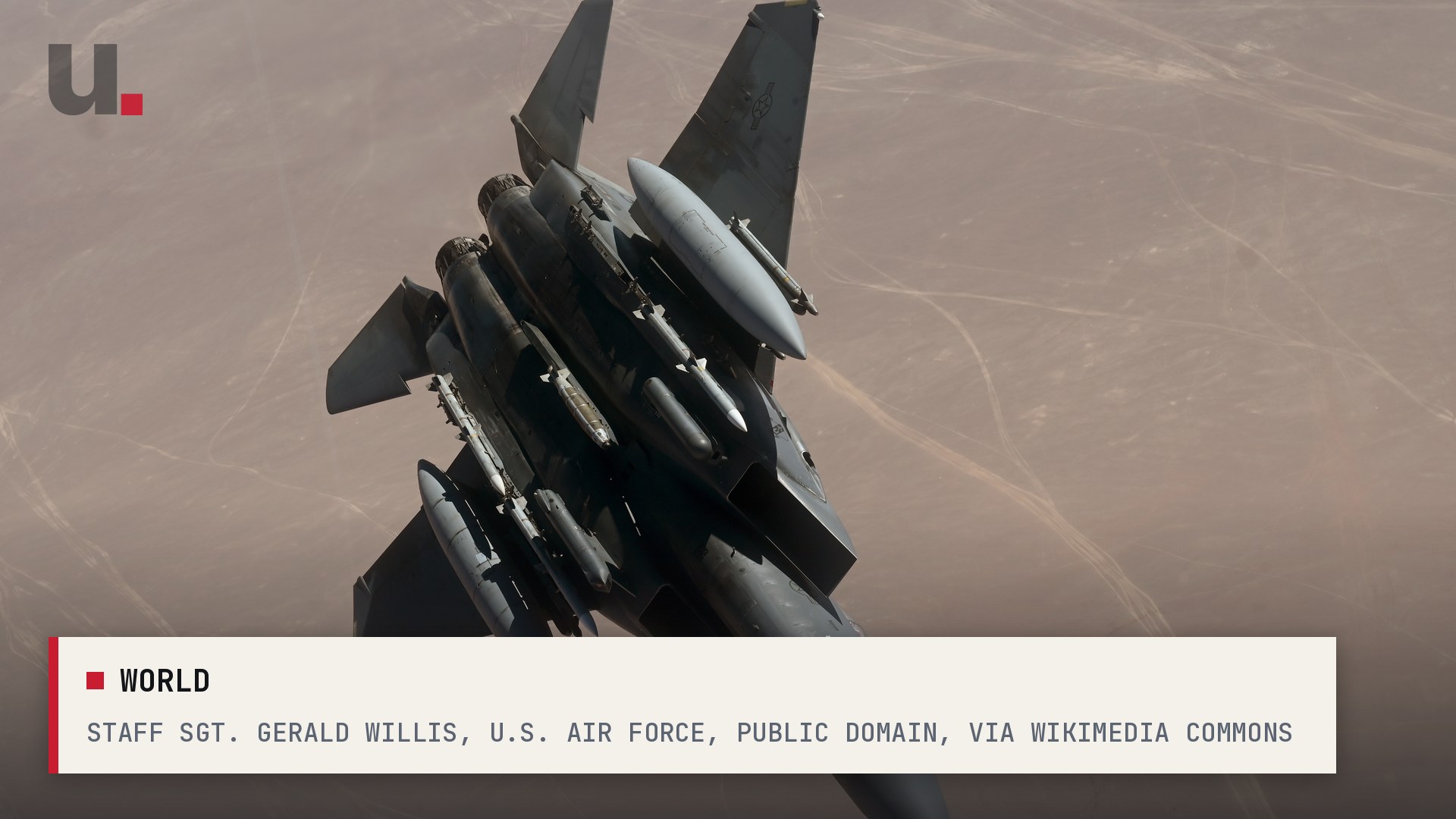
Iran spent the past week testing whether America would keep taking punches. On Tuesday night it got its answer. U.S. fighter jets hit a Revolutionary Guard missile launch site on Qeshm Island, the long, flat island that sits in the throat of the Strait of Hormuz, using what military officials called “precision munitions.”
A U.S. military official told CBS News the strike was carried out “in self-defense.” The official put it plainly: “The strike was in response to IRGC aggression targeting U.S. personnel and assets. U.S. Central Command remains highly vigilant and fully postured to protect Americans across the region.”
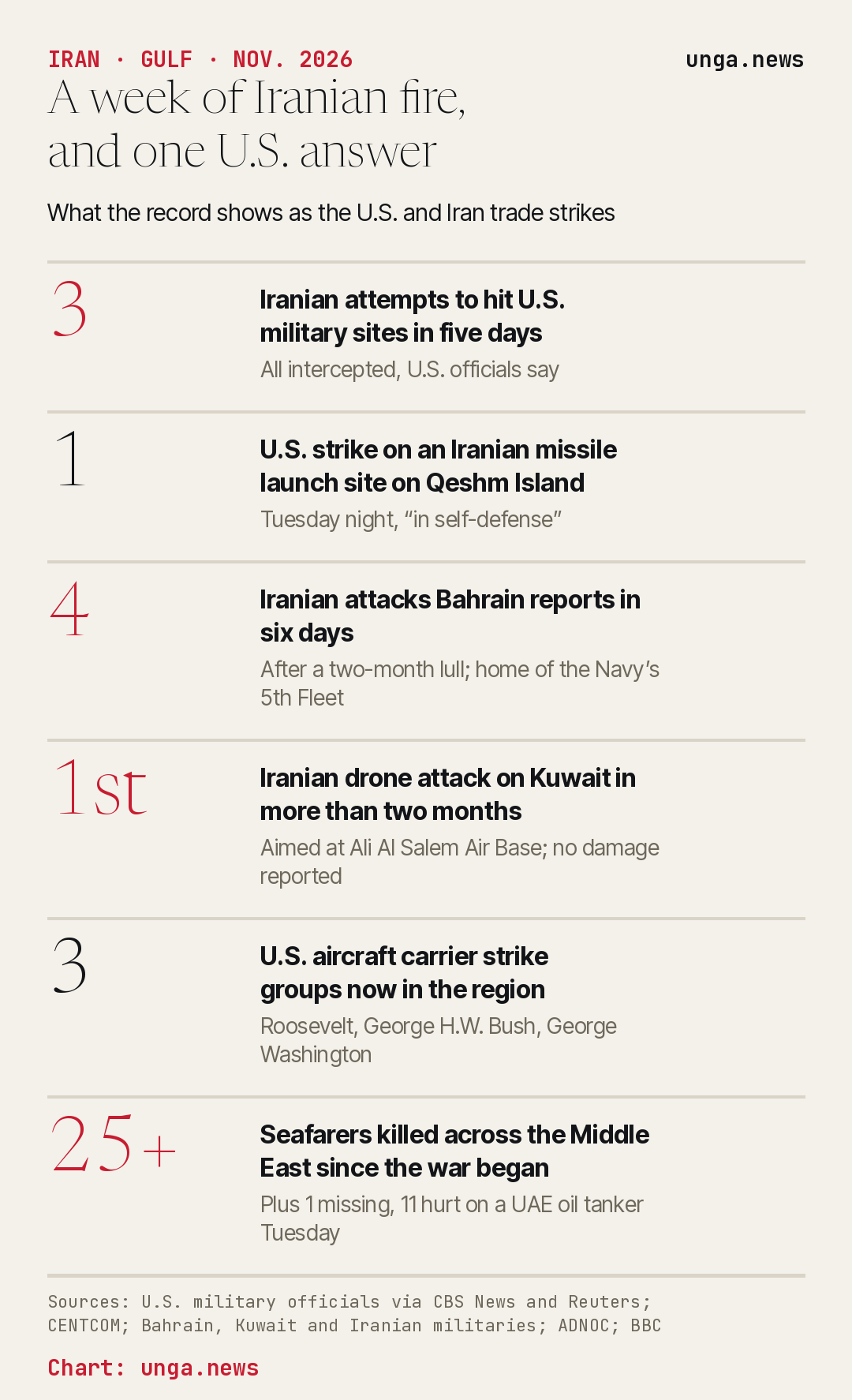
That aggression is not a matter of opinion. Hours before the jets went in, Iran had gone after a U.S. radar site in Bahrain. U.S. officials said it was the third time in five days Iran had tried to hit an American military installation, and all three attempts were intercepted. unga.news reported the first two Bahrain attempts on Saturday. The new development is that America has now struck back on Iranian soil, and Tehran answered by widening the fight to a country it had left alone since September.
Tehran’s story fell apart in real time
The Revolutionary Guard has been working the propaganda angle as hard as the drone angle. After Monday’s launch toward Bahrain, the Guard claimed its drones had hit a U.S. radar system. U.S. Central Command went straight at the claim on 𝕏, labeling it false and saying the drones never got through.
U.S. Central Command on 𝕏 — Iran’s claim of a hit on a U.S. radar in Bahrain is “FALSE”; the drones were intercepted.
— @CENTCOM View on 𝕏
Iran’s spin on the U.S. strike went the other direction. Ahmad Nafisi, a deputy provincial governor in Hormozgan province, told the state news agency IRNA that the attack on Qeshm “caused no damage to residential, commercial, or infrastructural areas.” Notice what that sentence leaves out. The target was a military missile launch site, not a shopping district.
Qeshm matters because of where it sits. It runs along Iran’s side of the strait, the narrow lane that normally carries about a fifth of the world’s oil and gas shipments. A missile site there sits within easy reach of tankers, Gulf ports and U.S. bases.
Iran’s reply hit its neighbors, not America
Overnight, Iran lashed out. The Iranian army said its drones “targeted Patriot air defence systems and drone and missile launch platforms” at Ali Al Salem Air Base in Kuwait, which hosts U.S. forces. Kuwait’s military said its air defenses engaged the “drone threats” and reported no casualties or damage. According to the BBC, it was the first Iranian attack on Kuwait in more than two months.
Kuwait did not mince words. Its foreign ministry said the attack “flagrantly violated Kuwait’s sovereignty, directly threatened its security and stability, and constituted a grave breach of international law,” and said the country reserves the right to take all necessary measures to protect itself.
Bahrain, home of the U.S. Navy’s 5th Fleet, said its air defenses “intercepted and destroyed several Iranian aerial attacks” early Wednesday. The small island kingdom has now reported four Iranian attacks in six days after a two-month lull, and Reuters reported that Bahrain accused Tehran of a “systematic hostile approach.” Even Qatar, the country that has been carrying messages between Washington and Tehran, called the strikes on its neighbors a “dangerous escalation that threatens to complicate efforts aimed at containing tensions.”
Iran’s top army commander, Maj. Gen. Amir Hatami, then threatened more. “If the enemy repeats its mistake… we have the readiness and the plans to confront it and its supporters in a stronger, more crushing way and without geographic limitations,” he said, according to the BBC. That “supporters” line is aimed squarely at the Gulf states that host American troops.
The water is still the battlefield
While the drones flew, the strait claimed more victims. The Abu Dhabi National Oil Company said one of its ships was struck in the Strait of Hormuz on Tuesday. One crew member is missing, 11 were hurt, and the rest were evacuated. “All other crew members have been safely evacuated from the vessel. Eleven sustained injuries and where required are receiving medical care,” the company said. The UK Maritime Trade Operations center reported the tanker was hit by an unknown projectile about 13 nautical miles north of Khasab, on Oman’s Musandam peninsula, setting a fire that was put out.
Iran, for its part, said two oil tankers and a liquefied natural gas carrier caught fire after hitting naval mines on what it called an “authorised route.” Translation: Tehran still wants to decide who gets to use an international waterway. The BBC counts at least 25 seafarers killed across the region since the war began in late February.
There is a reason Gulf oil is still moving at all. In recent months, U.S. Navy protection for tankers shuttling through the strait has pushed Gulf crude exports back to roughly 80 percent of prewar levels, according to analysts cited by the BBC. A preliminary deal to end the fighting and reopen the strait was reached in June, then collapsed within weeks when Iranian attacks on shipping resumed and the U.S. put its blockade of Iranian ports back in place.
America has the muscle parked next door
Iran is picking this fight with a lot of American steel nearby. The U.S. military confirmed Monday that three aircraft carrier strike groups are now in the region, the USS Theodore Roosevelt, the USS George H.W. Bush and the USS George Washington, and Central Command posted photos of the Roosevelt and Washington sailing together in the Arabian Sea. An open-source analysis by Israel’s Institute for National Security Studies says the U.S. naval presence in the area is now larger than it was at the peak of Operation Epic Fury, with 12 destroyers in the Arabian Sea.
The timing is no accident on Tehran’s end either. President Trump is in Shenzhen, China, for Thursday’s first three-way sit-down with Xi Jinping and Vladimir Putin, and Iran has every reason to make noise while the world’s biggest powers sit at one table. The response from Washington so far has been measured and direct: shoot down what Iran launches, then hit the site it launches from.
For the Gulf states, the math is simple. Every drone shot down over Kuwait or Bahrain is one that did not land, and every Iranian launch site American jets hit is a reminder of what the next drone will cost.
Sources
- CBS News — Iran War Updates: Gulf states and tankers under fire as U.S. and Iran ramp back up tit-for-tat strikes
- U.S. Central Command on 𝕏 — CLAIM vs. FACT: Iranian drones toward Bahrain were intercepted
- U.S. Central Command on 𝕏 — USS Theodore Roosevelt sails with USS George Washington in the Arabian Sea, Nov. 17
- BBC — Kuwait says it repelled first Iranian attack in two months after US strikes island
- Associated Press — Iran widens Gulf attacks by targeting a US air base in Kuwait and sites in Bahrain
- Reuters (via Al-Monitor) — Iran fires at Kuwait after US strike on Iranian island
- unga.news — Iran Fired Drones at a U.S. Base in Bahrain Twice in Three Days. None Got Through.