

Duffy Found the Two Routers That Grounded Every Flight. Now He Wants Congress to Replace the Rest.
The gear they knocked over was bought in 2001 and obsolete by 2006. Trump says the plan is ready and Congress needs to fund it “FAST!”
Two days after every departing flight in America sat frozen on the ground, the people hunting for the cause finally have it in their hands. Transportation Secretary Sean Duffy said Sunday that investigators have pulled two routers from remote Federal Aviation Administration sites in El Dorado, Arkansas, and Amarillo, Texas, and are taking them apart in a lab. He also put a date on the gear those routers knocked over. The FAA bought it in 2001. It was obsolete by 2006. It was still running Friday.
“We have the router. It’s at the L3Harris lab in Florida with FAA staff,” Duffy said in his Sunday show rounds. “We think it was the installation or the router that was the bad actor.” L3Harris is the defense contractor that runs the FAA’s private communications network, and Duffy said he spoke with its chief executive directly. Engineers from the FAA, Juniper and Cisco are helping with the testing, and the FBI has offered to assist.
When we first reported on the shutdown Friday night, nobody had said on the record what tripped it. Now the FAA has published its own account, and it is more specific than anything that came out of the first briefing.
A copper line, a new router and a flood
Here is the chain the FAA laid out in a question-and-answer page posted Sunday. The phone company that serves the El Dorado site was retiring an old copper line, so L3Harris crews went in to switch it to fiber and put in a new router. Around 3:30 p.m. Eastern on Friday, data started pouring across the FAA’s network at a rate of 1,000 connection attempts every four to five seconds. A radar site in Amarillo, where a system had been replaced about three weeks earlier, started flooding the network too.
The legacy equipment couldn’t take it. Seventeen of the FAA’s 22 regional control centers, the ones that handle planes at cruising altitude, went unstable, and the trouble spread into several of the approach facilities that guide planes near big airports. Radio links and radar feeds got shaky. The FAA stopped departures nationwide.
“This router was broadcasting. And when it broadcast, it was shooting off this data to all of our other routers in the system,” Duffy explained. “By the way, the routers that were experiencing issues, those routers were purchased in 2001, they were obsolete in 2006, and we still use them in 2026, just to underscore how old the network is.”
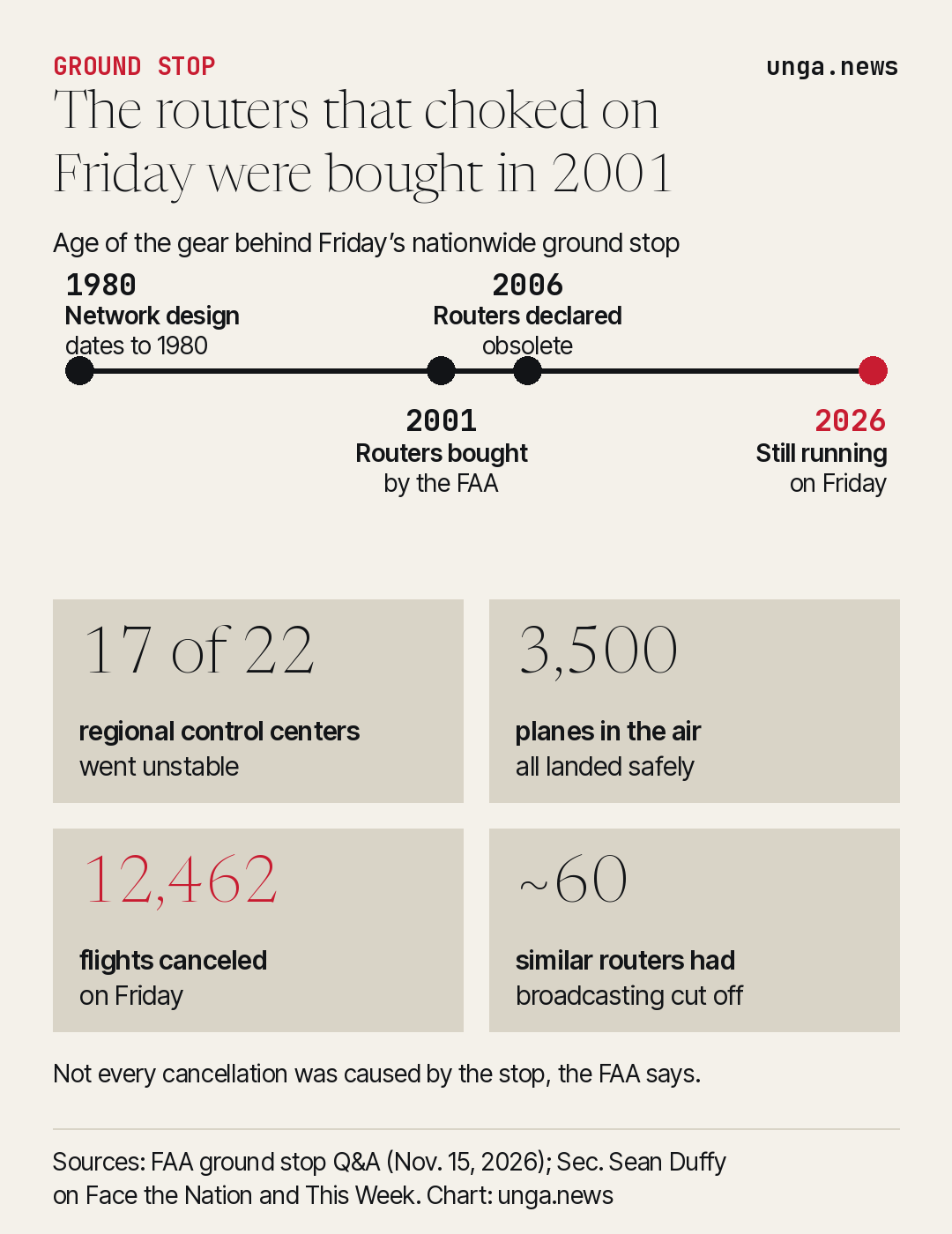
L3Harris blocked the two sites, and the network settled down. As a precaution, the FAA turned off the broadcasting function on the new routers, about 60 of them across the system. Flights started moving again at 8:15 p.m.
No hackers, and every plane down safe
The first question anyone asks when the whole country’s air traffic stops is whether somebody did it on purpose. Duffy has been consistent on that. “Was this a cyber attack from a foreign nation? We have no indication that that was at play here,” he said. The FAA’s own page says the same: no sign of a cyberattack “or an outside nefarious actor.”
The safety record held, too. About 3,500 planes were in the air when the stop hit, and every one of them landed without incident, according to the FAA. Controllers kept enough working radio frequencies and radar feeds to bring them down, and military, law enforcement and life-saving flights kept flying the whole time.
Duffy’s Sunday update after speaking with the head of L3Harris. (@SecDuffy)
— @SecDuffy View on 𝕏
The price showed up at the gate. Airlines canceled about 12,462 flights Friday, 9,082 of them by the major carriers, the FAA said, though it noted not every one of those was caused by the stop. Duffy said the skies should be back to normal Sunday and “probably fully normal tomorrow,” once planes and crews are back where they belong.
The agency is also changing one habit. Big maintenance jobs at major control facilities usually happen at night, but swaps at small remote sites like El Dorado have been done during the day for decades without a hiccup. “Based on what happened Friday, we will reevaluate when we do replacement/maintenance work,” the FAA wrote.
The $12.5 billion question
President Trump weighed in Sunday morning and went straight to the fix. “We have the knowledge and plan for the Flight Control Systems, we need Congress to give the money, FAST!” he wrote on Truth Social, adding that “our FAA is doing a great job and is ready to go.” In a second post, he said the work “should be done all at once, not in drips and drabs,” because “much of our current air control system is 50 years old.”
That is the fight now. Congress put $12.5 billion toward air traffic control in last year’s big Republican tax law, and Democrats are asking where it went. Duffy answered on 𝕏 that the money bought “new radios, new radars, electronic flight strips, and modern telecom lines,” that every cent is accounted for, and that the equipment will all be in place by the end of 2028. His department says about 70% of the old copper wire has already been swapped for fiber and nearly 470 radios have been converted.
The catch, Duffy says, is that Congress fenced that money into hardware. “I don’t have money for a new telecom system. I don’t have money for new software,” he told CBS. The network’s basic design dates to 1980, he said, and AT&T, Verizon and Lumen are lined up to build a modern one. He has put the full price of the job at about $50 billion.
The FAA also made a point Friday’s critics skipped. None of the towers upgraded with the $12.5 billion went down. What failed was the old network the money was never allowed to touch.
Republicans control Congress only until Jan. 3, and Duffy is pitching this as the one thing both parties can still agree on. “This is the most bipartisan thing in all of Washington,” he said on NBC. He has the routers in a lab, a plan on paper and carriers ready to build. What he doesn’t have yet is the check.
Sources
- Federal Aviation Administration — Nationwide Ground Stop: Questions and Answers (Nov. 15, 2026)
- U.S. Department of Transportation — ICYMI: Secretary Duffy provides update across Sunday shows on airspace and ongoing investigation (Nov. 15, 2026)
- The White House — ICYMI: Secretary Duffy’s full Sunday circuit outlines ground stop response and the path forward (Nov. 15, 2026)
- Sean Duffy on 𝕏 — Sean Duffy on 𝕏 — “We spoke with the CEO of L3Harris, and the contractor secured the two routers” (Nov. 15, 2026)
- Sean Duffy on 𝕏 — Sean Duffy on 𝕏 — “Where $12.5 BILLION went and what we’re doing next” (Nov. 15, 2026)
- USDOT Rapid Response on 𝕏 — USDOT Rapid Response on 𝕏 — modernization progress: 70% of copper wire replaced with fiber, nearly 470 radios converted (Nov. 15, 2026)
- ABC News — Transportation Secretary Duffy says ATC routers’ ability to broadcast data turned off, being investigated (Nov. 15, 2026)
- CNBC — Trump breaks silence on FAA nationwide ground stop (Nov. 15, 2026)
- Associated Press — Trump administration asks for billions to overhaul FAA (Nov. 15, 2026)