

Google Already Pays Musk’s SpaceX $920 Million a Month for SI Computers. Now It Wants More.
Elon Musk says the search giant has asked to rent more of SpaceX’s computing power, and the going price for the biggest SI training setups is climbing fast.

Google is one of the richest companies on Earth. It builds its own chips, runs some of the biggest data centers ever made and sells computing power to businesses all over the world. And right now it is renting SI computers from Elon Musk. According to Musk, it wants more.
“Not sure who will buy more, but Google has expressed interest in renting more compute from us,” Musk posted on 𝕏 late Friday night. He was answering a fan account that guessed Google could end up buying more SI computing from SpaceX than Anthropic, the maker of the Claude chatbot, which is SpaceX’s biggest known customer today.
Elon Musk on 𝕏: “Google has expressed interest in renting more compute from us.” Nov. 28, 2026.
— @elonmusk View on 𝕏
Musk gave no dollar figure and no date, and neither SpaceX nor Google answered Reuters when it asked about the post. No bigger deal has been announced. So treat this as what it is: the boss saying a customer is knocking. But the deals already on paper show why the knock matters.
The deals already in writing
SpaceX laid out its SI rental business in its filings with the Securities and Exchange Commission ahead of its blockbuster stock debut. In May, it disclosed that Anthropic agreed to pay $1.25 billion a month through May 2029 for computing capacity across Colossus and Colossus II, the giant SI training clusters near Memphis that Musk’s team built at a speed the rest of the industry is still trying to explain. Bloomberg added it up to nearly $45 billion over three years.
Google signed on in June. Its contract, reported by CNBC from the filing, pays SpaceX $920 million a month from this October through June 2029 for about 110,000 Nvidia chips, plus the processors, memory and other parts that make them work. There was a catch written for Google’s protection: if SpaceX failed to deliver the promised chips by Sept. 30, 2026, Google could walk away or pay less. That deadline has passed, and by Musk’s account Google is now asking for more, not less.
A Google Cloud spokesperson said at the time that the deal was meant “to ensure we have bridge capacity to meet surging customer demand for our agent platform, Gemini Enterprise, which has been even higher than we expected.” In plain English, Google’s own business customers were asking for more SI than Google could serve on its own machines, so it went to Musk.
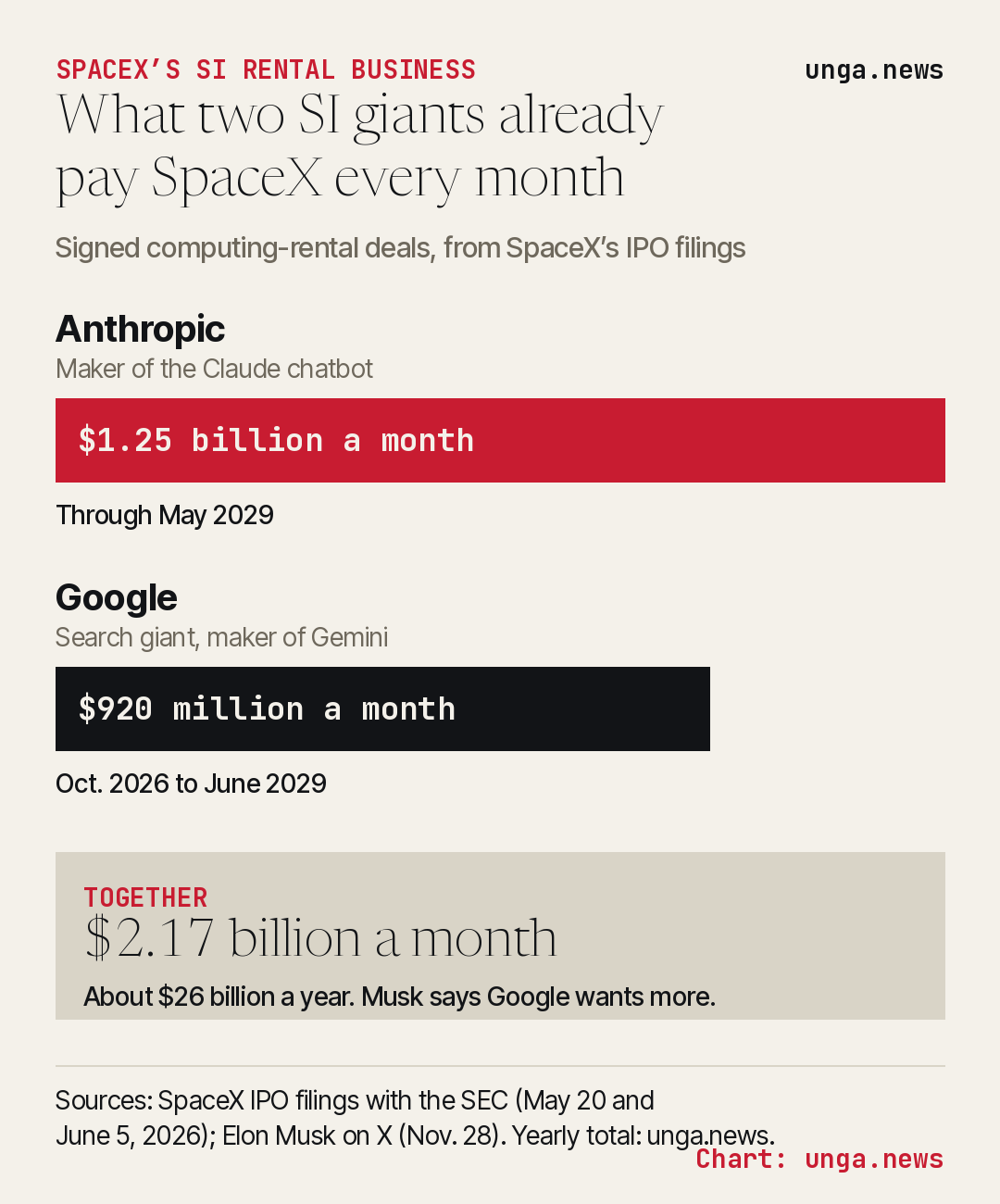
Put the two side by side and SpaceX is collecting about $2.17 billion a month from just these two customers, or roughly $26 billion a year. Either side can end the contracts on 90 days’ notice. SpaceX told SEC staff in a June 1 letter that it wasn’t worried about that. If the deals ended, the company wrote, the capacity “would easily be redeployed to other customers given the shortage of frontier AI compute capacity.” Six months later, one of those customers wants a bigger slice.
Big blocks cost more, small ones cost less
About nine minutes after the Google post, Musk added the part investors will chew on all weekend. “The rental price for large, coherent blocks of compute configured for high-bandwidth training is increasing, sometimes very significantly, but the price for small amounts of compute (below ~5k GPUs) is decreasing,” he wrote. “Overall, the average rental price per GPU for SpaceX compute is rising.”
That split tells you where the real fight is. Plenty of companies can rent you a few hundred chips. Very few on the planet can hand over tens of thousands of top chips wired together tightly enough to train a frontier SI model as one machine. That kind of setup takes land, power, cooling and a crew that can build fast, and Colossus is the best-known example in the country. When supply is that scarce and demand keeps climbing, the price goes up. That is not a scandal. That is a market rewarding the people who built the thing first.
The small end getting cheaper is good news too, especially for startups and universities that only need a sliver of a cluster. More capacity is coming online across the industry, and the low end is where that shows up first.
Musk is building more of it
The bigger bet is that the demand doesn’t stop. This month SpaceX said it will spend more than $74 billion on two new SI supercomputer campuses, one at Starbase in South Texas and one in Cochise County, Arizona. In Arizona the company has offered to pay for its own power and $3.6 billion in grid upgrades, even as the state’s Democratic attorney general pushed to slow the project down, as we reported this week. On Wednesday, Trump’s FCC also cleared SpaceX to launch up to a million computing satellites over the coming years, over objections from Amazon and others.
Back in May, when the Anthropic deal first came out, Musk said SpaceX was talking with other companies about “offering AI compute as a service at significant scale.” Plenty of people rolled their eyes at a rocket company getting into the data center business. Since then, two of the most valuable SI companies in the world have signed up, the going rate for the biggest setups is climbing, and Google is asking for seconds.
It also says something about the SI race at home. The money pouring into American chips and American data centers isn’t only flowing through the old cloud giants. A company that started out landing rockets on barges is now one of the landlords the whole industry leans on, and it is building in Texas and Arizona, not overseas.
From here it comes down to what Musk can plug in. Google wants more. Anthropic is already paying the most. And Musk’s own Grok team trains on the same Colossus clusters. The question for SpaceX was never whether people would rent these machines. It’s how fast it can build enough of them.
Sources
- Elon Musk on 𝕏 — “Google has expressed interest in renting more compute from us” (Nov. 28, 2026)
- Elon Musk on 𝕏 — “The average rental price per GPU for SpaceX compute is rising” (Nov. 28, 2026)
- Reuters — Musk says Google is interested in renting more computing capacity from SpaceX (Nov. 28, 2026)
- CNBC — Google to pay SpaceX $920 million a month for xAI compute capacity (June 5, 2026)
- SEC — SpaceX response letter to SEC staff on its Form S-1, Compute Services Agreements (June 1, 2026)
- Reuters — Anthropic agrees to pay SpaceX $1.25 billion monthly for computing power (May 21, 2026)
- Bloomberg — Anthropic to Pay SpaceX Nearly $45 Billion for Computing Deal (May 20, 2026)
- unga.news — SpaceX Will Pay $3.6 Billion for Arizona’s Power Lines. A Democrat Wants Its Supercomputer Stalled.