

SpaceX Will Pay $3.6 Billion for Arizona’s Power Lines. A Democrat Wants Its Supercomputer Stalled.
Arizona’s attorney general asked a rural county to delay its vote on SpaceX’s $50 billion SI campus. SpaceX answered point by point: it pays for its own power, prepays the grid upgrades, uses no industrial water, and wants residents heard on Dec. 9.

Most big tech companies show up in a small town and ask the neighbors to trust them on the power bill. SpaceX put its promise in writing, offered to make it binding, and asked for one thing in return: a public hearing that goes ahead on Dec. 9 as planned.
That’s the heart of a fight now playing out in Cochise County, Arizona, the rural corner of the state east of Tucson where SpaceX wants to build a roughly $50 billion supercomputer campus to train its SI models. When the company first laid out the project two weeks ago, the pitch was lower power bills and almost no water. Since then, Arizona Attorney General Kris Mayes, a Democrat, has asked the county to put off its vote. SpaceX answered her this week, point by point.
What the attorney general asked for
On Nov. 19 Mayes sent a five-page letter to the Cochise County Planning and Zoning Commission urging it to delay the Dec. 9 vote on SpaceX’s land-use permit until state and federal agencies finish their own reviews. Her press release lists worries about the electric grid, water, fire safety, traffic, wildlife and national security.
“The people of Cochise County deserve answers before county officials approve a project of this magnitude,” Mayes said. “Approving a project of this scale before critical questions have been answered would be premature.”
Her biggest number is power. At full size the campus could draw up to 6 gigawatts, which her office calls nearly 20% of Arizona’s current generating capacity. The nearby Apache Generating Station puts out about 625 megawatts, and her letter says SpaceX hasn’t explained how it closes the gap. She also raised water, a huge battery yard outside any fire district, truck traffic on U.S. 191, the sandhill cranes on the Willcox Playa and Army testing out of Fort Huachuca.
If the county votes anyway, Mayes wants the permit to sit on hold until every state and federal approval is in hand. She has scheduled her own town hall in Cochise on Dec. 3, six days before the county’s hearing.
SpaceX’s answer: keep the hearing
SpaceX replied on Nov. 24 in a [letter to the commission](https://content.spacex.com/cms-assets/assets/SpaceX%20Letter%20to%20Commission%20SU26-22%20-Final%20(letter%20only).pdf) signed by Sheila McCorkle, a vice president on its legal team. Its core argument is simple. A county land-use permit decides whether and where the campus can be built. It doesn’t switch on a single light.
No power can flow until the Arizona Corporation Commission, the state’s elected utility regulators, approves the service deal with the two local electric co-ops. No grading can start without county, highway and environmental permits. No building goes up without building permits. “Delaying the hearing would not produce them sooner; it would only push them later,” the letter says.
On power, SpaceX says the attorney general measured against the wrong plant. Apache Station’s output isn’t contracted to the campus at all. The statewide co-op would buy wholesale power from across the western grid, and the co-ops decide when they can serve each phase. Under the proposed deal SpaceX pays for its own electricity, prepays the grid upgrades and posts financial security before getting power. The letter says those terms keep the costs with SpaceX “including if the campus is delayed, built at a smaller scale, or never built,” so “no existing customer subsidizes SpaceX.”
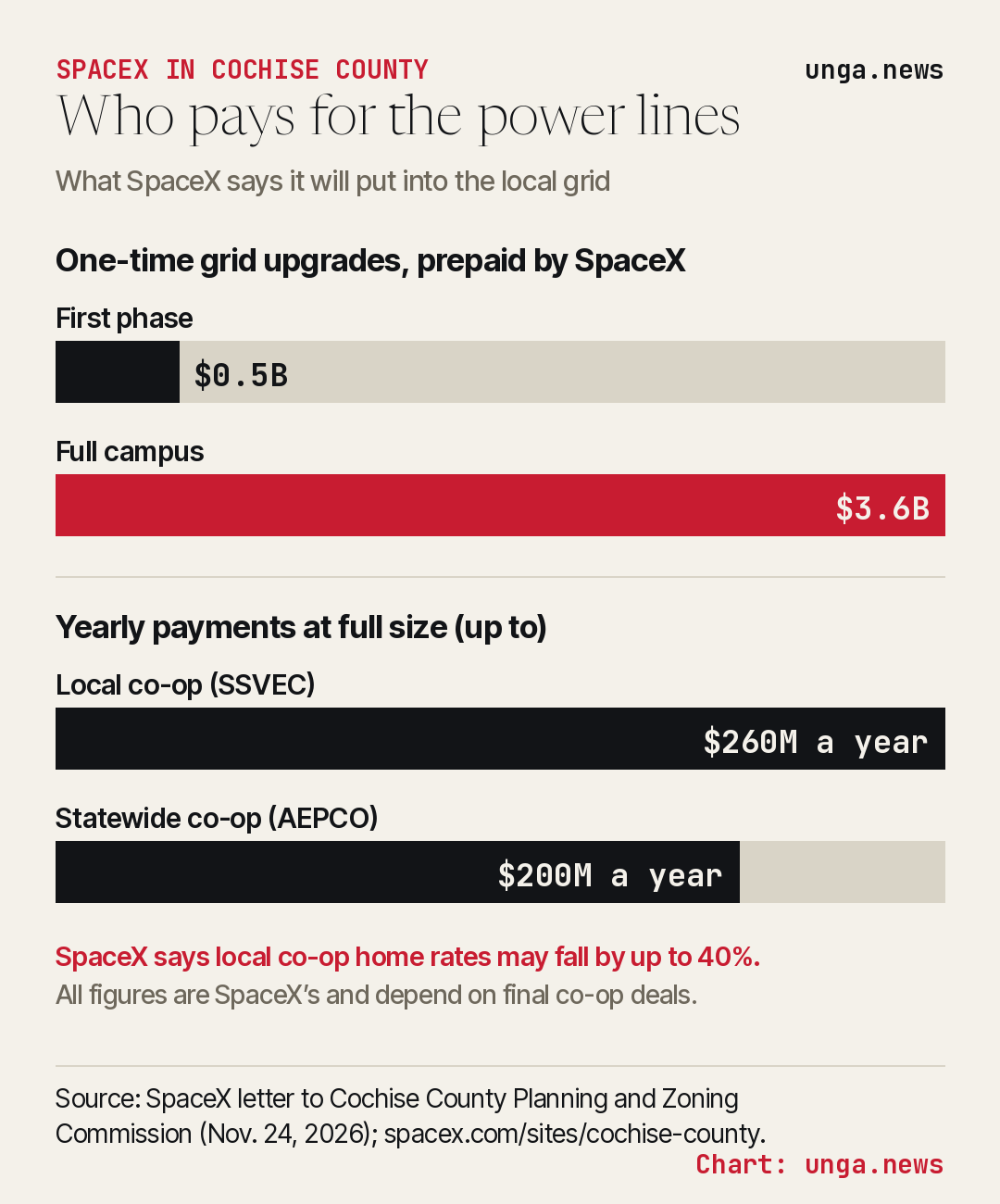
Those upgrades add up to about $3.6 billion, roughly $0.5 billion of it in the first phase. Most of it restrings existing lines with wire that carries about two and a half times as much power, plus new transformers and a substation. The co-ops would own all of it.
On water, the letter says the attorney general estimated water use for “a hypothetical one-gigawatt natural gas plant” that nobody has proposed. SpaceX isn’t asking to build a power plant at all, only about 10 megawatts of standby generators per building for outages. The campus itself uses sealed, dry cooling with no cooling towers, and the company estimates 7 to 10 acre-feet of water a year, mostly for drinking fountains and restrooms. It proposes no new industrial well in the Willcox groundwater basin, and it says it will make that promise an enforceable condition.
Firefighters, roads and cranes
The fire question is where SpaceX gave the most ground. At a public meeting on Nov. 12 the county’s emergency planning committee asked for six things, including a hazard plan, a deal with a nearby fire district, site access and training for local crews. SpaceX accepted all six as conditions of approval, at its own expense.
On traffic, SpaceX now says it will pay for an independent review of its traffic study, one of the things Mayes requested, on top of worker shuttles and staggered shifts. For the cranes, it promises no ponds, shielded lighting and bird diverters, and notes they already winter beside a power station that has run since 1964. The campus doesn’t broadcast anything, and SpaceX says it will consult the Army before the first building permit.
Then SpaceX took its case to the public. In a Wednesday [post on 𝕏]({X}), the company promised “no gas plant, no industrial water use,” and repeated that it will pay for its own power plus the $3.6 billion in upgrades.
SpaceX on 𝕏 — “Current residents will not subsidize this project – in fact, residential rates for SSVEC customers may decrease by up to 40%.”
— @SpaceX View on 𝕏
That 40% is SpaceX’s own projection for home rates at the local co-op, Sulphur Springs Valley Electric Cooperative, and nobody outside the company has checked it yet. The yearly payments of up to $260 million to the local co-op and $200 million to the statewide one also depend on final deals and state review. What’s already on paper is the structure: SpaceX prepays, the co-ops own the wires, and state regulators get the final word on the power contract.
SpaceX says it has already held a town hall, briefed about 80 local contractors and mailed postcards to nearly 51,000 county addresses. Its application estimates about 5,500 construction jobs at peak and about 1,000 permanent jobs.
Mayes says residents deserve a real chance to be heard, and on that point the two sides actually agree. The difference is timing. Her plan sends the question to more agencies and more meetings before the county decides anything. SpaceX’s plan puts the company in front of the people who live there on Dec. 9, with its promises written up as enforceable conditions, and leaves power to state regulators on their own schedule.
“Speculation about facilities no one has proposed should carry no weight in a land-use decision,” the letter says. The neighbors can weigh that themselves in two weeks, at a hearing that’s already on the calendar.
Sources
- SpaceX on 𝕏 — SpaceX on 𝕏 — “Our supercompute site in Cochise County has been designed with Arizona in mind” (Nov. 25, 2026)
- SpaceX — Letter to the Cochise County Planning and Zoning Commission, SU26-22: Response to the Attorney General’s Letter of Nov. 19, 2026 (Nov. 24, 2026)
- SpaceX — Cochise County, AZ supercomputing campus project page and FAQ
- Arizona Attorney General’s Office — Attorney General Mayes Urges Cochise County to Delay Vote on Proposed SpaceX Data Center (Nov. 19, 2026)
- AZFamily — AG Mayes asks Cochise County to delay vote on $50B SpaceX data center (Nov. 19, 2026)
- unga.news — SpaceX Is Building $74 Billion in SI Supercomputers. Its Arizona Neighbors Could Pay Less for Power. (Nov. 13, 2026)